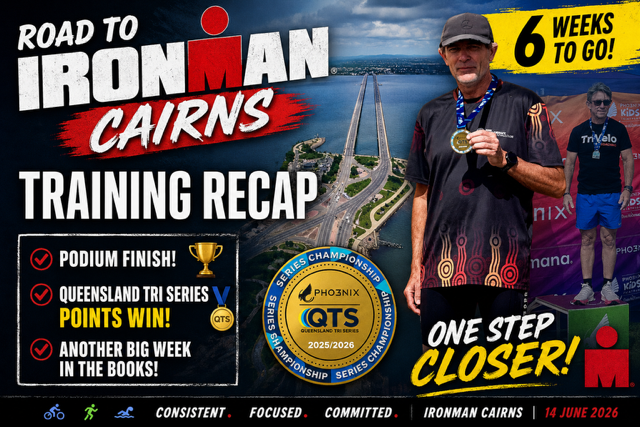
Six weeks to go. Thirty-four days.
That number is no longer abstract — it's a countdown, and the nerves are properly kicking in now. But this week wasn't about pushing through nerves. It was about backing off, recovering, and letting the body absorb four weeks of hard building.
And then the week ended with a race that delivered a podium, a series win, and one very important equipment lesson.
Why Recovery Weeks Actually Make You Faster
I've said this before and I'll keep saying it:
You don't get fit in the build weeks. You get fit in the recovery week.
The build weeks are where you load the body — fatigue it, stress it, ask it to do more than it's comfortable with. But the adaptation, the actual fitness gain, happens when you back off and let the body rebuild.
The previous block was a five-week cycle — four weeks of progressive build (the last of which was a 16-hour week) plus this recovery week. That's longer than my usual three-on, one-off pattern, but the body was responding well and I wanted to push through one extra build week.
The cost? I came into this recovery week carrying serious fatigue. Which made the discipline of backing off even more important.
If you want the deeper science behind why this matters, have a read of why doing less after 50 is often the fastest way forward.
The Week at a Glance
| Day | Session | Details |
|---|---|---|
| Monday | Rest Day | Light walk and stretching only |
| Tuesday | Easy Ride | 90 minutes — pure Zone 2, no efforts |
| Wednesday | Easy Run | 60 minutes — low to mid Zone 2 |
| Thursday | Wetsuit Swim | 2,000 m in the pool wearing wetsuit |
| Friday | Short Run | 2×4 min efforts in race shoes, ~6 km total |
| Saturday | Easy Ride | 60 minutes with race wheels, 2×2 min at race pace |
| Sunday | Moreton Bay Tri | 2 km swim, 60 km bike, 15 km run — 3rd place, series win |
The key pattern here: one session a day, no doubling up, reduced volume across the board. Every session had a purpose, but none of them were about pushing limits.
Thursday — Wetsuit Swim in the Pool
This was the most Cairns-specific session of the week.
If you haven't raced Cairns before, it's a wetsuit swim — primarily because of box jellyfish risk (it's not peak season in June, but they err on the side of caution). Water temperature up there sits around 23–24°C.
My local 50 m heated pool runs at 28°C, which is actually warmer than race conditions. But that's exactly why it's useful for heat acclimatisation in the wetsuit — you overheat slightly, and the body learns to manage it.
The session itself was deliberately simple:
| Block | Distance | Details |
|---|---|---|
| Warm-up | 400 m | Easy freestyle, using the wetsuit buoyancy to glide |
| Main Set | 15 × 100 m | Off 2:00, coming in at 1:23–1:27 |
| Cool-down | 100 m | Easy out |
The key with wetsuit swimming is adjusting your stroke. I find it's almost like a half-catch-up — you hold the stretch out front a beat longer than normal, letting the buoyancy carry you through the glide phase. Fighting against the wetsuit wastes energy. Working with it is free speed.
Heaps of rest on the 2:00 send-off. Not pushing pace. Just grooving the wetsuit stroke and building comfort in the extra heat.
Friday — Waking the Legs Up
With Sunday's race on the horizon, Friday was about putting a little sharpness into the legs without creating any fatigue.
Ten-minute warm-up jog down to the beachfront, then:
2 × 4 minutes at race effort, with a 2-minute full-recovery walk between each.
I ran these in my ASICS MetaSpeed Sky Tokyo carbon-plated race shoes — the same ones I'd been planning to wear at Cairns. More on that decision later (spoiler: it changed).
The focus wasn't pace. It was form, breathing, and cadence. These short, sharp efforts just remind the neuromuscular system what "race mode" feels like after a quiet week.
Ten-minute cool-down jog and done. About 6 km total, maybe 35 minutes. In and out.
Saturday — Race Wheels and Final Prep
Set the bike up with the race wheels for Sunday's tri, then rolled out for a relaxed 60-minute spin. Inside that hour, I dropped in two 2-minute efforts at approximate race power — just enough to confirm the legs had some pop, with long recovery between each.
That's it. No heroics the day before a race. Just enough to know the equipment is working and the body is ready.
Sunday — Moreton Bay Triathlon
This was always the target race for the end of the recovery week — a proper race simulation six weeks out from Cairns.
The Format
| Leg | Distance | Format |
|---|---|---|
| Swim | 2 km | 2 laps (~1 km each) |
| Bike | 60 km | 6 laps |
| Run | 15 km | 2 laps |
How It Went
Swim: Felt controlled and comfortable. Happy with where the swim fitness is sitting — no dramas, solid execution.
Bike: Held myself back deliberately. Didn't push, kept it controlled, rode to power. The 60 km was a good dress rehearsal for pacing discipline on a multi-lap course.
Run: This is where things got interesting — and educational.
I didn't feel my usual self from the start. The residual fatigue from that 16-hour build week was still lingering, even after a recovery week. That's not unusual — sometimes it takes more than one easy week to fully clear a big training block.
I was leading the 55–59 age group through the swim and bike and into the first half of the run. Then at about the 3 km mark, Darren — my nemesis from the previous race who'd beaten me by 8 seconds — came past me. And he was flying.
I tried to go with him at the 3.5 km turnaround. The next kilometre, I looked down: 4:30/km. That was roughly my target race pace for the whole run, and he was pulling away from me effortlessly. He ran an extraordinary race — well done, Darren.
I ended up fading in the last 3 km as well, getting overtaken for second by John (well deserved). Finished third in age group.
Not the result I wanted on paper, but exactly the race I needed for the information it gave me.
The Shoe Lesson
This was the biggest takeaway from the race — and it might have saved my Cairns campaign.
I'd been racing in the ASICS MetaSpeed Sky Tokyo — a carbon-plated speed shoe. Brilliant for 5 km to 10 km distances. Light, fast, responsive.
But at about the 12 km mark of this 15 km run, my feet were absolutely aching. The shoe simply doesn't have enough:
- Heel support for longer distances
- Cushioning for a marathon off the bike
- Lateral stability — I've nearly rolled my ankle on turn markers multiple times
| Shoe Factor | Short Distance (5–10 km) | Long Distance (Half/Full IM) |
|---|---|---|
| Cushioning | Adequate | Insufficient |
| Heel support | Fine | Lacking |
| Lateral stability | Marginal | Risky |
| Carbon plate benefit | High | Diminishing |
I was planning to wear these at Cairns for the marathon. After Sunday, I'm absolutely not.
Better to learn this at Moreton Bay than at kilometre 30 of an Ironman marathon.
The next few days will be spent researching a shoe with better cushioning and support for the full distance. If you've got suggestions, I'm all ears.
Queensland Tri Series — Overall Points Win 🏆
The Moreton Bay Tri was the final race in the Pho3nix Queensland Tri Series — an eight-race season. With work commitments and scheduling, I managed to race six of the eight rounds.
And I'm very proud to say I accumulated enough points across those six races to take out the overall series points score for the 55–59 age group.
This wasn't even a goal for the season. I was using these races purely as training, motivation, and race practice leading into Cairns.
To come away with the series win is a genuine bonus and a credit to the consistent racing throughout the season. Credit too to the organisers for running a safe, well-organised series, and to everyone who raced — the competition in our age group was quality all year.
Key Takeaways This Week
- Recovery weeks work. One session a day, no doubling up, reduced volume. The fitness comes in the backing off.
- Wetsuit practice matters. Adjust your stroke to work with the buoyancy, not against it. If your race is wetsuit-legal, train in it.
- Test your race gear before race day. I nearly took the wrong shoes to Cairns. A 15 km race exposed what a 10 km session never would.
- Residual fatigue is real. Even after a recovery week, a big build block can still show up in race performance. That's normal — it doesn't mean the fitness isn't there.
- Race for information, not just results. Third place wasn't the goal. The pacing data, shoe feedback, and nutrition practice were worth more than a podium.
- Consistency compounds. Six races across a season, none of them "A" races, all of them contributing to an overall series win. That's what showing up does.
What's Ahead: 5 Weeks to Go
- Begin the final build phase
- Source new race shoes for the Ironman marathon
- Continue wetsuit swim practice
- Start sharpening race-specific intensity
- Dial in race-day nutrition plan
Thirty-four days. The hay is nearly in the barn. Now it's about staying healthy, staying sharp, and arriving at that Cairns start line ready to execute.
Catch the full video recap on YouTube: 6 Weeks to Go — Road to Ironman Cairns
Previous week: 7 Weeks to Go — Big Week, Big Lessons
Want to build your own Ironman plan? Check out the Training Plans, explore the free Resources, or get in touch directly.
— Coach Des Trindall