For years, endurance athletes have relied on coaches, training partners, heart rate monitors, and experience to guide their training decisions.
Now there's another tool entering the mix — Artificial Intelligence.
At first, I was sceptical. Could AI really help a 57-year-old athlete preparing for an Ironman while balancing full-time shift work, family commitments, recovery, and the normal stresses of life?
After months of using it daily, my answer is simple: yes — if you use it the right way.
And no, I don't believe AI replaces coaching, experience, or common sense. But I do believe it can become one of the most valuable sounding boards an athlete has.
My Daily Routine
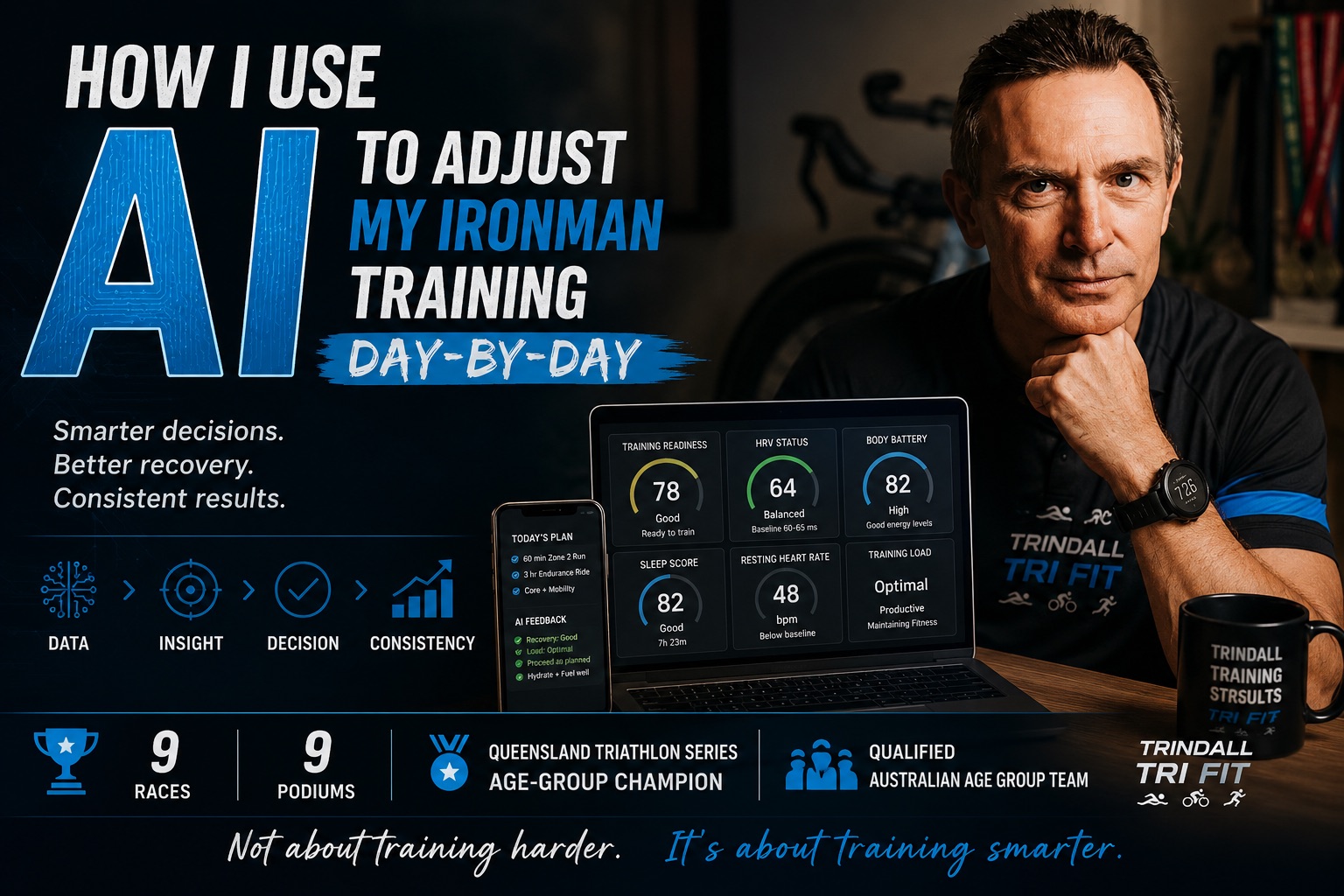
Every morning before training, I upload my Garmin data into ChatGPT.
That usually includes:
| Metric | Why It Matters |
|---|---|
| HRV status | Autonomic nervous system readiness |
| Sleep score | Recovery quality overnight |
| Body Battery | Overall energy reserves |
| Resting heart rate | Fatigue and recovery indicator |
| Training readiness | Garmin's composite readiness score |
| Previous session data | Cumulative load context |
| Planned session | What I intend to do today |
I then ask AI for feedback on whether the planned session aligns with my recovery status and current training load.
For example, a typical morning prompt might look like:
"HRV 58ms (baseline 62), sleep score 74, body battery 61, resting HR 46 (baseline 43). Yesterday was a 2-hour Zone 2 ride. Today's plan is 4×4-minute threshold run efforts. Should I proceed, modify, or rest?"
What's interesting is that AI often confirms what I'm already feeling physically. Other times, it picks up trends I may have ignored — a creeping resting heart rate over three days, or a declining sleep score pattern.
That's where the real value starts.
AI Isn't Coaching Me — It's Helping Me Think Better
One of the biggest misconceptions is that AI tells you exactly what to do.
That's not how I use it.
I use AI as:
- A second opinion — when I'm unsure whether to push or pull back
- A training sounding board — to pressure-test my own decisions
- A recovery checkpoint — to objectively assess readiness
- A decision-making assistant — to remove emotion from the equation
And if you're an endurance athlete — especially a masters athlete — you know emotion can be dangerous.
Sometimes we push because we feel guilty about missing a session. Sometimes we panic because the plan says "long ride" but the body says "rest day." Sometimes we try to "make up" training that was lost to work, weather, or life.
That mindset almost always leads to injury, fatigue, or inconsistency.
AI helps me step back and look at the bigger picture objectively.
A Real Example: The Calf Strain
Just last week, I developed a right calf issue during what was meant to be an easy recovery run.
In the past, I probably would have tested it the next day. Maybe tried to "run it out."
Instead, I adjusted training immediately:
- Stopped running — no ego, no heroics
- Focused on swim and bike — maintained aerobic fitness without calf load
- Monitored recovery daily — tracked how the metrics responded to rest
- Used AI feedback alongside common sense — confirmed the risk/reward calculation
A few days later, I returned carefully with a controlled Zone 2 run.
The result?
| Metric | Outcome |
|---|---|
| Heart rate | Low and controlled |
| Pacing | Stable throughout |
| Aerobic fitness | No measurable decline |
| Calf | No worsening |
That's the difference between smart training and stubborn training. Especially after 50, consistency matters far more than hero sessions.
The Season That Proved It
One thing I've learned after decades in endurance sport:
The athletes who stay healthy and consistent usually outperform the athletes who constantly train on the edge.
This season has reinforced that lesson more than ever.
At 57 years old, while balancing full-time shift work and family life, I've managed:
| Achievement | Detail |
|---|---|
| Races completed | 9 |
| Podium finishes | 9 out of 9 |
| Queensland Triathlon Series | Age-group overall points champion |
| Australian Age Group Team | Selected for 2026 World Championships (Spain) |
That didn't happen because I smashed myself every session.
It happened because I stayed consistent.
AI became part of that process by helping me:
- Monitor recovery trends over weeks, not just days
- Adjust sessions when the data said "not today"
- Avoid digging unnecessary fatigue holes
- Make smarter day-to-day decisions
Sometimes the smartest session is not the hardest session. And for masters athletes especially, that mindset can be the difference between improving steadily and constantly battling fatigue or injury.
Where AI Falls Short
AI is not perfect. It's important to be honest about its limitations.
AI doesn't know:
- Your full injury history and biomechanical quirks
- How your body truly feels internally on any given morning
- Your mental state, motivation, or life stress beyond what you tell it
- The difference between productive discomfort and warning-sign pain
AI can't replace:
- Decades of racing experience
- Good coaching and personalised programming
- Sports medicine professionals
- Self-awareness built over years of training
You still need to think critically. You still need common sense. And you still need to listen to your body.
But when used properly — as a tool, not a coach — AI becomes genuinely powerful.
Why This Matters for Masters Athletes
As we get older, recovery becomes more important than volume.
You can't always train harder. But you can always train smarter.
That's the key.
At 57, I'm not trying to prove how tough I am anymore. I'm trying to:
- Stay healthy enough to keep racing
- Train consistently week after week
- Recover properly between sessions
- Arrive at the start line in the best condition possible
AI helps support that process. Not by replacing experience, but by adding an objective layer of analysis to decisions I'm already making.
How to Get Started
If you're curious about using AI in your own training, here's a simple starting point:
- Record your daily metrics — HRV, sleep score, resting HR, body battery (most modern watches provide these)
- Write down your planned session for the day
- Upload both into ChatGPT (or your preferred AI tool) and ask: "Based on these metrics and yesterday's session, should I proceed with today's plan, modify it, or rest?"
- Compare the AI response with how you actually feel — over time, you'll learn where it adds value and where your own instinct is more reliable
- Track the patterns — after a few weeks, you'll start seeing trends in your data that you previously missed
It takes less than five minutes a day, and the insights compound over time.
Final Thoughts
Technology is changing endurance sport rapidly. Some athletes resist it. Some rely on it too heavily.
I believe the best approach sits somewhere in the middle.
Use AI as a tool. Not as a replacement for experience.
For me, it's become one of the most useful additions to my training routine — not because it trains for me, but because it helps me make better decisions day by day.
And in Ironman training, better decisions repeated consistently over time usually lead to better results.
Not about training harder. It's about training smarter.
Free 30-Minute Training Review
Want to know if your current training approach is working for you — or working against you?
I'm offering a free 30-minute training review call for masters athletes (40+) who want an honest, no-obligation conversation about their training.
No sales pitch. No pressure. Just a straightforward look at:
- Where your training is now
- What's working and what might need adjusting
- Whether AI-assisted decision-making could help your consistency
- Simple changes that could make a real difference
Book your free training review →
Limited spots available each month. First in, first served.
Related: Why Zone 2 Training Is the Foundation of Triathlon Success
Recent: 4 Weeks to Go — Calf Injury Scare and Managing Risk
Free resources: Training Plans, Nutrition Guides, and More
Watch on YouTube: Trindall Tri Fit Channel