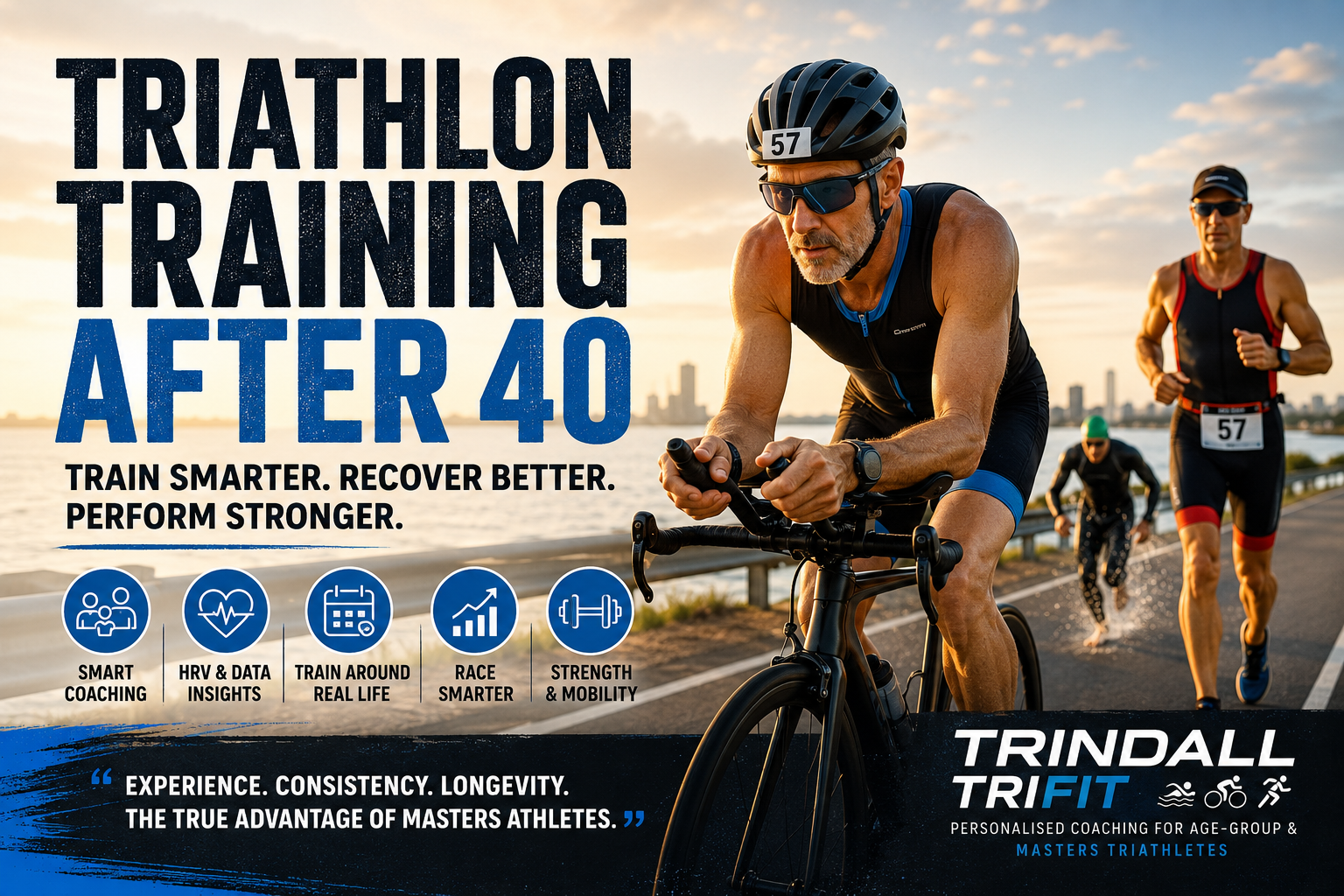
For many triathletes, turning 40 or 50 doesn't mean slowing down or becoming less competitive. In many cases, it's when athletes finally have the experience, patience and discipline to train properly.
But there's one important reality: you can't necessarily train at 50 the same way you trained at 25.
I've been involved in triathlon for more than four decades — I completed my first triathlon as a teenager in 1983 and I'm still racing competitively today. Over that time I've watched training methods, equipment and sports science change enormously. What hasn't changed is the importance of consistency.
For masters athletes, though, achieving that consistency requires balancing training stress with recovery, work, family and everything else life throws at us. Here are five areas I believe matter most when coaching and training masters triathletes.
The best training program isn't the most sophisticated one. It's the one an athlete can consistently complete, recover from and enjoy.
1. Coaching an Age-Group Athlete Is Different From Coaching a Professional
Professional athletes essentially have one major responsibility: prepare their bodies to perform. Most age-group athletes don't have that luxury. They have careers, families, businesses, school drop-offs, travel, mortgages and countless other commitments competing for their time and energy.
That's why one of the biggest mistakes in age-group coaching is taking a professional training program and simply reducing the volume. The training needs to be designed around the athlete's life — not the athlete's life around the training program.
If an athlete only has an hour available on Tuesday morning, there's little value prescribing a two-hour session. Likewise, an athlete who's had an extremely stressful week at work may not respond to a hard session the same way they would during a relatively stress-free week.
The best training program isn't necessarily the most sophisticated one. It's the one an athlete can consistently complete, recover from and enjoy.
2. Using HRV to Help Guide Training and Recovery
One of the biggest changes I've seen in endurance sport is the sheer amount of information now available to everyday athletes. Heart rate, power, sleep, resting heart rate and Heart Rate Variability (HRV) can all provide valuable insight into how an athlete is responding to training.
For masters athletes, HRV can be particularly useful — but I don't believe we should let a single number on a watch or app dictate whether we train. Instead, I look for trends. When several signals line up, they tell a story:
| Signal | What I look for | What it may suggest |
|---|---|---|
| HRV | Consistently suppressed | Accumulated fatigue |
| Resting heart rate | Elevated over several days | Incomplete recovery |
| Sleep | Poor or broken | Reduced adaptation capacity |
| Perceived feeling | Flat, heavy, unmotivated | Body needs a lighter day |
When those signals appear together, it may mean reducing the intensity of a planned session, shortening it, or occasionally replacing it with recovery. Conversely, one unusual HRV reading on its own isn't a reason to cancel training.
Data should support coaching judgement — not replace it. And it needs to be combined with perhaps the most sophisticated monitoring system we have: how the athlete actually feels. If you'd like to go deeper on this, I've written a full guide to using HRV in your training.
3. What Should a Typical Training Week Look Like?
There isn't one perfect training week. The right volume depends on the athlete's experience, goals, available time, injury history and the race they're preparing for. That said, I generally prefer a structure that develops all three disciplines while leaving enough space for recovery.
For an age-group athlete balancing work and family, a week might include three swims, three bike sessions and three runs, with one run built into a short brick. That sounds like a lot, but not every session needs to be long:
| Day | Session |
|---|---|
| Monday | Recovery / rest + mobility |
| Tuesday | Bike + short run (brick) |
| Wednesday | Swim + easy run |
| Thursday | Bike quality session + strength |
| Friday | Swim + recovery / mobility |
| Saturday | Longer endurance bike |
| Sunday | Swim + endurance run |
The precise structure isn't as important as the principle behind it:
- Hard sessions need a purpose.
- Easy sessions need to actually be easy.
- Recovery is part of the program — not something we do only when we're exhausted.
For masters athletes in particular, more training isn't automatically better training.
4. Structuring a Season Without Burning Out
Another common mistake is trying to hold peak fitness all year. It's virtually impossible. Instead, I prefer athletes to identify their most important races and work backwards from them.
Some events are designated A races, where we're aiming for peak performance. Others become B or C races that form part of the training process. That lets us build through progressive blocks, introduce recovery periods, and gradually increase race-specific work as the important events approach.
I like the concept of several weeks of progressive training followed by a lighter adaptation week. That recovery week isn't lost training — it's where the body absorbs the work you've already done. (I break this down further in my guide to training periodisation.)
The same principle applies across an entire season. After a major event or racing block, sometimes the smartest thing an athlete can do is back off. Fitness matters, but so does maintaining the enthusiasm to train. We're trying to build athletes who can enjoy endurance sport for decades — not simply survive until their next race.
5. Strength and Mobility Become Increasingly Important After 40
If I could convince more masters endurance athletes to change one thing, it would be to stop treating strength and mobility as optional extras. As we get older, maintaining muscle mass, strength and movement becomes increasingly important.
For a triathlete, strength work isn't about lifting enormous weights or becoming a bodybuilder. It's about building a body capable of handling the repetitive demands of swimming, cycling and running — developing strength through the legs, hips, glutes and calves while maintaining trunk and upper-body strength. Mobility is equally important.
The objective isn't simply to race faster. It's to remain strong enough and mobile enough to keep training consistently. That's why my approach to masters training increasingly revolves around four interconnected areas:
Strength. Mobility. Endurance. Recovery.
Ignore one of them for long enough and eventually the others suffer.
The Biggest Advantage Masters Athletes Have
There's a tendency to focus on everything we supposedly lose as we get older. I prefer looking at what we gain: experience, patience, better pacing, a greater understanding of our bodies — and often a much clearer understanding of why we're doing the sport in the first place.
A 50-year-old athlete may not recover exactly like they did at 25, but that doesn't mean they can't keep improving. It simply means the approach needs to evolve. Train with purpose. Recover deliberately. Build strength. Maintain mobility. And above all, stay consistent.
Because one of the greatest achievements in endurance sport isn't simply seeing how fast you can go today — it's seeing how long you can keep doing it.
If this resonates and you'd like a program built around your life rather than a pro's, book a free 30-minute consultation with me, explore my free training resources, or learn more on the coaching page.
About Trindall TriFit
Trindall TriFit provides personalised online triathlon coaching for age-group and masters athletes, combining more than 40 years of firsthand triathlon experience with modern training tools including heart rate, power and HRV. The focus is simple: fit training around real life while helping athletes become stronger, healthier and more consistent.
What's the one area — smart training, HRV, weekly structure, season planning or strength — you find hardest to get right? Drop a comment below and let me know.