
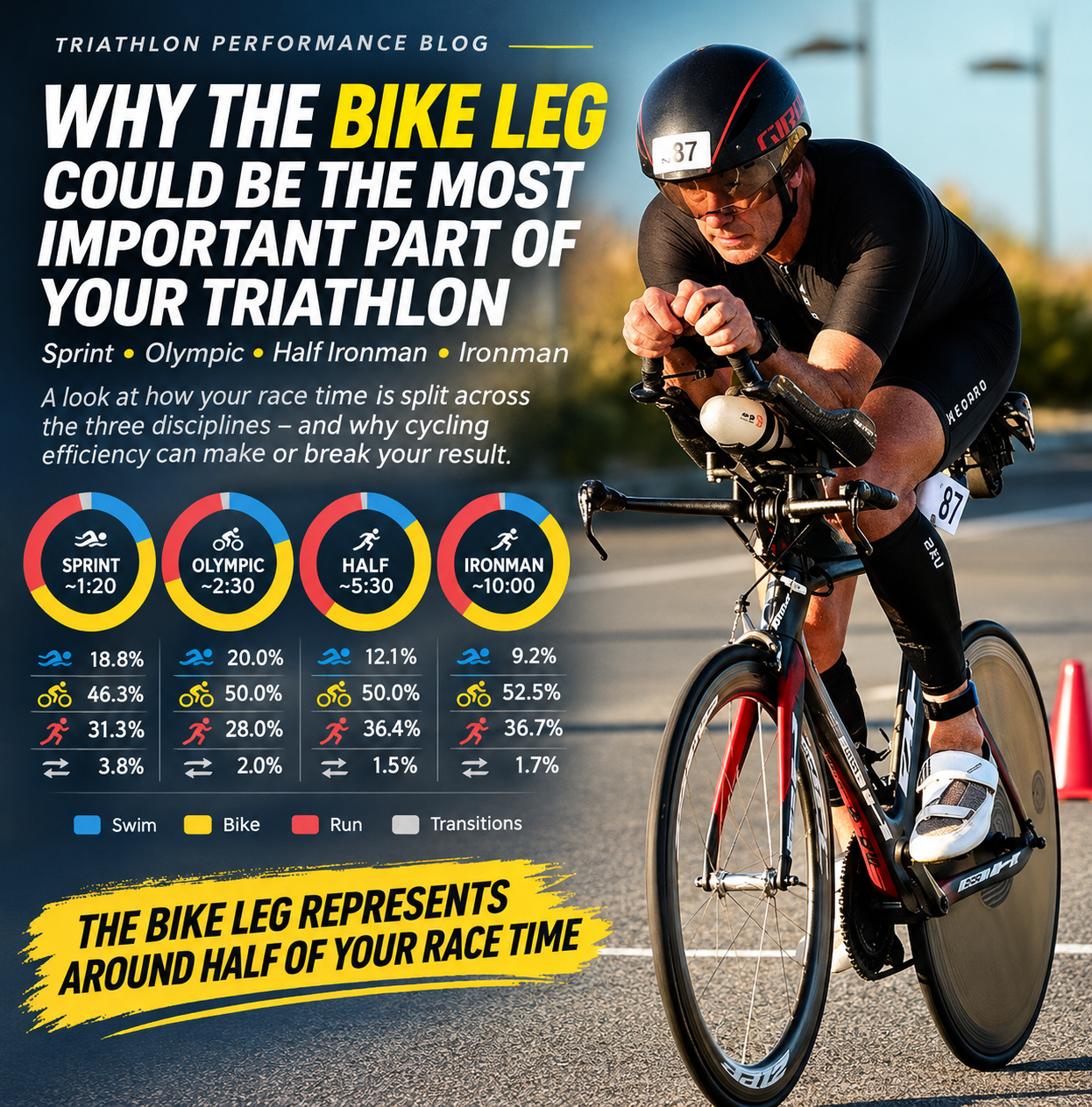
Sprint, Olympic, Half Ironman and Ironman: where do we really spend our racing time?
When we think about improving our triathlon performances, we often focus on swimming faster, increasing our FTP or improving our running pace.
But have you ever considered exactly how much of your race is spent on each discipline? More importantly, how does that percentage change as we move from sprint-distance racing through to a full Ironman?
The numbers are interesting — particularly when we consider the influence the bike leg has on our ability to run well afterwards.
Let's break it down.
1. Sprint Triathlon — Approximately 1 Hour 20 Minutes
750m swim | 20km bike | 5km run
For this example, we'll use a competitive age-group finishing time of 1 hour 20 minutes.
| Discipline | Time | Percentage |
|---|---|---|
| 🏊 Swim | 15 min | 18.8% |
| 🚴 Bike | 37 min | 46.3% |
| 🏃 Run | 25 min | 31.3% |
| 🔁 Transitions | 3 min | 3.8% |
| Total | 1:20:00 | 100% |
Even in a sprint triathlon, almost half the race is spent cycling.
However, because the overall duration is relatively short, athletes can generally sustain a much higher percentage of their maximum cycling power. The challenge is maintaining that intensity without compromising the 5km run.
In sprint racing, a strong bike leg can establish a significant advantage — but an athlete who overbikes can quickly lose that advantage on the run.
The takeaway: Cycling speed matters enormously, but so does the ability to transition immediately into fast running.
2. Olympic Distance — Approximately 2 Hours 30 Minutes
1.5km swim | 40km bike | 10km run
Now let's double the distances.
| Discipline | Time | Percentage |
|---|---|---|
| 🏊 Swim | 30 min | 20.0% |
| 🚴 Bike | 1 hr 15 min | 50.0% |
| 🏃 Run | 42 min | 28.0% |
| 🔁 Transitions | 3 min | 2.0% |
| Total | 2:30:00 | 100% |
Here, cycling accounts for exactly half the total race time. That's a significant proportion of the event.
At Olympic distance, the relationship between cycling intensity and running performance becomes increasingly important. An athlete who pushes slightly beyond their sustainable cycling intensity may gain a minute or two on the bike but lose considerably more during the 10km run.
This is where aerobic efficiency, pacing discipline and cycling-specific muscular endurance start becoming major performance factors.
The takeaway: A strong 40km bike split is valuable, but the ability to run close to your standalone 10km potential afterwards is equally important.
3. Half Ironman — Approximately 5 Hours 30 Minutes
1.9km swim | 90km bike | 21.1km run
As we move into middle-distance racing, the demands change considerably.
| Discipline | Time | Percentage |
|---|---|---|
| 🏊 Swim | 40 min | 12.1% |
| 🚴 Bike | 2 hr 45 min | 50.0% |
| 🏃 Run | 2 hr | 36.4% |
| 🔁 Transitions | 5 min | 1.5% |
| Total | 5:30:00 | 100% |
Once again, approximately half the race is spent cycling. But there's an important difference: we're now talking about nearly three hours of sustained cycling before attempting a half marathon.
At this distance, the bike leg becomes more than a test of power and speed. It becomes a test of energy management.
- How efficiently can you produce power?
- How effectively can you fuel?
- How much muscular fatigue are you accumulating?
- And most importantly, what condition are your legs in when you reach T2?
An athlete who saves five minutes by riding too aggressively could potentially lose 15 minutes or more during the half marathon.
The takeaway: The objective isn't simply to ride 90km quickly. It's to ride quickly enough to remain competitive while preserving the ability to run strongly.
4. Ironman — The Sub-10-Hour Challenge
3.8km swim | 180km bike | 42.2km run
Now we reach the full Ironman. For this example, we'll use a target finishing time of exactly 10 hours.
| Discipline | Time | Percentage |
|---|---|---|
| 🏊 Swim | 55 min | 9.2% |
| 🚴 Bike | 5 hr 15 min | 52.5% |
| 🏃 Run | 3 hr 40 min | 36.7% |
| 🔁 Transitions | 10 min | 1.7% |
| Total | 10:00:00 | 100% |
More than half the race is spent on the bike. But the most important consideration isn't necessarily the percentage — it's what happens during those five-plus hours.
Unlike shorter triathlons, Ironman racing requires athletes to hold a relatively conservative percentage of their maximum cycling power. The objective is to produce the fastest sustainable bike split without accumulating excessive fatigue or compromising the marathon.
And that's where cycling efficiency becomes critical.
Imagine two athletes with identical running ability:
| Bike split | Marathon | Bike + run | |
|---|---|---|---|
| Athlete A | 5:10 | 4:00 | 9:10 |
| Athlete B | 5:20 | 3:40 | 9:00 |
Athlete B rides ten minutes slower but completes the combined bike and run ten minutes faster.
That's the Ironman equation.
The takeaway: The fastest bike split doesn't necessarily produce the fastest Ironman.
Comparing All Four Distances
Let's put the percentages together.
| Discipline | Sprint | Olympic | Half Ironman | Ironman |
|---|---|---|---|---|
| 🏊 Swimming | 18.8% | 20.0% | 12.1% | 9.2% |
| 🚴 Cycling | 46.3% | 50.0% | 50.0% | 52.5% |
| 🏃 Running | 31.3% | 28.0% | 36.4% | 36.7% |
| 🔁 Transitions | 3.8% | 2.0% | 1.5% | 1.7% |
Percentages are rounded and based on illustrative finishing times. Actual proportions vary with athlete ability, course conditions and race execution.
What Does This Tell Us?
Three things stand out.
First, cycling represents approximately half of the total racing time across all four distances. That alone makes cycling fitness a major contributor to overall performance.
Second, swimming represents a smaller percentage of total race time as the distance increases. In our examples, swimming accounts for nearly 19% of a sprint but only around 9% of an Ironman. That doesn't mean swimming becomes unimportant — an efficient swim can reduce fatigue and improve positioning, particularly in competitive age-group racing.
Third, the consequences of poor cycling execution grow over longer distances. In a sprint triathlon, an overly aggressive bike leg might affect the final kilometre of the run. In an Ironman, poor pacing or inadequate nutrition can contribute to substantial deterioration during the marathon.
That's one reason I'm such an advocate of training and racing with power — it takes much of the guesswork out of bike pacing.
Why I Believe Cycling Frequency Matters
For athletes targeting longer-distance triathlons, I believe consistent cycling frequency deserves serious consideration.
Rather than relying exclusively on one enormous weekend ride, spreading cycling volume across the training week can help develop aerobic fitness, muscular endurance and the ability to sustain power efficiently.
For example, a five-ride training week might include:
- One easy recovery ride.
- Two aerobic endurance rides.
- One structured power-development session.
- One progressively longer endurance ride.
The exact distribution should depend on the athlete's experience, recovery capacity and overall training load. A mix of indoor and outdoor riding can make that frequency far more manageable around work and family life.
The objective isn't simply to accumulate kilometres. It's to improve the ability to sustain an appropriate race intensity at the lowest manageable physiological cost.
For Ironman athletes, that means developing the capacity to ride for five or six hours and still have sufficient energy, hydration and muscular resilience to run a marathon — what I often refer to as durability.
Importantly, cycling volume shouldn't come at the expense of adequate running preparation. The marathon still requires running-specific durability.
The Real Goal: Arrive at T2 Ready to Race
I often think we place too much emphasis on individual discipline performances.
A great swim split doesn't guarantee a great triathlon. A fantastic bike split doesn't guarantee a great triathlon. And a fast standalone marathon doesn't necessarily translate into a fast Ironman marathon.
Triathlon performance is about combining all three disciplines effectively.
The best cycling performance isn't always the fastest possible 180km ride. It's the fastest ride you can execute while still being capable of producing the run performance your fitness allows.
That requires fitness, discipline, nutrition, pacing and experience.
Final Thoughts
Whether you're racing a sprint triathlon or chasing a sub-10-hour Ironman, the bike leg represents an enormous opportunity to improve overall performance.
Across our four examples, cycling accounts for approximately 46–53% of total race time.
But perhaps its greatest influence is something the stopwatch doesn't immediately reveal. A well-executed bike leg doesn't just save time on the bike — it helps protect your performance on the run.
And when it comes to long-course triathlon, that could be the difference between achieving your goal and watching it disappear during the final kilometres of the marathon.
Train consistently. Ride efficiently. Fuel properly. And remember — the race doesn't finish at T2.
Coach Trindall Triathlon | Endurance Training | Masters Performance