Can you improve your triathlon fitness, lose weight and maintain performance in your late 50s? Here's what happened when I committed to four weeks of consistent training after the Raby Bay Triathlon.
At 58, I've been involved in triathlon for more than four decades. One thing I've learned over those years is that fitness doesn't necessarily disappear as we get older — but maintaining it requires consistency, discipline and a little more attention to recovery.
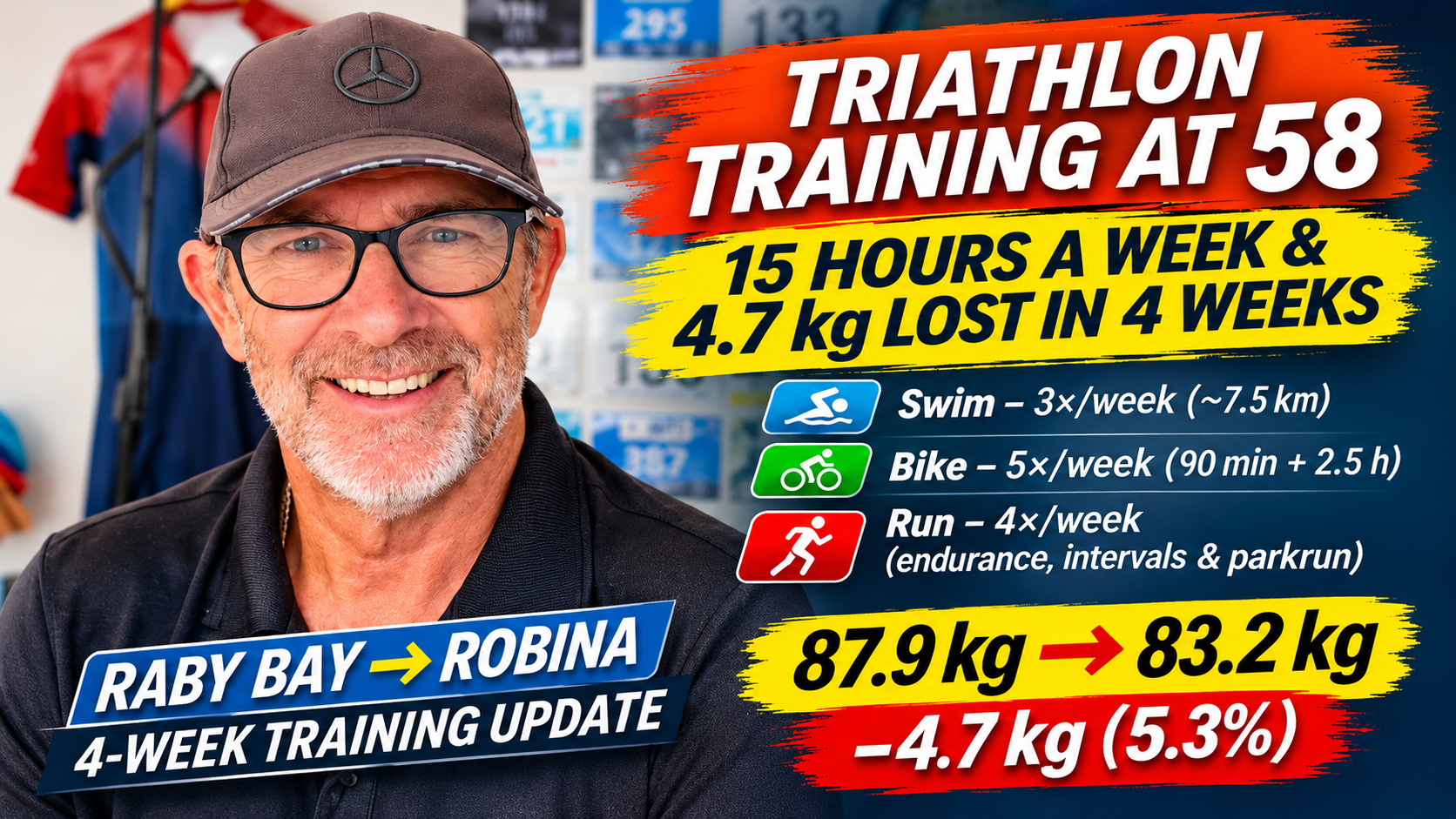
Over the past four weeks, I've completed a structured block of triathlon training averaging approximately 15 to 15.5 hours per week. During that period, I've also reduced my body weight from 87.9kg to 83.2kg — a loss of 4.7kg.
But this wasn't simply about losing weight. It was about rebuilding my fitness, improving my endurance and preparing for the Queensland Olympic Distance Triathlon State Championships at Robina.
Here's exactly what I did, why I did it and what I've learned along the way.
The Wake-Up Call: Raby Bay Triathlon
On 11 October 2026, I competed in the Raby Bay Triathlon, the second round of the Queensland Triathlon Series:
- 900m swim
- 20km bike
- 6km run
I was racing in the men's 55–59 age group and managed to finish second. On paper, another podium finish looked like a good result.
The reality was that I struggled considerably more than I expected.
The Raby Bay bike course includes a series of relatively small inclines. Individually, they're nothing particularly challenging, but repeated over five laps, they start to add up. I found myself struggling to generate power on those inclines — and the run wasn't much better.
| Raby Bay run | Average pace |
|---|---|
| March 2026 | ~4:25/km |
| October 2026 | 4:41/km |
| Difference | +16 sec/km |
I finished approximately three minutes slower overall than my previous performance, despite what I considered to be more favourable conditions.
Something clearly needed attention.
How I Gained Almost 9kg Without Realising
Back in June, I travelled to Cairns to compete in Ironman Cairns. Unfortunately, my race ended prematurely with a Grade 2 calf tear.
The injury interrupted my training for approximately six weeks and forced me to rebuild gradually. During that period, I wasn't paying much attention to my diet or body weight.
At Cairns, I'd been weighing between 78 and 80kg. Following Raby Bay, I stepped onto the scales.
87.9kg.
I'd gained somewhere between 8 and 10kg, depending on which of my Cairns weigh-ins I used as the comparison. It had happened gradually, without me really noticing. (I wrote about it at the time in From 78kg to 87.9kg.)
Looking back, it wasn't particularly surprising. My training volume had dropped significantly during injury recovery, but my eating habits hadn't adjusted accordingly. Chocolate, ice cream, chips and other extras had gradually become part of the routine — and when you're no longer burning the calories you were during Ironman preparation, those extras make a considerable difference.
The question was what I could do about it without compromising my return to racing.
The Four-Week Training Block: Consistency Over Complexity
With five weeks between Raby Bay and the Robina State Championships, I decided on a four-week training block followed by a recovery and taper week.
Normally, I prefer a progressive structure where volume or intensity increases over three weeks before a reduced-load recovery week. This time, I took a different approach: I repeated essentially the same training week four times.
There were minor adjustments for weather and circumstances, but the overall structure remained remarkably consistent. The objective wasn't to chase bigger numbers every week. It was to establish a sustainable workload, rebuild endurance and let the consistency do the work.
My Typical Training Week
| Day | Training sessions |
|---|---|
| Monday | 🏊 2,500m swim + 🚴 90-min Zone 2 bike |
| Tuesday | 🏃 90-min Zone 2 run + 🚴 90-min indoor bike |
| Wednesday | 🚴 90-min Zone 2 bike + 🏊 2,500m swim |
| Thursday | 🏃 4 × 4-min run intervals + 🚴 90-min bike |
| Friday | Recovery or easy bike |
| Saturday | 🏃 Parkrun tempo session + 🏊 2,500m swim |
| Sunday | 🚴 2.5-hour endurance bike + 🏃 30-min easy run |
Total training volume: approximately 15–15.5 hours per week.
The majority of that training was performed at relatively low intensity — and that was deliberate.
Why Zone 2 Training Was the Foundation
One of the biggest mistakes endurance athletes make is turning every training session into a competition. It's particularly tempting when you're trying to regain lost fitness — you feel like you need to train harder to catch up.
My approach was the opposite. Most of my cycling and endurance running was performed in Zone 2.
For me, that means keeping the effort controlled, maintaining a sustainable heart rate and finishing sessions without feeling completely exhausted. The purpose is to develop aerobic endurance while managing fatigue. Over time, consistent aerobic training can improve your ability to sustain exercise, support cardiovascular adaptations and make you more efficient at endurance efforts.
For masters athletes, I believe this approach becomes increasingly important. At 58, I can still train hard — but I also need to recover and turn up for the next session. There's little benefit in one exceptional workout if it leaves you too fatigued to train properly for the next three days.
Consistency across weeks and months is far more valuable than one spectacular training session.
If you're unsure how to set your own training zones, try my free heart rate zone calculator in the Resources section.
Five Bike Sessions a Week: Building the Engine
Cycling formed the largest component of this training block. Most weeks included five rides, the majority lasting approximately 90 minutes, with Sunday extended to around two and a half hours.
Some rides were completed outdoors, while others were performed indoors on my smart trainer. Living in Brisbane, afternoon traffic and unpredictable weather can make outdoor training difficult — and we had some significant storms during this block, which meant more time indoors than I would have liked.
But indoor training has its advantages: no traffic, no stopping at intersections and no coasting. You can hold a controlled effort for the entire session.
For the Sunday endurance ride, the focus was slightly different. I concentrated on staying aerodynamic, keeping my power output controlled and practising nutrition. Even on undulating roads, I resisted the temptation to attack every incline. The goal was endurance, not hill PBs.
This approach is particularly relevant to my longer-term goal of returning to Ironman racing. The bike represents around half of an Ironman, and being able to produce a strong bike split without destroying your running legs is critical.
Running: Endurance, Intervals and Parkrun
My running was built around four sessions each week, each with a different purpose.
Tuesday: The 90-Minute Endurance Run
Tuesday was my longest run of the week. I gradually built this session to 90 minutes, keeping the intensity in Zone 2.
There was nothing complicated about it. The objective was to develop aerobic endurance and improve my ability to hold a comfortable running pace over an extended period. I also included approximately one kilometre of walking afterwards to transition out of the session before training again later in the day.
Thursday: 4 × 4-Minute Intervals
Thursday was my main high-intensity running session:
- 10-minute warm-up
- 4 × 4 minutes at approximately my intended Olympic-distance 10km race effort
- 2-minute walking recovery between intervals
- Easy running cool-down
- Approximately 1km walking home
The aim wasn't to sprint each interval. I wanted to practise running at a pace I believed I could sustain for the 10km run at Robina. By the end of the block, these efforts were feeling noticeably more comfortable — an encouraging sign that my running fitness was returning.
Saturday: Parkrun as a Tempo Session
Rather than treating every parkrun as a flat-out 5km time trial, I used it as a controlled tempo session:
- 2km warm-up
- 5km parkrun
- 1km easy cool-down
- 1km walk
During the parkrun itself, I aimed to hold an average heart rate around 150–153bpm. Rather than chasing a finishing time, I watched how my pace responded at a consistent effort.
For me, that's one of the most useful ways to monitor running progress. If I can run faster at approximately the same heart rate, that's a positive sign.
Sunday: The Easy 30-Minute Run
My final run of the week was a short 30-minute session on Sunday afternoon, generally around 5:50–6:00/km at upper Zone 1 to lower Zone 2 effort.
Importantly, this wasn't performed immediately after the morning bike ride — I deliberately separated the two sessions. At this stage, maintaining good running form was more important than practising brick sessions. The afternoon run simply provided additional easy aerobic work without unnecessary intensity.
Swimming: Three Sessions and ~7.5km Per Week
Swimming was the most consistent component of the program. I generally completed three sessions per week, each around 2,300–2,500m.
A typical swim included:
- 500m warm-up
- 10 × 50m freestyle with 30 seconds recovery
- Main set of either 12 × 100m or 6 × 200m, with approximately 30 seconds recovery
- Easy cool-down
Occasionally, I'd replace the interval work with a continuous endurance swim.
The emphasis was on maintaining technique, swimming consistently and rebuilding endurance. Having come from an Ironman preparation earlier in the year, I wasn't looking to dramatically increase swimming volume — just to maintain a solid foundation while directing more time towards the bike and run.
The Weight-Loss Results: 87.9kg to 83.2kg
Alongside the training, I started paying closer attention to what I was eating. I didn't introduce a complicated diet. I simply removed many of the unnecessary extras and returned to fairly straightforward meals.
A typical day looked something like this:
- Breakfast: An egg on toast and coffee.
- Lunch: Two ham, cheese and tomato sandwiches, usually with a sugar-free drink.
- Snacks: A banana or mandarin when needed.
- Dinner: A meal such as a stir-fry, generally around 700 calories.
And yes, I still enjoyed my coffee — usually three small espressos a day!
My estimated daily food intake was generally around 2,000–2,200 calories, against an estimated total daily energy expenditure of approximately 3,000 calories. Those figures were estimates, but they helped me understand the overall balance between energy in and energy out. I also weighed myself regularly and reviewed my training data to see how I was responding.
Four-Week Summary
| Measurement | Result |
|---|---|
| Starting weight | 87.9kg |
| Weight after four weeks | 83.2kg |
| Total weight lost | 4.7kg |
| Average weekly loss | 1.18kg |
| Percentage of starting body weight | 5.3% |
| Average weekly training | 15–15.5 hours |
I'm pleased with that result, but there's an important qualification.
A reduction of 4.7kg in four weeks is relatively rapid, particularly alongside a substantial endurance training load. Not all short-term weight loss is body fat — changes in glycogen, water and other factors also influence the scales. And a calorie deficit that works over a short period isn't necessarily appropriate to maintain indefinitely.
The last thing I want is to become lighter but weaker.
The Balancing Act: Losing Weight Without Losing Power
This is probably the most important lesson from the entire block.
As endurance athletes, we often focus on body weight because carrying unnecessary mass can affect running economy and climbing. But weight is only one part of the equation. If you reduce your weight at the expense of muscle, recovery or power output, you may actually become a slower athlete.
For me, the objective is to improve performance, not simply produce the lowest possible number on the scales. That's why I've been monitoring how my legs feel, how my cycling power responds and whether my running sessions remain comfortable.
I use Garmin training data and ChatGPT to help review sessions, body-weight trends and estimated energy intake. These tools are useful for spotting patterns, although neither can precisely measure my actual calorie expenditure or tell me whether I'm losing muscle.
It's also important to fuel longer and harder sessions appropriately, even when trying to reduce body fat. For anyone attempting a similar approach, I'd recommend a more individualised nutrition strategy — ideally with input from a qualified sports dietitian — particularly when training 15 hours or more each week.
The aim should be gradual, sustainable weight loss while preserving training quality and recovery.
What About My Target Race Weight?
My longer-term goal is to see whether I can eventually return to approximately 76kg without sacrificing strength or performance. But I'm not rushing towards that number.
The first checkpoint will be around 78kg, which is approximately where I was during my Ironman Cairns preparation. At that point, I'll assess my running, cycling power and general recovery. If everything is progressing well, I may gradually reduce my weight further. If performance starts to deteriorate, I'll reassess.
There's no point being the lightest athlete on the start line if you can't produce the power required to race competitively.
What This Means for Robina and Beyond
The immediate test of this block will be the Robina Olympic Distance Triathlon on 15 November — also the Queensland Olympic Distance State Championships:
- 1,500m swim
- 40km bike
- 10km run
I'll be competing in the men's 55–59 age group. After the difficulties at Raby Bay, I'm looking forward to seeing whether the improvements I've felt in training translate into a stronger race.
Beyond Robina, my focus turns to the Gold Coast T100 in March 2027 — a race where I want to perform strongly. Further down the road, I'm looking towards Ironman Australia at Port Macquarie in October 2027, as part of my longer-term ambition to break 10 hours for an Ironman around the age of 60.
Each training block is another step towards those goals.
Five Lessons From Four Weeks of Training at 58
1. Consistency beats complexity. I didn't need a complicated program. Repeating a sensible structure and completing the sessions was the foundation of the block.
2. Most training doesn't need to be hard. The majority of my training was aerobic. The harder running sessions had a specific purpose rather than adding intensity for its own sake.
3. Body weight can creep up during injury recovery. When training volume drops, nutritional requirements change. It's worth monitoring that transition rather than waiting until race performance suffers.
4. Recovery matters more as we age. At 58, I can still handle a substantial training load, but that doesn't mean ignoring fatigue. Training needs to be balanced with adequate food, sleep and recovery.
5. Performance matters more than the scales. Weight loss is useful only if it supports the bigger objective: becoming a stronger, faster and more efficient triathlete.
Final Thoughts: Can You Still Improve at 58?
Absolutely.
But I think the key is understanding that improvement doesn't always come from doing more or training harder. Sometimes it comes from getting back to basics: consistent aerobic training, a manageable amount of intensity, sensible nutrition, monitoring recovery — and turning up day after day.
Over these four weeks, I've completed around 60 hours of triathlon training and reduced my body weight by 4.7kg. More importantly, I've started feeling stronger and more comfortable in my training again.
The next challenge is to translate that progress into race-day performance. Robina will give me a good indication of where I stand. And whatever happens there, the bigger picture remains the same.
At 58, I'm not interested in simply maintaining fitness. I'm interested in seeing just how much performance I can still develop.
That's what keeps me coming back.
Coach Trindall
Explore More Triathlon Training Resources
Want to understand your training zones, improve your endurance or learn more about preparing for triathlon as a masters athlete? Visit the Free Resources page for training calculators, practical guides and tools to help you get more from your training.
And if you'd like to see the original breakdown of this four-week block, including the Garmin data and weight-loss results, check out the accompanying video on my YouTube channel.