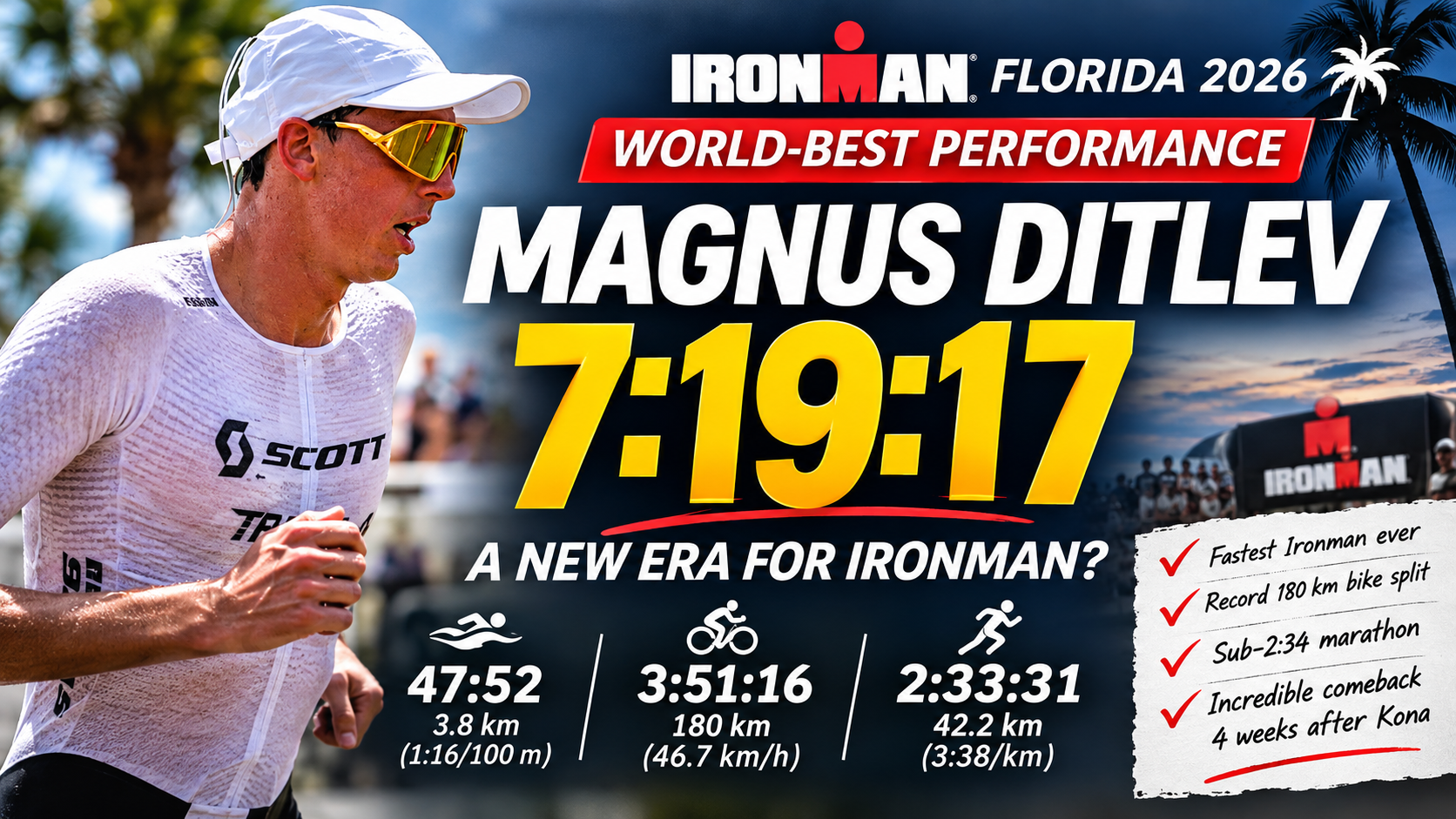
Seven hours, nineteen minutes and seventeen seconds. Just consider that for a moment.
On Saturday, 7 November 2026, Danish professional triathlete Magnus Ditlev produced one of the most extraordinary performances in the history of long-distance triathlon. Racing at Ironman Florida in Panama City Beach, Ditlev completed the full 3.8km swim, 180km bike ride and 42.2km marathon in an astonishing 7:19:17.
Not only did he win the race, he established a new world-best time for the full Ironman distance. And perhaps even more remarkable than the finishing time was how he achieved it.
The Numbers Are Almost Impossible to Comprehend
Let's break down Ditlev's performance.
| Discipline | Time | Average |
|---|---|---|
| 🏊 Swim — 3.8km | 47:52 | 1:16/100m |
| 🚴 Bike — 180km | 3:51:16 | 46.7km/h |
| 🏃 Run — 42.2km | 2:33:31 | 3:38/km |
| 🏆 Overall | 7:19:17 | World-best performance |
These aren't individual performances achieved by three specialist athletes. They were produced by one athlete, on the same day, without stopping.
A 47-minute Ironman swim is exceptional. Riding 180 kilometres at almost 47km/h is extraordinary. But then running a marathon at approximately 3:38 per kilometre after that bike ride? That's where this performance moves into another category entirely.
Many dedicated runners spend years trying to break 2:35 for a marathon on fresh legs. Ditlev did it after swimming 3.8 kilometres and cycling 180 kilometres at a speed most competitive amateur cyclists would struggle to hold for even a fraction of the distance.
The Bike Split That Changed Everything
Ditlev has long been recognised as one of the strongest cyclists in professional triathlon. But his performance in Florida was something else. He completed the 180km bike leg in just 3:51:16 — an average speed of approximately 46.7km/h. For nearly four hours.
To appreciate what that means, consider the enormous aerodynamic resistance involved. Aerodynamic drag rises with the square of speed, and the power needed to overcome it rises roughly with the cube — so riding a little faster costs a lot more watts. At close to 47km/h, aerodynamic efficiency becomes absolutely critical. Position, equipment, rolling resistance, pacing and the ability to sustain exceptional power output all contribute.
Florida is known as a relatively flat and fast course, which certainly helps produce quick times. However, a fast course doesn't explain everything. Every professional in the field raced on the same course, yet Ditlev arrived at T2 more than 11 minutes ahead of his nearest competitors.
At the professional level, where races are often decided by seconds or a handful of minutes, that is an enormous advantage. His bike split also set a new benchmark for the fastest recorded 180km bike leg in an Ironman race.
And Then He Ran a 2:33 Marathon
This is arguably the most impressive part of the entire performance. Cycling fast is one thing. Cycling fast while preserving enough energy to run a competitive marathon is something completely different.
Ditlev didn't simply survive the marathon. He ran 2:33:31 — approximately 3:38 per kilometre for the entire 42.2 kilometres — straight after producing the fastest Ironman bike split ever recorded.
For anyone who has completed an Ironman, the significance of this cannot be overstated. The marathon is where the accumulated cost of the swim and bike becomes apparent. Nutrition, muscular fatigue, glycogen availability, hydration, pacing and cardiovascular efficiency all come into play. Athletes who overextend themselves on the bike frequently pay a substantial price in the second half of the run.
Yet Ditlev demonstrated an extraordinary ability to combine exceptional cycling with world-class running endurance. It raises an interesting question: just how much further can professional Ironman performances improve?
From Kona Heartbreak to World-Best Performance
What makes this story even more remarkable is what happened just four weeks earlier.
At the October 2026 Ironman World Championship in Kona, Ditlev appeared to be on his way to the biggest victory of his career. After taking control of the race, he remained in contention for the win deep into the marathon. But his race unravelled in the closing kilometres and he was forced to withdraw. He was one of 22 professionals who didn't finish that day, something I wrote about in 22 Pros DNF at Kona 2026 – Why Knowing When to Stop Is Part of Being an Ironman.
For an athlete who had invested months of preparation into the world championship, it was a devastating outcome. Fast-forward just 28 days. Rather than allowing that disappointment to define his season, Ditlev lined up at Ironman Florida — and produced the fastest full-distance performance ever recorded.
The physical recovery required to race again at this level within four weeks is remarkable. But perhaps equally impressive is the psychological resilience. To return after such a public and painful disappointment and produce a performance of this magnitude says a great deal about the athlete.
Florida wasn't simply another race victory. It was an extraordinary response to adversity.
A New World Best — But What Does That Actually Mean?
Before Florida, the fastest recorded full-distance triathlon time was 7:21:04, set by Sam Laidlow at Challenge Roth in July 2026. Ditlev's 7:19:17 improved that benchmark by 1 minute and 47 seconds. He also bettered Kristian Blummenfelt's previous Ironman-branded best of 7:21:12.
| Athlete | Race | Time |
|---|---|---|
| Magnus Ditlev | Ironman Florida, Nov 2026 | 7:19:17 |
| Sam Laidlow | Challenge Roth, Jul 2026 | 7:21:04 |
| Kristian Blummenfelt | Previous Ironman-branded best | 7:21:12 |
There is an important distinction here. Unlike athletics, where world records are set on precisely measured and regulated courses, Ironman racing takes place across vastly different environments. Course profiles, weather, water temperature, currents and road surfaces can all influence finishing times. That's why "world-best time" is generally a more accurate term than an officially standardised world record.
Nevertheless, the significance of Ditlev's performance is undeniable. He has set a new benchmark for what is possible over the full Ironman distance — and demonstrated that a sub-7:20 Ironman is achievable in a conventional professional race.
Florida Wasn't Just About Ditlev
While Ditlev understandably dominated the headlines, there were other extraordinary performances further down the podium.
| Place | Athlete | Time | Highlight |
|---|---|---|---|
| 1 | Magnus Ditlev (DEN) | 7:19:17 | World-best time, record bike split |
| 2 | Rudy von Berg (USA) | 7:33:25 | |
| 3 | Matt Hanson (USA) | 7:35:48 | 2:28:07 marathon |
| 4 | Sam Long (USA) | 7:38:59 |
Four professional athletes finishing a full Ironman in under 7 hours and 40 minutes — and Hanson running a 2:28 marathon after the swim and bike!
The women's race was equally impressive, with Switzerland's Alanis Siffert winning in 8:07:37 to set a new women's course record.
These results highlight just how far the professional side of long-distance triathlon has progressed.
Why Are Ironman Times Getting Faster?
There probably isn't one simple explanation. Instead, we're seeing the combined effect of improvements across several areas of endurance sport.
1. Aerodynamics and Equipment
Modern time-trial bikes, aero helmets, clothing, wheel technology and improved tyre systems have all contributed to faster cycling. At professional speeds, even relatively small reductions in drag produce meaningful time savings over 180 kilometres.
2. A Better Understanding of Nutrition
High-carbohydrate fuelling strategies have changed how endurance athletes approach long-distance racing. Professionals are increasingly able to consume and tolerate large quantities of carbohydrate during competition, helping them sustain high power outputs and reducing the risk of severe energy depletion on the run.
3. Training Science
Power meters, physiological testing, lactate measurement, heart-rate monitoring and detailed training analysis allow athletes and coaches to manage intensity with increasing precision. Training isn't necessarily about doing more. It's about understanding what produces the greatest adaptation while managing fatigue and recovery.
4. Athlete Specialisation
Professional long-course triathlon has become increasingly specialised. Athletes now dedicate enormous resources to optimising every aspect of performance, and the standard required to compete at the front of an Ironman field continues to rise.
5. Pacing and Race Execution
Perhaps the biggest development is the ability to combine exceptional cycling speed with a strong marathon. A fast bike split means very little if the athlete then loses 20 or 30 minutes on the run. The modern professional must be extraordinarily efficient across the entire race — and Ditlev's performance in Florida demonstrated that principle perfectly.
What Can Age-Group Athletes Learn From This?
It's easy to look at these performances and conclude that professional athletes operate in an entirely different world. In many respects, they do. But there are lessons that apply to athletes of every age and ability.
1. Ironman is one race, not three. Performance is about the ability to combine all three disciplines efficiently. A strong cyclist who destroys their marathon through poor pacing isn't necessarily a strong Ironman athlete. Likewise, an excellent runner who arrives at T2 excessively fatigued may never realise their running potential.
2. Pace the bike for the run. For most age-groupers, the single biggest time saving on race day comes from riding a little more conservatively and running well, rather than chasing a bike split and walking the second half of the marathon.
3. Aerobic endurance is the foundation. The ability to sustain a high percentage of your available capacity for many hours is fundamental to Ironman performance — and it's built through consistent aerobic training in the right zones.
4. Practise your fuelling. The pros aren't just fitter; they've trained their gut to handle serious carbohydrate intake. Rehearse your race-day nutrition in long training sessions, not for the first time on race day.
5. Consistency beats everything. Equipment and technology can help, but they cannot replace years of progressive training, recovery and adaptation.
Whether you're trying to break eight hours, ten hours, twelve hours or simply finish your first Ironman, those principles remain the same.
So Where Does Ironman Racing Go From Here?
Not that long ago, completing an Ironman in under eight hours was considered an extraordinary achievement. Today, the very best professionals are approaching seven hours.
Ditlev's 7:19:17 raises an intriguing possibility: could we eventually see a legitimate sub-seven-hour Ironman in a conventional race?
There is still an enormous difference between 7:19 and 6:59. Finding another 20 minutes at this level would require significant improvements in performance, favourable racing conditions, or both. It certainly won't happen simply because athletes decide to push harder. But if the history of endurance sport has taught us anything, it's that perceived limits have a habit of being challenged.
For now, though, we should appreciate what happened in Florida.
A 47-minute swim. A 3:51 bike. A 2:33 marathon. And a finishing time of 7:19:17.
One athlete. One race. One extraordinary performance.
Congratulations to Magnus Ditlev. After the disappointment of Kona, this was a remarkable comeback and a performance that deserves its place in Ironman history.
The question now isn't whether the standard of professional Ironman racing has improved. It clearly has. The question is: how much faster can they go?
What do you think — will we see a sub-7-hour Ironman in the next few years? Share your prediction in the comments below. And if you'd like help pacing your own Ironman, take a look at my Ironman training plan or find out about coaching.
Race information: Ironman Florida, 7 November 2026, Panama City Beach, USA. Reporting sources: TRI247, Triathlete, Slowtwitch and Triathlon Magazine Canada.