What happens when some of the world's best endurance athletes simply cannot finish? And what can everyday age-group triathletes learn from it?
The 2026 Ironman World Championship in Kona, held on 10 October, delivered another extraordinary display of endurance, determination and athletic performance.
But while much of the attention understandably focused on the winners and podium finishers, another statistic caught my attention.
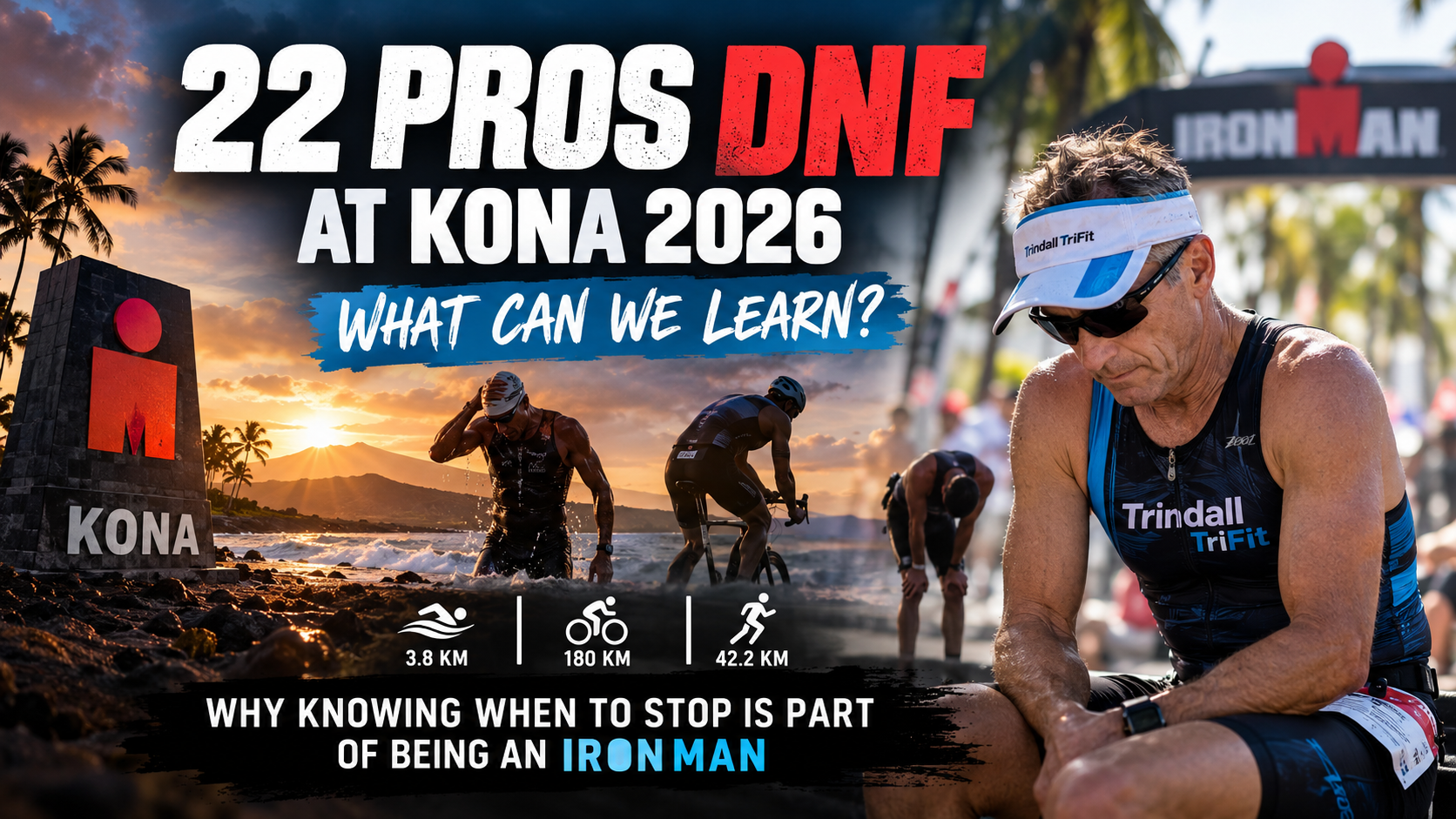
Twenty-two professional athletes failed to finish.
Eleven men and eleven women recorded a DNF (Did Not Finish) — roughly one in five of the professional field.
Among them were some of the biggest names in long-course triathlon: former Ironman World Champions, established podium contenders and athletes who had spent months preparing for arguably the biggest race of their careers.
And yet, despite their experience, preparation and extraordinary fitness, their races ended early.
For me, this story struck a particularly personal chord. Because just four months earlier, I experienced something similar at Ironman Cairns.
And after more than 40 years in triathlon, it reminded me of one of the sport's most important lessons:
Sometimes the strongest decision an athlete can make is knowing when to stop.
When the World's Best Don't Finish
Triathlete magazine published a detailed article, The 2026 Ironman World Championship DNF Files, exploring what happened to the professionals who didn't make it to Ali'i Drive.
The list included Patrick Lange, Sam Laidlow and Magnus Ditlev in the men's race, and Lucy Charles-Barclay in the women's.
The reasons were as varied as the athletes themselves:
- Patrick Lange, the 2024 champion, battled severe cramping on the bike and decided a marathon simply wasn't possible on those legs.
- Sam Laidlow withdrew on the run with symptoms of an iliac artery problem restricting blood flow to his leg.
- Magnus Ditlev led for much of the day before his body shut down late in the marathon.
- Others stopped because of illness, vomiting, migraines, sprained ankles, sciatic nerve pain and lingering foot injuries.
These aren't inexperienced competitors who underestimated an Ironman. They are among the best endurance athletes in the world — athletes who understand pacing, nutrition, hydration, preparation and the physiological demands of racing 226 kilometres.
Yet none of that guarantees a finish.
Kona is particularly unforgiving. Ocean chop, exposed roads, strong winds, heat and humidity can turn even the best race plan upside down. And at the professional level, where every second matters, the margin for error is incredibly small.
But there's another important lesson here:
You can arrive at an Ironman in exceptional physical condition and still be unable to finish. Fitness is only one part of race-day success. Your body still has to cooperate.
My Own DNF at Ironman Cairns 2026
I've been involved in triathlon since 1983. Over more than four decades, I've experienced the highs and lows that come with endurance sport. I've represented Australia, completed multiple Ironmans, won age-group races and had plenty of challenging days.
But until June 2026, I hadn't recorded a DNF since 1986.
That changed at Ironman Cairns.
I'd spent months preparing. My goal was ambitious but clear: break 10 hours and put myself in contention for Kona qualification. Training had gone well, and I arrived in Cairns believing I had the fitness to deliver.
The swim went reasonably well. I exited the water in around 1 hour 7 minutes, sitting third in my age group. Everything was still on track.
But as I ran my bike out of T1, I felt a sharp pain in my right calf.
I hoped it would settle once I started cycling. It didn't.
I kept going, hoping things would improve. But as the kilometres passed, it became increasingly obvious that something wasn't right.
At approximately 60 kilometres, I made the decision to withdraw. My Ironman was over.
The diagnosis later confirmed a Grade 2 calf tear.
After months of training, countless early mornings and a significant investment of time and energy, the race I'd worked so hard for ended before I'd even reached halfway on the bike.
It was incredibly disappointing.
But looking back, stopping was the right decision. Continuing could have turned an already significant injury into something much worse.
The Difference Between Discomfort and Injury
One of the greatest challenges in endurance sport is learning to tell the difference between normal racing discomfort and a genuine physical problem.
Let's face it — Ironman racing is supposed to be hard.
At some point during a 3.8km swim, 180km bike and 42.2km marathon, you're almost certainly going to hurt. Your legs will fatigue. Your energy will fluctuate. Your mind will question why you signed up in the first place.
That's part of endurance racing. Learning to manage those difficult moments is one of the skills that makes a successful long-course athlete.
But there's a significant difference between fatigue and injury.
Fatigue is something we train ourselves to manage. Injury is something we need to recognise and respect.
Signs that shouldn't simply be dismissed as "part of racing" include:
- Sharp or worsening pain
- Altered movement patterns or limping
- Unusual weakness in a limb
- Chest discomfort or severe breathing difficulty
- Dizziness, confusion or vision problems
- Vomiting you can't control or stopping sweating in the heat
In my case at Cairns, the calf wasn't ordinary fatigue. It was a genuine muscle injury, and no amount of mental toughness was going to change that.
As a coach, I believe this distinction is one of the most important lessons we can teach athletes. Determination is essential. But determination without judgment can be dangerous.
Are We Pushing Too Hard in Modern Ironman Racing?
One interesting question raised by the Kona withdrawals is whether athletes are now racing closer to their physiological limits than ever before.
Professional Ironman racing has changed considerably. Athletes are swimming faster, producing huge power numbers on the bike and running marathon times that would have seemed extraordinary not long ago. The depth of competition keeps growing, which creates enormous pressure to stay with the leaders, respond to attacks and race aggressively.
But Ironman remains an endurance event. You can't ignore the cumulative cost of racing for eight, nine, ten or more hours — and small mistakes early can become big problems later. Poor pacing, inadequate fuelling, dehydration, overheating or simply an off day can derail months of preparation.
Of course, we can't assume aggressive racing caused the DNFs in Kona. Each athlete had their own circumstances, and plenty were down to illness or injury. But the withdrawals reinforce just how narrow the margin between success and failure can be.
For age-group athletes, the takeaway is simple: race your own race, not somebody else's.
- You don't need to chase every athlete who passes you.
- You don't need to ride above your sustainable power because someone in your age group has gone past.
- And you certainly don't need to ignore warning signs simply because you've invested months preparing.
Smart racing is about managing the entire distance — not winning the first 90 kilometres of the bike. (If you want a practical way to check whether your pacing is sustainable in training, have a read of my post on cardiac drift.)
The Masters Athlete Perspective
At 58, my perspective on endurance sport is very different from when I started racing as a teenager.
I'm still competitive. I still set ambitious goals. And I still want to improve.
But after more than 40 years in the sport, I've learned that consistency and longevity matter enormously.
As Masters athletes, we can continue to achieve outstanding performances well into our 50s, 60s and beyond. But recovery, injury management and training consistency become increasingly important.
A decision to push through an injury might cost far more than a single race. It could mean weeks or months away from training — and that lost consistency can have a much greater impact on long-term performance than one disappointing result.
That's not an argument for racing conservatively or avoiding big goals. Far from it. I firmly believe Masters athletes should keep challenging themselves. But we need to balance ambition with intelligent decision-making.
The objective isn't simply to finish the next race. It's to remain healthy enough to keep racing for years to come.
A DNF Doesn't Define Your Season
One of the hardest parts of withdrawing from an important race is dealing with the disappointment afterwards.
When you've spent months preparing for an Ironman, the race becomes a huge focus. Training, nutrition, equipment, travel and family commitments all revolve around that one day. When it doesn't go to plan, it can feel as though all that work has been wasted.
But it hasn't.
The fitness you built doesn't disappear because you didn't cross the finish line. Neither does the experience. And one result certainly doesn't define your ability as an athlete.
After Cairns, I had to focus on recovering from the calf injury — gradually rebuilding my running and being patient with the process. I also had a hamstring setback during my return to training.
It wasn't the second half of the year I'd planned. But I kept working towards getting back on the start line.
In September, I returned to racing at QTS Round 1 Moreton Bay, finishing second in my age group. Two weeks later, at Raby Bay, I collected another silver medal.
Neither race was perfect. But both represented progress — and perhaps more importantly, they reminded me why I love this sport.
Sometimes success isn't measured by a personal best or a finishing time. Sometimes it's simply being back on the start line.
Five Lessons Every Triathlete Can Learn From a DNF
Whether you're preparing for your first sprint triathlon or your tenth Ironman, here are five lessons I think we can all take from the Kona withdrawals.
- Preparation reduces risk, but doesn't eliminate it. You can complete every session, follow your nutrition plan and arrive in excellent condition — and unexpected problems can still happen. That's endurance sport.
- Learn to recognise your body's warning signs. There's a difference between normal fatigue and symptoms that mean you should stop. Experience helps build that judgment, but no athlete should feel pressured to continue through potentially dangerous symptoms.
- Don't let one race define you. A DNF is a result. It isn't a reflection of your character, determination or ability. What matters is how you respond afterwards.
- Recovery is part of performance. Rushing back from injury often creates further setbacks. Sometimes taking a few weeks to recover properly is the fastest route back to consistent training.
- Think beyond the next finish line. Especially for Masters athletes, longevity should always be part of the bigger picture. One race matters — but being able to keep swimming, cycling and running for another decade is worth far more.
Final Thoughts: There's More to Ironman Than Finishing
When we watch the Ironman World Championship, we naturally celebrate the athletes who cross the finish line. And rightly so — completing an Ironman is an extraordinary achievement.
But I think we should also recognise the athletes whose races don't go to plan.
The professionals who withdrew in Kona didn't suddenly become less capable athletes. Their achievements, experience and commitment haven't disappeared because of one result.
The same applies to everyday age-group competitors.
My DNF at Cairns was disappointing. After four decades of racing, it certainly wasn't the result I wanted. But it reinforced something I've come to appreciate more as I've grown older:
Being a successful endurance athlete isn't just about knowing how hard to push. It's also about knowing when pushing harder is no longer the right decision.
There will always be another race. Another start line. Another opportunity to challenge yourself.
The key is making sure you're healthy enough to take it.
And at 58, with plenty more racing ambitions ahead of me, that's a lesson worth remembering.
Train smart. Race strong. Think long-term.
— Des Trindall, Trindall TriFit
Coming back from an injury or a disappointing race? You might find my posts on Project 58 and getting faster after 50 helpful — or take a look at my coaching options if you'd like help planning your comeback.
Reference: Triathlete magazine — The 2026 Ironman World Championship DNF Files (October 2026).