
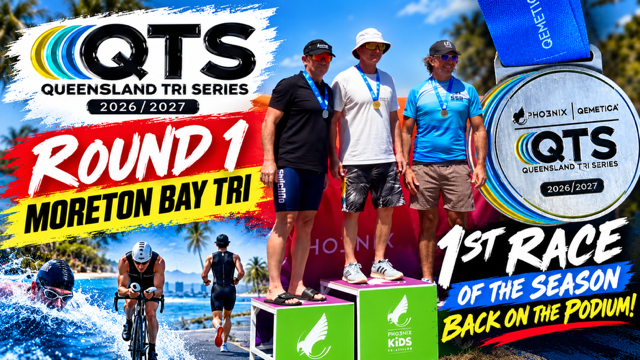
The 2026/27 Queensland Tri Series is underway, and my first race of the new season delivered a result I was very happy to take — second place in the 55–59 age group and a silver medal at QTS Round 1.
After everything that's happened over the past few months, however, this race was about much more than the result.
It was about getting back on a start line, putting together a complete race and, most importantly, seeing how the body responded.
Choosing the Sprint Distance
Round 1 of the Queensland Tri Series was held at the Moreton Bay Tri on Sunday, 27 September 2026.
There were several distances available, but I decided to start the season with the sprint:
750m swim | 20km bike | 5km run
That decision was largely based on what has happened since Ironman Cairns in June.
Cairns ended with a DNF after I suffered a Grade 2 tear in my right calf. The months since have been about rehabilitation and gradually rebuilding my training.
Then, just over two weeks before QTS Round 1, I developed some tightness in the right hamstring. That added another question mark.
I'd managed some light running before race day, but I hadn't done enough hard running to be completely confident about how the hamstring would respond at race intensity.
So rather than chase a longer distance, the sprint made sense:
- Get back out there
- Race hard where I could
- Be sensible where I needed to be
- Get a benchmark for the season ahead
(If you'd like the backstory, I wrote about the lead-up in Back on the Start Line the day before the race.)
A Great Morning for Racing
Conditions on Sunday morning were close to ideal.
We'd had considerably stronger winds around Brisbane in the days leading into the race — including during my short bike shakedown the day before — but race morning brought only a light breeze. For an early spring morning in Brisbane, it was pretty hard to complain.
I also thought the course itself was extremely well organised.
There were roughly 270–280 competitors in the sprint race, along with athletes from the other distances sharing sections of the bike course. Despite that, it never really felt congested. There was plenty of room to race safely, which made for an enjoyable start to the QTS season.
The Swim — 750m
The sprint swim was a straightforward one-lap course. We headed out from shore, turned right at the first buoy, swam parallel to the beach, made another right turn and headed back to shore.
Moreton Bay can be quite shallow, so the opening section involved a combination of wading and a few porpoise dives before getting into proper swimming depth.
Once we were underway, several of the faster swimmers got away during the opening few hundred metres. I settled onto another athlete's feet and stayed there until around the first turn buoy. From there I swam through and continued towards the second turn.
We eventually started catching athletes from the wave ahead, which made it a little harder to keep track of exactly where everyone in my wave was.
Coming out of the water, though, I was second in my age group and approximately 50 seconds behind the age-group swim leader.
More importantly, the swim had felt comfortable and controlled. For the first race of the season, that was exactly what I wanted.
T1 — Keeping Things Simple
I had deliberately positioned my bike in transition so it would be easy to find.
Rather than trying to remember exactly which row or rack I was on while coming out of the water with an elevated heart rate, I could simply follow the fence around and effectively run straight to it.
Wetsuit off. Helmet on. Grab the bike. And out onto the course.
Simple and effective.
Coaching tip: When you set up transition, pick a rack position you can find without thinking — a fence line, a tree, the end of a row. After a hard swim, your brain isn't at its best. Make it easy.
The Bike — 20km
The bike consisted of two laps.
Coming out of transition, we headed towards the bridge and immediately encountered a gradual incline. I wouldn't describe it as a climb, but it's enough to push the heart rate up — particularly when you've just come out of the swim and are trying to settle onto the bike.
The course then takes you most of the way across the bridge before a hairpin turn sends you back down, past the transition area and towards another turnaround. Then it's back around to begin lap two.
There were athletes from the standard-distance event already on the course, and later we started mixing with competitors from the Enticer event. Even with the different races overlapping, I never felt as though the course became dangerously crowded. There was plenty of space to ride and concentrate on getting the work done.
After the uncertainty of the previous few weeks, the bike was also an opportunity to simply race rather than spend the whole time thinking about the hamstring.
The real test was still coming.
T2 — And the Big Question
Coming back into transition, I racked the bike, took the helmet off and sat down to put my running shoes on.
Yes, I sit down these days. Sometimes experience teaches you that a couple of seconds isn't worth falling over in transition!
Shoes on, race belt, cap and sunglasses — and out onto the run.
This was the part of the race I was most uncertain about.
The Run — 5km and a Different Race Plan
The hamstring issue had started around two weeks earlier. I'd rested it, tested it with some light running and thought things were improving.
But during an indoor bike session in race week, I attempted a short 1km transition run and felt it tighten again. I stopped immediately.
From there, running into race day was deliberately conservative. A couple of short, easy runs told me that I could run, but I hadn't tested the hamstring properly at race pace.
That meant Sunday's 5km couldn't be approached like a normal sprint triathlon run.
The first priority was getting through the opening couple of kilometres without aggravating it.
Rather than charging out of T2, I kept the opening section firm but controlled and allowed the hamstring time to settle.
The course runs alongside the bike course before heading up the incline onto the bridge. That climb was one of the sections I was particularly interested in, because the change in load could potentially have exposed the hamstring.
Fortunately, it didn't.
By around the 2km mark, the hamstring was actually starting to loosen up.
That's when the race changed.
Finally Able to Open the Stride
Once I became more confident that the hamstring was going to behave itself, I gradually increased the pace. The final couple of kilometres felt much more like running again.
I was able to open my stride and bring the pace down towards the 4:20/km range, with the closing section a little quicker again.
After spending the first part of the run wondering what the hamstring might do, finishing strongly was probably one of the most encouraging parts of the entire race.
It wasn't simply about the pace. It was about being able to increase the load late in the run and have the leg respond.
The lesson for returning athletes: You don't have to race the whole thing at 100% to have a successful comeback race. A controlled start, a check-in with the body and a progressive build is a smart way to race when you're carrying a niggle — and you'll often finish faster than you expect.
Second Place — Back on the Podium
I crossed the finish line second in the 55–59 age group, giving me a silver medal to start the 2026/27 Queensland Tri Series.
I'll happily take that.
The winner put more than five minutes into me, so there's certainly no shortage of work to do! But that's also what makes the season interesting.
This wasn't the race where everything needed to be perfect. It was the first race back.
After the calf tear at Cairns, the rehabilitation that followed and then the hamstring issue immediately before this event, getting through all three disciplines and finishing strongly was a significant step forward.
And coming away with a podium was a pretty nice bonus.
The Bigger Goal: Queensland Tri Series 2026/27
The Queensland Tri Series gives us a full season of racing rather than everything hinging on one event.
I'm racing the 55–59 age group, having turned 58 just seven days before Round 1.
The series consists of multiple rounds, with the best five results contributing towards the overall series points. That creates an interesting challenge. It's not simply about producing one great race — it's about consistency across the season.
Staying healthy will therefore be one of the biggest priorities from here.
After what happened with the calf and then the hamstring, I'll continue working on strength, mobility and flexibility — particularly through that right leg — while gradually rebuilding the running load.
There's a long season ahead.
Next Stop: Raby Bay
There's not much time to celebrate Round 1, because the next race is already approaching.
QTS Round 2 at Raby Bay is next, this time over:
900m swim | 24km bike | 6km run
It's another opportunity to build on what we learned at Moreton Bay.
The goal between now and then isn't to suddenly find huge amounts of fitness. It's to recover properly, keep the hamstring happy and arrive at the next start line ready to put together another solid race.
Round 1 gave me something I'd been waiting several months for:
A complete race.
And it finished with a silver medal.
Not a bad way to start the season.
Watch the Full Race Review
I've also put together a full video review of QTS Round 1, where I talk through the swim, bike and run, the course itself, the hamstring concerns coming into the event and how the race unfolded.
Watch the full QTS Round 1 race review on my YouTube channel
For more age-group triathlon content, training advice and free resources, keep exploring Trindall TriFit.
Train smarter. Race stronger. Keep showing up.
— Des Trindall, Trindall TriFit