Can you really get faster at triathlon after 50?
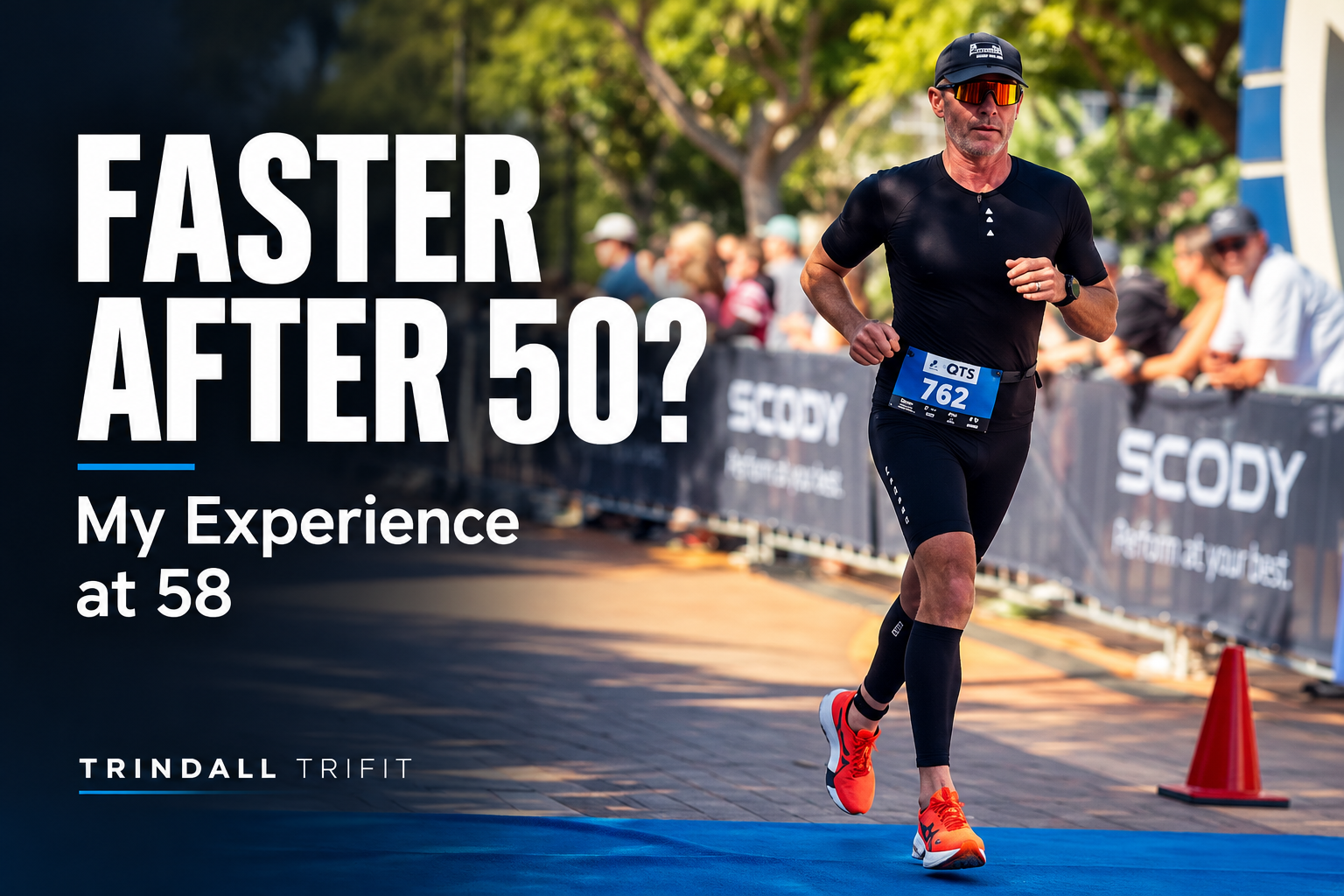
It's a question I hear regularly, and having recently turned 58, my answer is a definite yes.
But there's an important qualification.
You probably won't get faster by training exactly the same way you did in your twenties or thirties.
You need to understand how your body responds to training, recognise the importance of recovery and, perhaps most importantly, learn to train smarter rather than simply training more.
After more than 40 years in triathlon, I'm still learning. And despite being 58, I'm certainly not finished chasing faster race times.
My Triathlon Journey: From 1983 to Today
My involvement in triathlon began back in 1983, when I was just 13 years old.
Triathlon was still a relatively new sport in Australia. Equipment was basic compared with what we have today, training knowledge was limited, and we certainly didn't have GPS watches, power meters or sophisticated training platforms.
We trained, raced, experimented and learned through experience.
Over the following decades, I've competed across everything from sprint-distance events through to Ironman. I've represented Australia at age-group level, completed multiple Ironman events and experienced just about every high and low that endurance sport can deliver.
But one of the most interesting chapters of my triathlon journey has been my return to competitive racing in my mid-fifties.
And it's taught me something important:
Getting older doesn't automatically mean you have to stop improving.
Returning to Competitive Racing After 50
When I returned to regular competitive triathlon, I wasn't interested in simply turning up and completing events. I wanted to see what I could still achieve.
- Could I rebuild my aerobic fitness?
- Could I improve my cycling power?
- Could I become a more efficient runner?
- And perhaps most importantly, could I still race competitively against athletes in my age group?
The answer has been encouraging.
During the 2025–26 season, I achieved nine podium finishes from nine races and won the Queensland Triathlon Series age-group championship. I was also selected for the Australian Age Group Triathlon Team.
Those results weren't achieved by trying to replicate the training volume I managed when I was younger. They came from a more structured approach to training, with a greater understanding of intensity, recovery and consistency.
At 58, I still have ambitious racing goals. But the way I approach achieving them has changed considerably.
1. Ageing Doesn't Mean You Stop Adapting to Training
One of the biggest misconceptions about endurance sport is that once you reach 50, your fitness can only decline.
That's simply not how the body works.
Yes, physiological changes occur as we age. Maximum heart rate generally decreases, muscle mass can decline, and recovery from demanding sessions may take longer. VO₂ max — the body's maximum capacity to utilise oxygen during exercise — also tends to decline with age.
But here's the important part: your body retains the ability to adapt to training well beyond 50.
- Aerobic endurance can improve.
- Muscular strength can increase.
- Cycling power can develop.
- Running economy can improve.
- Swimming technique can become more efficient.
The extent of those improvements depends on factors including training history, current fitness, health, recovery and consistency.
For athletes returning to the sport after several years away, the potential improvements can be substantial. For those who have trained consistently for decades, improvements may be smaller and harder earned.
But improvement remains possible.
2. Zone 2 Training Has Become the Foundation of My Training
If there's one area where my approach has evolved significantly, it's how I use lower-intensity aerobic training.
Years ago, like many endurance athletes, I probably spent too much time training at a moderately hard intensity — not quite easy enough to maximise recovery, but not always hard enough to produce the specific adaptations I was chasing.
Today, a substantial proportion of my cycling and running is performed at Zone 2 intensity. This is a relatively comfortable aerobic effort where breathing remains controlled and conversation is generally possible.
The benefits include developing aerobic endurance, supporting mitochondrial adaptations and improving the body's ability to sustain prolonged exercise.
For masters athletes, there's another significant advantage. Lower-intensity sessions generally create less fatigue than repeated high-intensity workouts, which makes it easier to train consistently throughout the week.
And consistency is something I've come to value enormously.
One excellent training session means very little if it leaves you unable to train properly for the following five days.
3. You Still Need Intensity to Get Faster
While aerobic endurance forms the foundation of my training, that doesn't mean I've abandoned harder sessions. Quite the opposite.
I still include structured intervals across swimming, cycling and running:
- Bike: longer efforts around threshold intensity, or shorter intervals designed to improve power
- Swim: regular sets of 50, 100 and 200-metre repetitions
- Run: intervals approached more cautiously, particularly following my recent injury setbacks
The purpose of these sessions is to provide a specific training stimulus. Higher-intensity training can help maintain or improve VO₂ max, threshold performance and the ability to sustain faster race speeds.
But the important distinction is that I no longer believe every session needs to feel hard to be effective.
The objective isn't to finish every workout exhausted. It's to produce the adaptation you're looking for.
For masters athletes, balancing intensity with sufficient recovery becomes increasingly important.
4. Recovery Is Part of Training, Not Time Away From Training
One of the biggest changes I've noticed as I've become older is the importance of managing recovery.
When you're younger, it's sometimes possible to get away with poor training decisions. You might complete a demanding interval session, back it up with another hard workout the following day and somehow manage to keep going.
At 58, I'm far more conscious of the cumulative fatigue that training creates.
That doesn't mean I need several days off after every demanding session. It means I pay closer attention to how sessions are distributed throughout the week.
I monitor factors such as resting heart rate, heart rate variability, perceived fatigue and how my legs respond during training.
But I don't rely exclusively on technology. Sometimes the most useful information comes from simply recognising how your body feels.
If I'm unusually fatigued, there's little benefit in forcing a hard session simply because it's written into the training plan.
Training plans should provide structure. They shouldn't remove common sense.
5. My Biggest Challenge Has Been Managing Running Injuries
If there's one area where I've had to become more conservative, it's running.
Cycling and swimming generally allow me to accumulate substantial aerobic training without the same repetitive impact associated with running. Running is different.
During Ironman Cairns in June 2026, I suffered a grade-two right calf tear that forced me to withdraw from the race. It was my first DNF in approximately 40 years of racing.
After working through rehabilitation and gradually returning to running, I subsequently experienced some right hamstring tightness.
Those setbacks reinforced something I've been learning for several years: more running isn't necessarily better running.
I've found that once my long runs extend beyond approximately two hours, my injury risk appears to increase. That's my personal experience rather than a universal limit for masters athletes — but it's an important consideration when designing my training.
Instead of chasing running mileage for its own sake, I'm increasingly focused on getting the most benefit from the running I can consistently tolerate. That means combining aerobic endurance runs with carefully managed faster sessions, and using cycling to develop additional aerobic fitness.
My priority is arriving at the start line healthy. Because there's no point having outstanding fitness if you're unable to race.
6. Cycling Is a Major Advantage for Masters Triathletes
One of the great things about triathlon is that we don't need to rely entirely on running to develop our cardiovascular fitness.
Cycling provides an excellent opportunity to build aerobic endurance while avoiding much of the impact associated with running, and it has become a particularly valuable part of my training.
I use indoor sessions to control power and intensity precisely, while outdoor rides allow me to build endurance and practise holding an aerodynamic position.
A power meter also provides objective feedback. Rather than guessing whether I'm improving, I can compare power output, heart rate and perceived effort across similar sessions.
For example, producing the same cycling power at a lower heart rate can be an encouraging sign of improved aerobic efficiency, provided factors such as temperature, fatigue and hydration are comparable. (I explain this in more detail in my post on cardiac drift.) Likewise, sustaining higher power for the same duration can indicate improved performance.
The key is looking at trends over time rather than drawing conclusions from one workout.
7. Strength Training Becomes Increasingly Important
If I could go back and change one aspect of my earlier training, I would probably place greater emphasis on consistent strength work.
As we age, maintaining muscle mass and strength becomes increasingly important. For triathletes, strength training can support muscular capacity, movement control and resilience — and help counteract age-related declines in muscle strength.
My current approach includes relatively short strength and mobility sessions throughout the week.
I'm not trying to become a bodybuilder. I'm trying to maintain the strength required to swim, cycle and run efficiently while reducing unnecessary physical limitations.
The challenge is fitting strength work around endurance training without creating excessive fatigue. Like everything else, it needs to be managed intelligently.
8. Training Smarter Means Understanding Your Own Body
After more than four decades in triathlon, one of the biggest lessons I've learned is that there is no single training formula that works for everyone.
Two athletes of the same age can respond very differently to identical training programs.
- One athlete might tolerate five running sessions each week. Another might achieve better results with three runs supplemented by additional cycling.
- One athlete may recover quickly from threshold intervals. Another may require more recovery between demanding sessions.
Training history, genetics, lifestyle, sleep, injury history and available training time all influence how an athlete responds.
That's why I believe masters athletes need to move beyond simply following generic training programs. You need to understand what works for you — and perhaps more importantly, recognise what doesn't.
9. My Goals Haven't Become Smaller at 58
One thing that hasn't changed with age is my competitive mindset.
I still enjoy training. I still enjoy racing. And I still enjoy seeing whether I can improve.
My current journey, which I've called Project 58, is focused on continuing to compete at a high level in age-group triathlon.
One of my major objectives is the T100 Gold Coast in March 2027:
2km swim | 80km bike | 18km run
My goal is to finish inside the top 10 in my age group and put myself in contention for qualification for the T100 World Championship.
It's an ambitious target. But I don't see any reason why being 58 should prevent me from setting ambitious goals.
The challenge is developing the fitness required while remaining healthy enough to train consistently. That balance is something I'm continually refining.
10. So, Can You Really Get Faster After 50?
Absolutely.
But I think it's important to define what getting faster actually means.
- For someone returning to triathlon after a long break, it might mean improving their 5km run time by several minutes.
- For an experienced athlete, it might mean increasing cycling power, improving swimming efficiency or producing a faster overall race despite running fewer kilometres in training.
- For others, success might simply mean maintaining competitive performance well into their sixties.
Not everyone will set lifetime personal bests after 50. Age-related physiological changes are real, and athletes who have trained consistently at a high level for decades may find absolute improvements increasingly difficult.
But that doesn't mean progress stops.
There are always opportunities to improve technique, pacing, nutrition, training structure and race execution — and those improvements can make a significant difference to overall performance.
My Five Key Lessons for Triathletes Over 50
If I had to summarise what I've learned, it would come down to five principles:
- Build your aerobic foundation. Consistent lower-intensity training remains one of the most valuable components of endurance performance.
- Keep some intensity in your program. Age doesn't mean you should abandon harder training. It means you need to manage it appropriately.
- Prioritise recovery. Fitness develops through the combination of training stress and adaptation. Both matter.
- Don't chase training volume for the sake of it. More isn't automatically better. The right amount of training is the amount you can recover from and sustain.
- Keep setting goals. Whether you're chasing a podium finish, your first sprint triathlon or simply trying to improve your fitness, having something to work towards provides motivation and direction.
Final Thoughts: Age Is a Factor, Not a Finish Line
When I started racing triathlons in 1983, I certainly wasn't thinking about what my performances might look like at 58.
Back then, I was simply a young athlete who enjoyed swimming, cycling, running and competing.
More than 40 years later, that enjoyment hasn't disappeared. If anything, I probably appreciate the opportunity to train and race more than ever.
I've experienced some fantastic results, plenty of setbacks and a few lessons learned the hard way. And I'm still learning.
The biggest difference today is that I have a much better understanding of the importance of balancing ambition with recovery.
I still want to get faster. I still want to compete. And I still have goals that genuinely excite me.
Because turning 50, 60 or even 70 doesn't mean you have to stop challenging yourself. It simply means you may need to approach those challenges a little differently.
And as far as I'm concerned, that's part of what makes the journey interesting.
See you at the next race.
— Des Trindall, Trindall TriFit
New to the sport or coming back after a long break? Start with my beginner's guide to triathlon after 50. And if you'd like a program built around your body, your history and your goals, take a look at my coaching options.
SCODY Ambassador 2026/27 | Australian Age Group Triathlon Representative