One of the questions I hear regularly from triathletes is:
"Is riding indoors actually as effective as riding outside?"
With platforms such as MyWhoosh making indoor training more accessible and engaging, it's a fair question.
If you only have 60–90 minutes available, should you jump on the indoor trainer, or are you better off getting outside on the road?
For most age-group triathletes, the answer is pretty simple:
A well-structured 90-minute indoor ride can be every bit as effective as 90 minutes outdoors — and for some sessions, it can actually be better.
But there are also things an indoor trainer simply can't teach you.
The Big Advantage: Training Density
One of the biggest differences between indoor and outdoor cycling is how much actual work you complete.
Ride outside for 90 minutes and you'll probably encounter some combination of:
- Traffic lights
- Intersections
- Descents
- Corners
- Traffic
- Pedestrian crossings
- Periods of coasting
None of those things are necessarily bad. They're simply part of riding outside.
Indoors, however, 90 minutes usually means something very close to 90 minutes of continuous pedalling.
That gives indoor cycling extremely high training density.
If you're prescribed 90 minutes of Zone 2, for example, an indoor trainer allows you to sit on the required power and simply get the work done. There are very few interruptions and very little wasted time.
For a busy age-group athlete, that's incredibly valuable.
Indoor Training Is Brilliant for Controlled Sessions
Where indoor cycling really shines is structured training.
If I'm trying to complete something like:
15-minute warm-up → 3 × 15–20 minutes at a prescribed power → recovery → cool-down
the trainer is almost the perfect environment.
I can control the power. I can control the cadence. I can control the recovery. And I can repeat the session later and compare the results.
That makes indoor training particularly useful for:
- Zone 2 endurance
- Sweet spot training
- Threshold work
- VO₂ intervals
- FTP development
- Cadence work
- Race-power intervals
There's no searching for the perfect stretch of road and no interval being interrupted halfway through because you've hit a red light.
You just ride.
Ninety Minutes Indoors Can Be Harder Than Ninety Minutes Outside
This is something athletes often underestimate.
Indoor cycling can feel significantly harder than riding outdoors at the same average power. There are several reasons:
- You're pedalling continuously.
- You don't get the little periods of recovery that naturally occur outside.
- Cooling is usually much poorer indoors.
- You're sitting in almost exactly the same position for extended periods.
That combination creates a substantial cardiovascular and muscular load.
It's why I consider a good fan almost mandatory for serious indoor training.
Hydration matters as well. Don't make the mistake of thinking that because you're not out in the Queensland sun, you don't need to drink. Without airflow, sweat rates indoors can be surprisingly high. For anything over an hour I'll have at least one full bottle — often with electrolytes — and a towel within reach.
The same goes for fuelling. A 90-minute indoor session with solid intervals still deserves carbohydrate, and it's a great opportunity to practise your race nutrition in a controlled setting.
What the Indoor Trainer Can't Teach You
This is where outdoor riding still earns its place in every triathlete's program.
The trainer is fantastic at building the engine. But on race day you don't just need an engine — you need to know how to drive the car.
Things that only really develop outdoors include:
- Bike handling — cornering, braking, descending and riding confidently on rough or wet roads
- Holding your aero position in real conditions — crosswinds, head winds, road vibration and fatigue all make it harder than it feels on the trainer
- Pacing on variable terrain — managing power up rises, over the top and into the wind, rather than on a perfectly smooth virtual road
- Eating and drinking on the move — grabbing a bottle or a gel while staying stable and aero is a skill in itself
- Race awareness — riding safely around other athletes, staying legal on drafting zones, and dealing with turnarounds and transitions
- Mental resilience — heat, wind and uncomfortable conditions build a toughness that a fan and a screen can't fully replicate
I've seen plenty of athletes arrive at a race with excellent indoor numbers, only to lose time on the corners, turnarounds and windy sections because they simply hadn't spent enough time on the road.
Race-Specific Preparation: Using Both
The smartest approach isn't choosing one over the other. It's using each for what it does best.
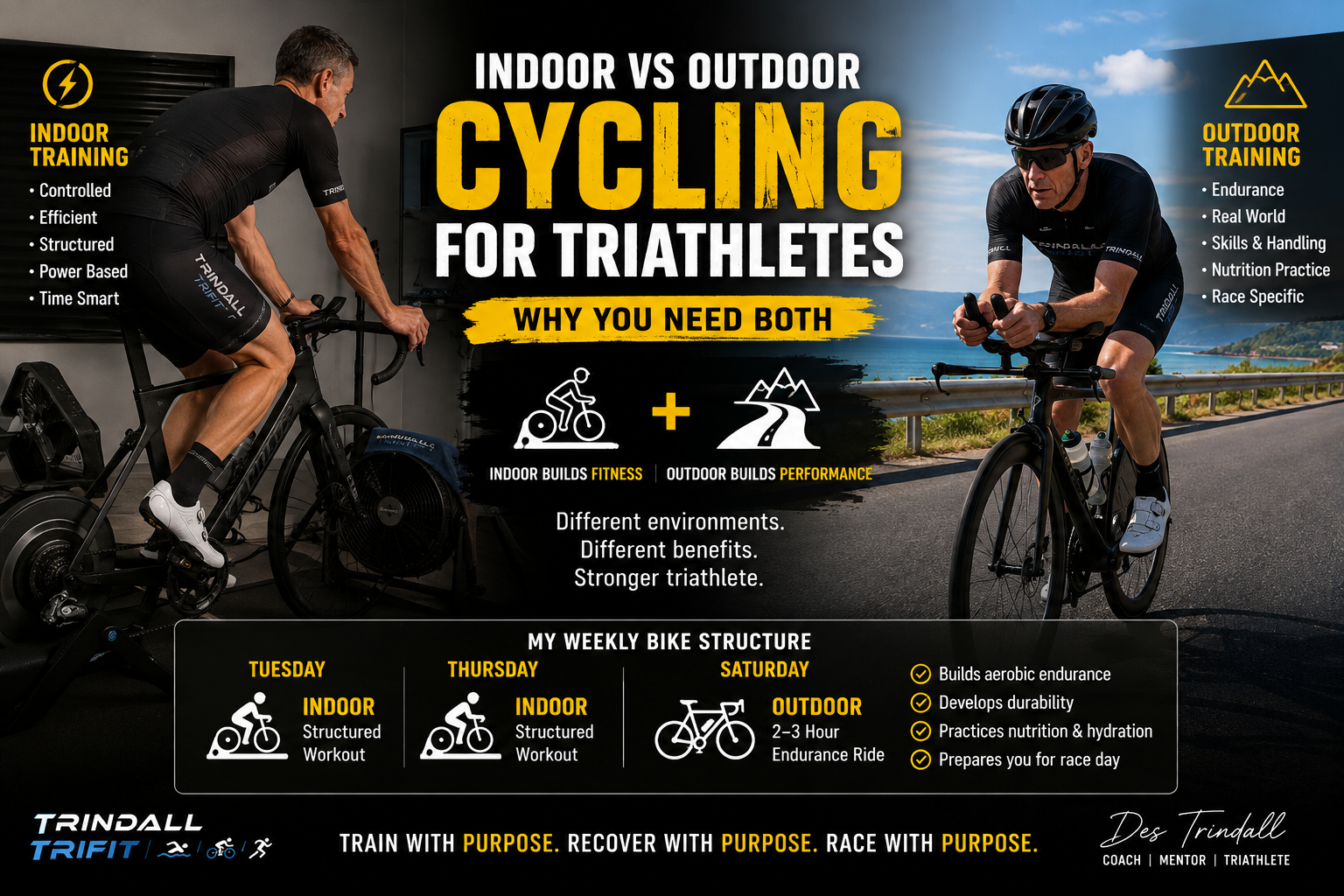
A typical week for me — balancing shift work, family and training — looks something like this:
- Midweek quality sessions indoors — intervals, threshold or race-power work where control matters most
- Midweek Zone 2 indoors when time is tight — high training density with no wasted minutes
- The long ride outdoors — building endurance, practising nutrition and developing real-world skills
- At least one ride on the race bike, in race setup, outdoors in the weeks leading into a race — race wheels, aero position and race-day equipment all tested on the road
As a race gets closer, I shift more of my riding outdoors, ideally on terrain similar to the course. Indoor training builds the fitness; outdoor riding makes sure you can actually use it on race day.
My Recommendation for Age-Group Triathletes
If you're short on time, don't feel guilty about riding indoors. A focused 60–90 minutes on the trainer is almost always better than a rushed, interrupted ride on busy roads — and often safer too.
But don't let the trainer become the only place you ride.
Aim to get outside at least once a week, and more often as race day approaches.
In short:
- Build the engine indoors
- Control your key sessions indoors
- Prepare for your race with both
- Develop real-world skills outdoors
Get that balance right and you'll arrive on race day with the fitness and the confidence to use it.
If you'd like help structuring your indoor and outdoor training around a busy life, check out my coaching options or explore the free resources here at Trindall TriFit.