If you're over 50 and thinking about doing your first triathlon, you're not alone.
Every week I receive messages from people in their 50s who are looking to get healthier, lose some weight, and challenge themselves with something new. Many of them tell me the same story: life got busy, careers took priority, families came first, and somewhere along the way fitness slipped down the list.
I understand — because I've been there myself.
At 57 years old, I've been involved in triathlon on and off for more than 40 years. My first triathlon was back in 1983, but there have been several periods throughout my life where training stopped, weight crept up, and fitness disappeared. Like many people, I found myself over 100kg and wondering how to get back to feeling healthy and energetic again.
The good news?
It's absolutely possible to start triathlon after 50.
The Biggest Mistake Beginners Make
One of the most common mistakes I see is people starting with too much enthusiasm.
Motivation is great, but motivation alone often leads people to train too hard, too often, and without any real structure. Before long they're injured, exhausted, or have simply lost interest.
The secret isn't motivation.
The secret is consistency.
You don't need perfect training sessions. You don't need expensive equipment. You don't need to train like a professional athlete.
You simply need to show up regularly and keep moving forward.
Before You Begin
Before starting any exercise program, especially if you've been inactive for a while, I strongly recommend visiting your doctor.
Have a health check-up, get some blood work done, and make sure there are no underlying health issues that need attention. Remember, we're not 20 years old anymore and it's important to start safely.
I also recommend investing in a simple heart rate monitor, or using an Apple Watch if you already own one. Monitoring your heart rate will help ensure you're training at the right intensity — and for masters athletes, that's one of the most important things you can get right.
Focus on Zone 2 Training
One of the most important concepts for beginner triathletes is learning to train easy.
Around 80% of your training should be completed at an easy aerobic effort, often referred to as Zone 2 training. This develops your aerobic base, improves endurance, and significantly reduces injury risk.
In fact, during your first few weeks, I'd suggest almost all of your training stays in Zone 2. The goal is not speed.
The goal is building routine.
If you're not sure what your zones are, my free heart rate zone calculator will work them out for you in a couple of minutes.
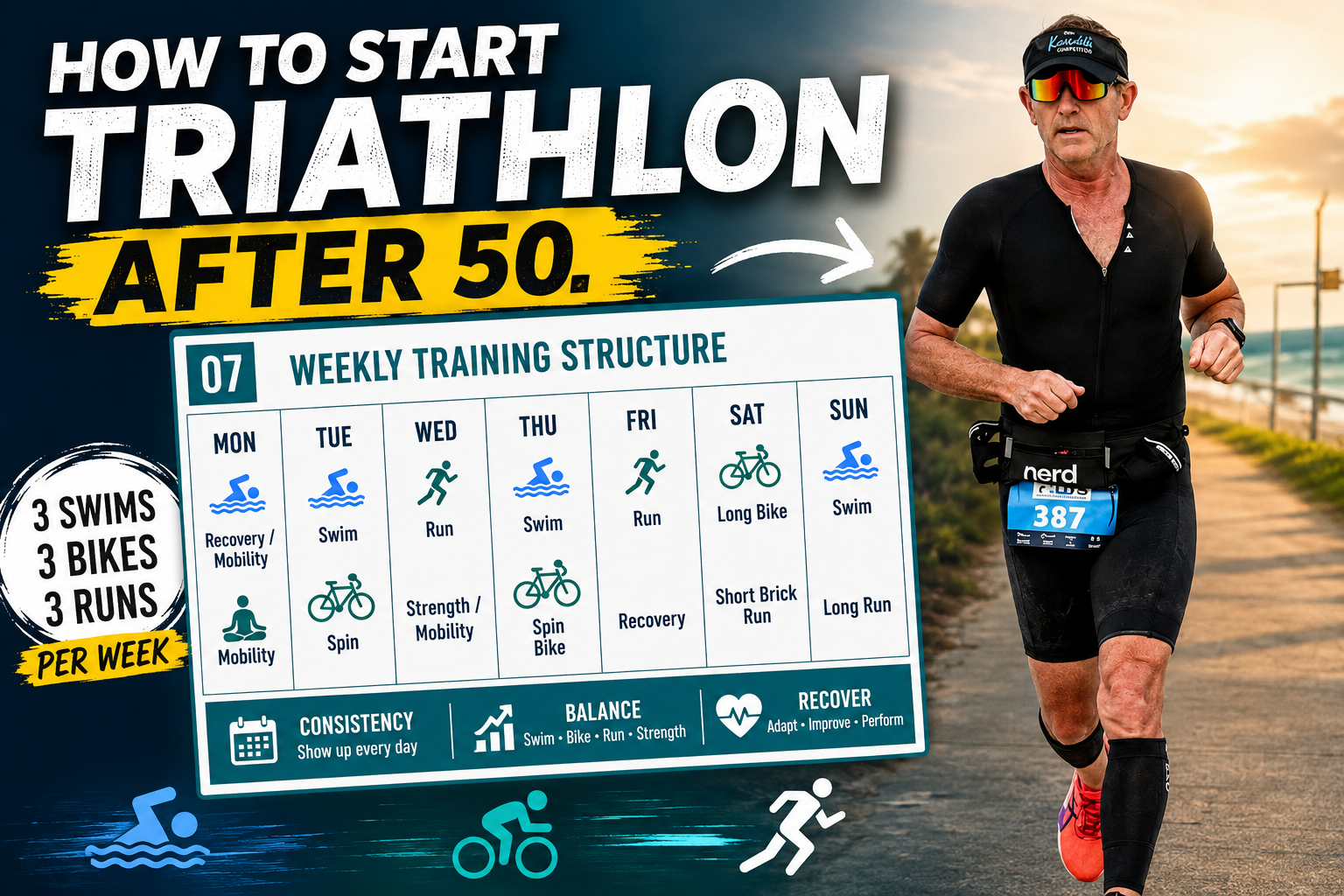
A Simple Weekly Training Structure
For most beginner triathletes over 50, I recommend:
- 3 swims per week
- 3 bike rides per week
- 3 runs per week
Each discipline should have a slightly different focus.
Swimming
- One technique session
- One aerobic endurance session
- One moderate effort session
Cycling
- Mostly aerobic riding
- Gradually increasing duration
- Building endurance and confidence
Running
- Keep it easy
- Build gradually
- Walk when needed
Running is where most injuries occur, so patience is critical. If your heart rate climbs too high, simply slow down or walk until it comes back under control. There's absolutely nothing wrong with run-walk intervals when starting out — in fact, for most beginners over 50, they're exactly the right approach.
Build in Phases
Rather than looking at your entire triathlon journey all at once, break it into manageable blocks.
Phase 1: Foundation (Weeks 1–4)
Focus on:
- Building consistency
- Establishing routine
- Easy aerobic training
Phase 2: Build (Weeks 5–8)
Focus on:
- Increasing training volume
- Adding some moderate intensity
- Improving endurance
Phase 3: Race Preparation (Weeks 9–12)
Focus on:
- Race-specific training
- Building confidence
- Practising race-day skills
At the end of every three-week build period, reduce your training volume by around 30–40% for one week. This recovery week allows your body to adapt and become stronger.
"Fitness isn't built during training itself — it's built during recovery."
Want the detail on how this works? I've written a full training periodisation guide that breaks it all down.
Don't Try to Make Up Missed Sessions
Life still happens after 50.
Work, family commitments, travel, and unexpected events will occasionally force you to miss training sessions.
That's okay.
One of the biggest mistakes athletes make is trying to "catch up" on missed workouts. Simply accept the missed session and move on to the next one. Long-term consistency matters far more than any single workout.
Example Weekly Schedule
| Day | Session |
|---|---|
| Monday | Recovery — mobility, stretching, or a gentle walk |
| Tuesday | 🚴 Bike ride (morning) + 🏊 Swim (lunchtime) |
| Wednesday | 🏃 Run + strength and mobility work |
| Thursday | 🚴 Bike ride + 🏊 Swim |
| Friday | 🏃 Run + recovery work |
| Saturday | 🚴 Long Zone 2 bike ride (beginners can skip the brick run initially) |
| Sunday | 🏊 Open water swim + 🏃 Long run |
Three swims, three bikes, three runs — with recovery and strength woven through the week. Simple, repeatable, and sustainable.
Why Triathlon After 50?
For me, triathlon has never really been about racing.
It's about:
- Maintaining health
- Managing weight
- Improving mental wellbeing
- Staying active as we age
- Being part of a supportive community
The podiums, medals and race results are nice, but they're not the real reward.
The real reward is feeling stronger, healthier and more capable than you did a year ago.
Final Thoughts
If you're over 50 and considering your first triathlon, remember this:
Consistency beats perfection.
You don't need to train like an elite athlete.
You don't need the latest equipment.
You don't need to be fast.
You simply need to start.
Three swims, three bikes and three runs each week, performed consistently over time, can completely transform your health and fitness.
The goal isn't just crossing a finish line.
The goal is creating a healthier, stronger version of yourself.
Ready to Take the First Step?
If you'd like a hand getting started, I offer a free 30-minute consultation — a no-pressure chat about your goals, your starting point, and how to build a plan that fits your life.
You can also explore my free resources for training tools, heart rate calculators and beginner guides, or grab my free 8-week sprint plan to get moving today.
Let me know in the comments — are you thinking about your first triathlon after 50? What's holding you back? I read and reply to every one.