Have you ever been halfway through a long run or ride and noticed something strange?
Your pace hasn't changed. Your bike power is almost identical. The terrain is similar.
But your heart rate keeps creeping upwards.
That's cardiac drift — and for endurance athletes, understanding it can tell you a lot about your aerobic fitness, pacing, hydration and ability to handle longer events.
What Is Cardiac Drift?
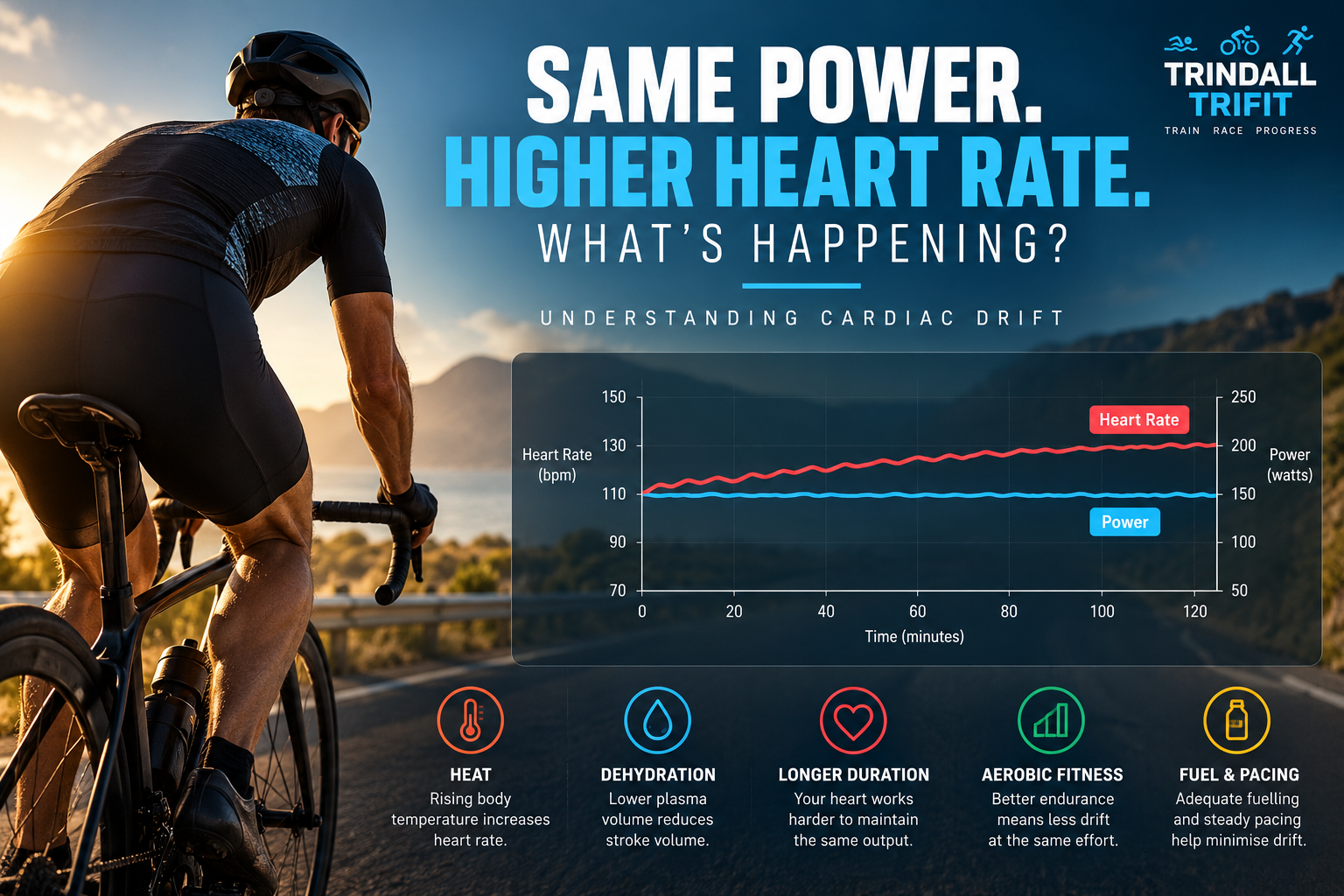
Cardiac drift, sometimes called cardiovascular drift, is the gradual increase in heart rate that can occur during prolonged steady-state exercise, even though your external workload — such as running pace or cycling power — remains relatively constant.
Imagine riding for 90 minutes at a steady 170 watts.
During the first 20 minutes your heart rate might sit around 120 bpm. An hour later you're still producing 170 watts, but your heart rate has climbed to 130 bpm.
Nothing obvious has changed with the workload, but internally your body is working harder to maintain it.
That difference is cardiac drift.
Why Does It Happen?
One of the major factors is body temperature.
As exercise continues, particularly in warm conditions, more blood is directed towards the skin to help dissipate heat. At the same time, sweating can progressively reduce plasma volume if fluid losses aren't replaced.
This can reduce the amount of blood pumped with each heartbeat — known as stroke volume.
To maintain cardiac output, your heart compensates by beating faster.
So while the Garmin might still show the same pace or power, the physiological cost of producing that performance has increased.
The main contributors are:
- Heat — rising body temperature increases heart rate
- Dehydration — lower plasma volume reduces stroke volume
- Duration — the longer you go, the harder your heart works to maintain the same output
Fitness Also Matters
This is where cardiac drift becomes particularly useful for endurance athletes.
A well-developed aerobic system should allow you to maintain a moderate workload for a considerable period without a major increase in cardiovascular strain.
If your heart rate climbs rapidly during what should be an easy endurance session, it may indicate that the intensity is too high for your current aerobic fitness.
Conversely, being able to hold the same pace or power with relatively little heart-rate drift can be a good sign that your aerobic durability is improving.
That makes cardiac drift a useful tool for assessing your Zone 2 training.
An Example
Suppose you complete a two-hour endurance ride averaging 175 watts.
| Average Power | Average Heart Rate | |
|---|---|---|
| First hour | 175 W | 120 bpm |
| Second hour | 175 W | 127 bpm |
Power hasn't changed, but heart rate has increased by around 6%.
That tells us that maintaining 175 watts became progressively more demanding.
Now imagine repeating a similar session several weeks later under comparable conditions:
| Average Power | Average Heart Rate | |
|---|---|---|
| First hour | 175 W | 120 bpm |
| Second hour | 175 W | 122 bpm |
That's a very different picture — less than 2% drift.
Your heart rate has remained much more stable despite producing the same external workload. Provided conditions are comparable, that's a useful indication that your aerobic efficiency and durability may have improved.
The 5% Guideline
You'll sometimes hear endurance coaches talk about keeping aerobic decoupling or cardiac drift below approximately 5%.
It's a useful guideline rather than a hard physiological law.
If you're completing a steady endurance session and the relationship between heart rate and pace or power changes by less than around 5%, that's generally a good sign that the intensity is sustainable.
Significantly greater drift may suggest several possibilities:
- the intensity was slightly too high
- your aerobic endurance at that workload needs development
- heat affected the session
- dehydration contributed
- accumulated fatigue played a role
- you simply haven't yet developed the durability to hold that workload efficiently for that duration
That's why context matters.
Cardiac Drift vs Aerobic Decoupling
The two terms are often used interchangeably, but they're slightly different.
Cardiac drift refers specifically to heart rate gradually increasing during prolonged exercise.
Aerobic decoupling looks at the changing relationship between your external output — pace or power — and your heart rate.
For athletes using power meters and GPS watches, aerobic decoupling can be particularly useful. You're not simply asking:
"Did my heart rate increase?"
You're asking:
"Did the physiological cost of producing the same performance increase?"
That's a much more useful question.
Why Triathletes Should Pay Attention
Cardiac drift becomes especially important as race distance increases.
In a sprint triathlon, you expect to race at a relatively high intensity and heart rate. But for Olympic-distance, middle-distance and particularly Ironman racing, controlling the physiological cost of the bike becomes critical.
You might feel fantastic early in a long ride and push slightly above your sustainable intensity. The power numbers look good. Speed looks good. Everything feels easy.
But two hours later, your heart rate is climbing despite holding the same watts.
By the time you reach the run, you've potentially paid a much larger physiological price than the power numbers alone suggested.
That's why endurance racing isn't simply about producing power.
It's about producing sustainable power.
Don't Chase Heart Rate Blindly
There's another important point.
If your heart rate begins drifting upwards during a long session, that doesn't automatically mean you should continually reduce power or pace to force your heart rate back to its starting number.
Heart rate naturally responds to heat, hydration, fatigue, caffeine, stress and environmental conditions. (It's also one reason why your zones need to be right in the first place — I covered that in Are Your Heart Rate Zones Wrong?)
Instead, use it alongside the other two pieces of the puzzle:
Power or pace + heart rate + perceived exertion
Together, those three metrics provide a much better picture of what's happening.
If power is steady, heart rate is gradually rising and perceived exertion is also increasing considerably, that's useful information. Your body is telling you the workload is becoming more expensive.
How Can You Reduce Cardiac Drift?
There isn't a magic workout.
The biggest factor is consistent aerobic training. Regular Zone 2 work improves your ability to sustain an aerobic workload efficiently for longer periods.
For triathletes, that means plenty of controlled endurance riding and running rather than turning every session into a threshold workout.
Also pay attention to:
- Hydration: Start adequately hydrated and replace fluids appropriately during longer sessions.
- Heat management: Expect more drift in hot and humid conditions — and on the indoor trainer, use a good fan.
- Fuel: Long sessions become increasingly difficult when carbohydrate availability drops.
- Pacing: Starting too hard is one of the easiest ways to create excessive drift later.
- Aerobic durability: Gradually extending appropriate endurance sessions teaches your body to maintain performance deeper into a workout.
A Simple Test You Can Try
One useful session is a steady Zone 2 ride on an indoor trainer, where conditions are easy to control and repeat.
- Warm up normally.
- Settle into a sustainable aerobic power.
- Hold that power as consistently as possible for around 60–90 minutes.
- Compare your heart rate relative to power during the first and second halves of the steady section.
To calculate your drift, take the average heart rate of the second half, subtract the first half, then divide by the first half. For example: (127 − 120) ÷ 120 = roughly 6%.
Don't obsess over a single session. Repeat it periodically under similar conditions — same time of day, similar room temperature, similar fuelling.
What you're looking for is a trend:
- Can you produce the same power with less heart-rate drift?
- Can you run the same pace with a more stable heart rate?
- Can you maintain that relationship for longer?
If the answer increasingly becomes yes, your aerobic engine is heading in the right direction.
The Takeaway
Cardiac drift is one of those metrics that can look insignificant on a training graph but actually tells us quite a lot.
- Your power meter tells you what you're producing.
- Your GPS tells you how fast you're moving.
- Your heart rate tells you what that performance is costing you internally.
For an endurance athlete, the goal isn't simply to become faster. It's to become capable of maintaining speed or power for longer without the physiological cost continually increasing.
So next time you're analysing a long Zone 2 ride or run, don't just look at average pace, average power or average heart rate.
Look at what happened from the beginning of the session to the end.
That gradual separation between performance and heart rate might tell you more about your endurance fitness than the average numbers ever will.
Want to know where your zones should actually sit? Try the free Heart Rate Zone Calculator, or if you'd like help interpreting your own training data, check out my coaching options.
Train smarter. Understand your data. Arrive at the start line ready to race.