For years, heart-rate zones have been one of the simplest ways to control endurance training.
Stay in Zone 2 for your easy sessions. Move into the higher zones for tempo and intervals. Keep the easy days easy and the hard days hard.
Simple enough.
But there's a problem.
What if the heart-rate zones on your watch don't accurately represent your physiology?
That question really hit home for me during an endurance run this week.
The Run That Made Me Question My Zones
I'd scheduled a straightforward 60-minute endurance run.
There was no pace target.
I wasn't trying to set a PB or turn it into a tempo session. In fact, I deliberately concentrated on just three things:
Relax. Run with good form. Control my breathing.
When I finished and looked at the data, I was genuinely surprised.
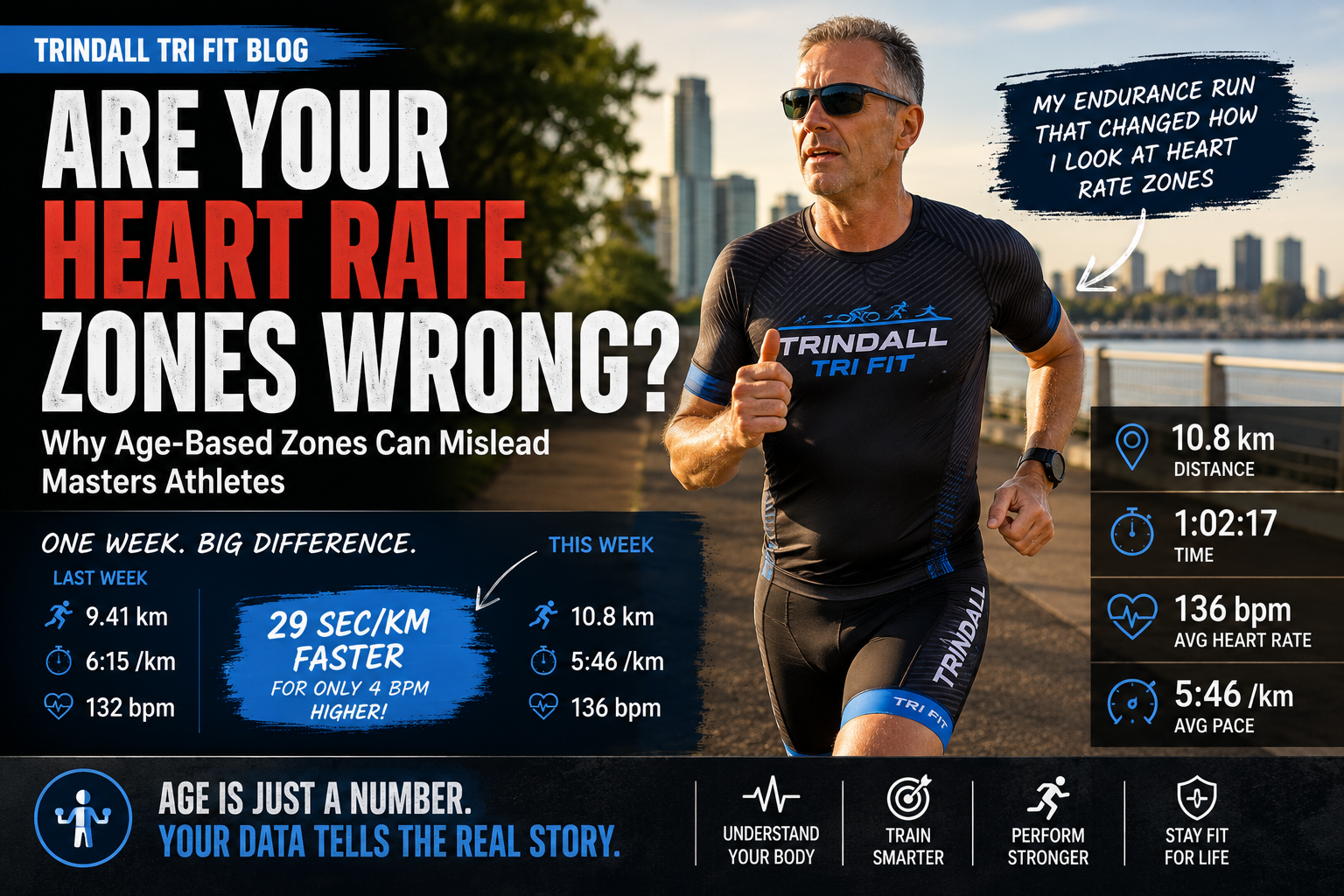
I had covered 10.8 km in 1:02:17, averaging:
- 5:46/km pace
- 136 bpm average heart rate
- 142 bpm maximum heart rate
More importantly, it had felt comfortable.
Not "comfortably hard."
Actually comfortable.
What surprised me even more was that I didn't remember running this comfortably at that sort of pace even before my build into Ironman Cairns.
So I compared it with the same endurance session from the previous week.
One Week Made for an Interesting Comparison
Last week's endurance run:
- 9.41 km
- 6:15/km average pace
- 132 bpm average HR
- 140 bpm maximum HR
This week's:
- 10.8 km
- 5:46/km average pace
- 136 bpm average HR
- 142 bpm maximum HR
That's 29 seconds per kilometre faster for only four additional beats per minute on average.
That doesn't mean I've suddenly gained 29 seconds per kilometre of fitness in seven days. There are plenty of variables involved.
But combined with how comfortable the run felt, it got me thinking about something else.
Are the heart-rate zones I've been using actually right for me?
The Problem With Age-Based Heart-Rate Formulas
One of the most familiar formulas for estimating maximum heart rate is:
220 − age
I'm 57, so that gives me an estimated maximum HR of:
163 bpm.
The problem is that this isn't my measured maximum heart rate.
It's a population-based prediction.
Two healthy, well-trained 57-year-old athletes can have significantly different maximum and threshold heart rates.
Yet if both simply enter their age into a device and allow an algorithm to calculate their zones, they can end up training according to numbers that don't necessarily represent their individual physiology.
And for a masters athlete who has been training for decades, that distinction can become pretty important.
Maximum Heart Rate Isn't Lactate Threshold
This is where I've started looking more closely at lactate-threshold-based heart-rate zones.
Maximum HR asks:
How high can my heart rate go?
Lactate threshold is concerned with something much more useful for endurance training:
At what intensity does my physiology begin moving from a predominantly sustainable effort toward an increasingly unsustainable one?
Once you have a reasonable estimate of your running lactate-threshold heart rate, training zones can be established relative to that threshold.
For an endurance athlete, that can potentially provide considerably more useful information than simply saying:
"You're 57, therefore your maximum heart rate should be approximately 163."
My heart doesn't know how old my driver's licence says I am.
Fitness Can Change Pace Without Dramatically Changing Heart Rate
There's another important lesson from my run.
Becoming fitter doesn't necessarily mean your heart rate suddenly becomes dramatically lower.
Instead, you may simply become capable of producing more speed at the same physiological cost.
That's aerobic efficiency.
Last week I was running around 6:15/km at 132 bpm.
This week I was around 5:46/km at 136 bpm.
The pace changed dramatically more than the heart rate did.
And because I wasn't consciously chasing pace, that's what makes the session particularly interesting to me.
My body simply found that rhythm.
Don't Make the Opposite Mistake
There's a trap here too.
After seeing this run, it would be very easy for me to decide:
"Great. My Zone 2 must be higher than I thought. I'll increase it."
I'm not going to do that.
That would just be replacing one assumption with another.
Instead, the sensible next step is to establish my actual running lactate-threshold heart rate and rebuild my running zones from meaningful individual data.
And there's another thing I'm definitely not doing.
I'm not making 5:46/km my new endurance target pace.
Next week's endurance run will be approached exactly the same way.
Relax.
Good form.
Controlled breathing.
Appropriate aerobic effort.
And let the pace take care of itself.
If 5:45–5:55/km continues appearing at roughly the same heart rate and perceived effort over several sessions, then I'll have much stronger evidence that my aerobic running really has moved forward.
This Matters Even More After 50
I think this is an important conversation for masters athletes.
We spend a lot of time talking about how training needs to change after 40, 50 and 60.
Recovery becomes more important. Strength work matters. Mobility matters. Managing training load becomes increasingly important.
But that doesn't mean we should automatically assume our performance capabilities from our chronological age.
Use age as context — not as your physiological measurement.
A formula can provide a starting point.
Your actual training data provides the evidence.
And perhaps the biggest lesson from this particular run wasn't the 5:46/km pace.
It was that 5:46/km didn't feel like 5:46/km.
After coming back from the calf tear that ended my Ironman Cairns race and gradually rebuilding my running over the past couple of months, that felt like a genuine breakthrough.
Now the challenge is not to chase it.
It's to understand it.
And keep building.
Free Triathlon Training Resources
If you're interested in learning more about heart-rate zones, lactate threshold testing, or how to structure your training using meaningful data rather than age-based predictions, visit the Trindall Tri Fit Resources page for free guides, calculators and training tools.
Train smart. Race confident. Enjoy the journey.