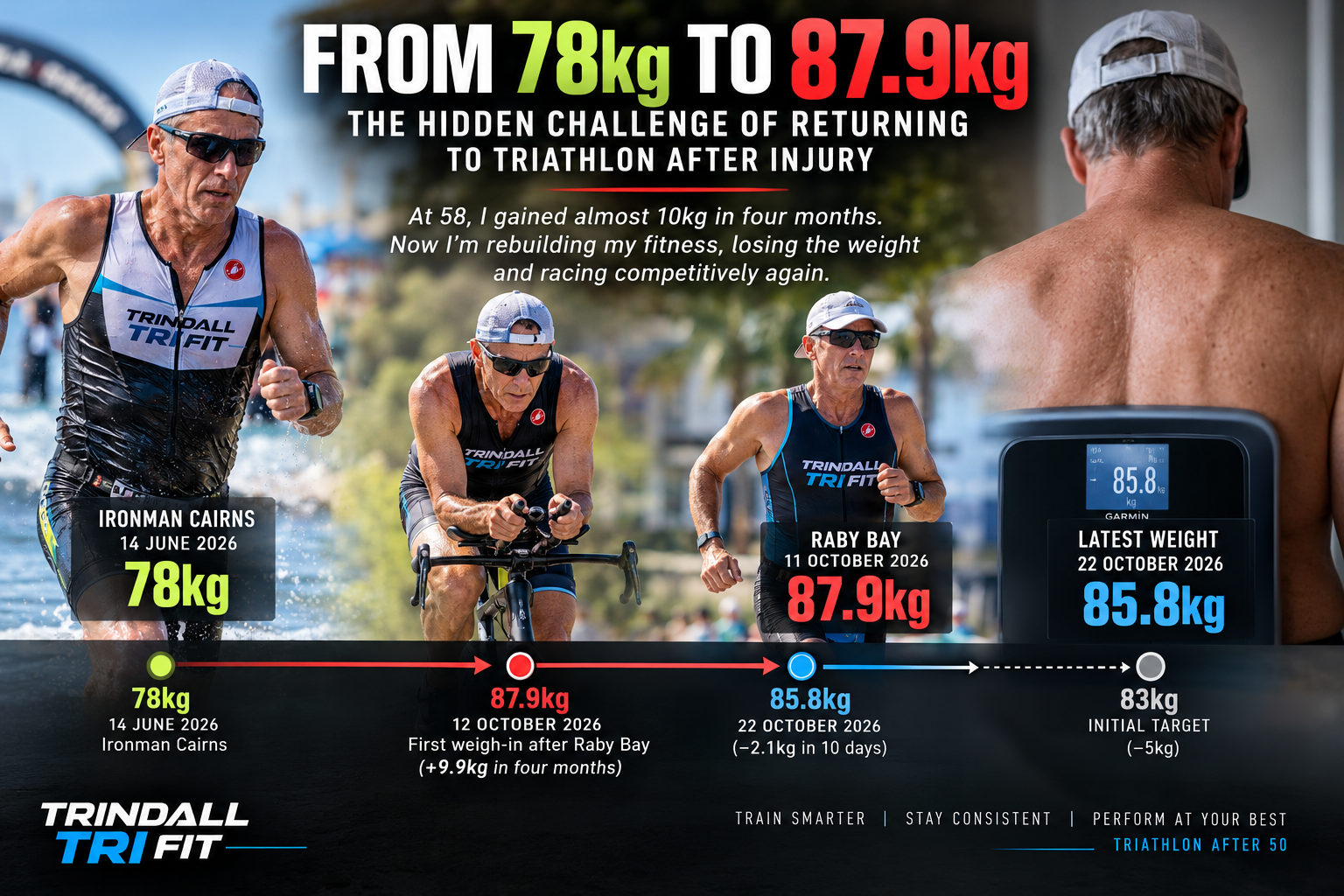
After four months of injury setbacks, I discovered I'd gained almost 10kg. Now, at 58, I'm facing another challenge: losing the weight while rebuilding my fitness and racing competitively.
| Date | Moment | Weight |
|---|---|---|
| 14 June 2026 | Ironman Cairns | 78kg |
| 12 October 2026 | First weigh-in after Raby Bay | 87.9kg (+9.9kg in four months) |
| 22 October 2026 | Latest weigh-in | 85.8kg (−2.1kg in 10 days) |
| Initial target | First milestone | 83kg (−5kg) |
Almost 10kg Heavier — How Did That Happen?
On 14 June 2026, I lined up for Ironman Cairns weighing 78kg.
I'd spent months preparing for the race, training consistently across swimming, cycling and running, and building the endurance required to tackle another Ironman. My fitness was strong, my weight was where I wanted it, and I was looking forward to putting all that preparation into practice.
Unfortunately, things didn't go according to plan.
A calf injury that had developed in the weeks leading into Cairns eventually forced me to withdraw approximately 60km into the bike leg. It was a disappointing end to months of preparation — and the beginning of a frustrating period of injuries, interrupted training and rebuilding fitness.
Fast-forward four months to Round 2 of the Queensland Triathlon Series at Raby Bay on 11 October.
I'd returned to racing, was gradually rebuilding my training volume and was beginning to feel like a competitive triathlete again.
But there was one thing I hadn't been paying much attention to.
My weight.
When I finally stepped on the scales after Raby Bay, I weighed 87.9kg — almost 10kg heavier than I had been at Ironman Cairns.
To say I was surprised would be an understatement.
How Injury Changes More Than Your Training
For someone who has been involved in triathlon for more than 40 years, training is simply part of everyday life. Swimming, cycling and running aren't things I occasionally fit into my schedule — they're part of my routine.
When you're consistently training for endurance events, your daily energy expenditure can be substantial. But injury changes that equation very quickly.
Following Cairns, I was diagnosed with a Grade 2 calf tear. Running stopped, cycling was restricted, and swimming became an important part of maintaining whatever fitness I could.
As the calf improved, I gradually returned to training. Then, just as things were progressing, a hamstring problem interrupted my running preparation for the new triathlon season. Once again, training had to be adjusted.
Looking back, I suspect the biggest contributor to my weight gain was the reduction in training volume without a corresponding adjustment to my eating habits.
When you're accustomed to training regularly, it's easy to keep eating as though you're still completing the same workload. The problem is that your body isn't burning the same amount of energy.
Over several months, those differences add up. And in my case, they certainly did.
Returning to Racing Doesn't Mean Everything Is Back to Normal
By late September, I'd returned to racing. I finished second in my age group at the opening round of the Queensland Triathlon Series at Moreton Bay, and two weeks later I was back on the start line at Raby Bay for Round 2.
From a racing perspective, things were heading in the right direction. My swimming was improving, my cycling endurance was returning, and I was gradually rebuilding confidence in my running.
But underneath that progress, I was carrying almost 10kg more than I had at Cairns.
You can be regaining fitness and racing competitively while still carrying the physical consequences of months of interrupted training.
For me, returning to fitness and returning to racing weight have become two separate challenges — and they're not necessarily progressing at the same speed.
The First Ten Days — 87.9kg to 85.8kg
After seeing 87.9kg on the scales, I decided it was time to pay closer attention to my nutrition. Not by going on a crash diet or dramatically cutting my food intake, but by monitoring what I was eating and making sure it aligned with my training.
Here's what I've changed:
- Tracking daily calories so I know what I'm actually eating, not what I think I'm eating.
- Weighing myself each morning under reasonably consistent conditions.
- Keeping meals simple — eggs and toast for breakfast, sandwiches for lunch, fruit for snacks and a balanced evening meal.
Nothing particularly complicated. The objective is to create a manageable calorie deficit while continuing to fuel my training and recovery.
Ten days after that initial weigh-in, my weight is now 85.8kg — a reduction of 2.1kg.
However, I'm realistic enough to understand that not all of that will be body fat. Changes in hydration, glycogen storage, digestion and daily fluid balance can significantly influence body weight. In fact, I've already had mornings when my weight increased despite a similar calorie intake.
That's frustrating, particularly when you're putting in the training. But I'm learning to focus less on individual daily readings and more on the overall trend.
The scales are providing information, not a daily verdict on whether I'm succeeding.
The Challenge of Losing Weight While Training Hard
This is where things become interesting.
I'm no longer recovering on the sidelines. I'm back completing regular swim, bike and run sessions, including longer aerobic workouts and more structured running efforts. Some days involve two sessions. My training volume is increasing, and I'm starting to feel the fitness returning.
But that creates a balancing act:
- To lose body fat, I need to maintain an appropriate calorie deficit over time.
- To train effectively, I need enough energy to complete sessions, recover and adapt.
- At 58, preserving muscle mass and avoiding another injury are particularly important.
The last thing I want is to become lighter but weaker.
The goal isn't simply to lose weight. It's to lose excess body fat while maintaining strength, endurance and training quality. That means taking a measured approach rather than chasing rapid changes on the scales — and recognising that some days, particularly those with longer or harder sessions, need more fuel than others.
What Difference Could Losing 5kg Make?
My initial target is to lose approximately 5kg from my post-Raby Bay weight, taking me to around 83kg. It's a realistic first milestone rather than an attempt to jump straight back to my 78kg Ironman Cairns weight.
But why does it matter?
- Running: We repeatedly support and propel our body weight with every stride. Reducing unnecessary body mass, while preserving muscle and strength, can improve running economy.
- Cycling: The benefits depend on the course. On flatter courses, aerodynamics and absolute power are the major factors. On hillier courses, power-to-weight ratio becomes increasingly important.
- Swimming: A little different again — technique, body position and efficiency play the biggest roles.
So I'm not expecting losing 5kg to suddenly transform my performances. But combined with improving fitness, better running endurance and consistent training, it could contribute to meaningful improvements.
And when you're competing in an age group where podium positions can be separated by seconds, small improvements matter.
The Queensland Triathlon Series Adds Another Dimension
This season, I'm also attempting to defend my Queensland Triathlon Series age-group title.
With two rounds completed and six points-scoring opportunities remaining, there's still a long way to go. Only the best five results count towards the final standings, so consistency throughout the season will be important. Some strong competitors have yet to race, and I expect the competition to intensify as the season progresses.
My next major race is the Robina Olympic Distance State Championships on 15 November. That gives me another opportunity to assess my progress — not just in finishing position, but in how my fitness, running and body weight are developing.
The challenge is to improve my fitness while gradually reducing weight, without compromising my ability to train and race. It won't necessarily be a straightforward process, but it certainly gives me something to work towards.
Weight Loss After 50 — Patience and Consistency
One thing I've learned over more than four decades in triathlon is that consistency matters more than occasional exceptional performances. The same principle applies to weight management.
At 58, I'm conscious of the importance of maintaining strength, supporting recovery and avoiding unnecessary fatigue. I don't want to compromise months of training simply to see a particular number on the scales.
Weight loss isn't always linear. Some weeks will show progress. Others might show very little movement. And there will undoubtedly be days when the scales move in the wrong direction. That's part of the process.
What matters is maintaining the habits that support long-term progress. For me, that means:
- Training consistently
- Monitoring my nutrition
- Getting adequate recovery
- Adjusting based on how my body responds
The Road Back to Racing Weight
Looking back at the past four months, the difference between 78kg at Cairns and 87.9kg after Raby Bay is a reminder of how quickly circumstances can change.
Injury doesn't just affect your ability to train. It can affect your routines, confidence, fitness and body composition — and sometimes you don't fully appreciate those changes until you stop and take stock.
The positive is that I'm now moving forward. My training is becoming more consistent, my running is improving, and I'm back racing competitively. The weight is simply another part of the rebuilding process.
My first milestone is approximately 83kg. From there, I'll reassess based on how I'm training, recovering and racing. Ultimately, I'd like to move closer to my previous racing weight — but not at the expense of strength or performance.
With the Queensland Triathlon Series underway and the Gold Coast T100 approaching in March 2027, there's plenty of motivation. I'll keep sharing my progress, including the good days, the frustrating weigh-ins, the training sessions and the race results.
Because I suspect I'm not the only athlete over 50 who has experienced this.
At 58, getting injured was frustrating. Rebuilding fitness has been challenging. But discovering I'd gained almost 10kg along the way was another wake-up call entirely.
Now the challenge is to turn things around — not through shortcuts or extreme dieting, but through the same approach that's kept me in triathlon for more than 40 years:
Consistency, patience and a willingness to keep working towards the next goal.
The comeback continues.
I'll be sharing regular updates on my training, weight-loss progress and results throughout the 2026/27 Queensland Triathlon Series as I work towards the Gold Coast T100 in March 2027. Have you struggled with weight gain during an injury layoff? Share your experience in the comments below.
If you'd like support with your own training, nutrition balance or comeback after injury, check out my coaching options.