
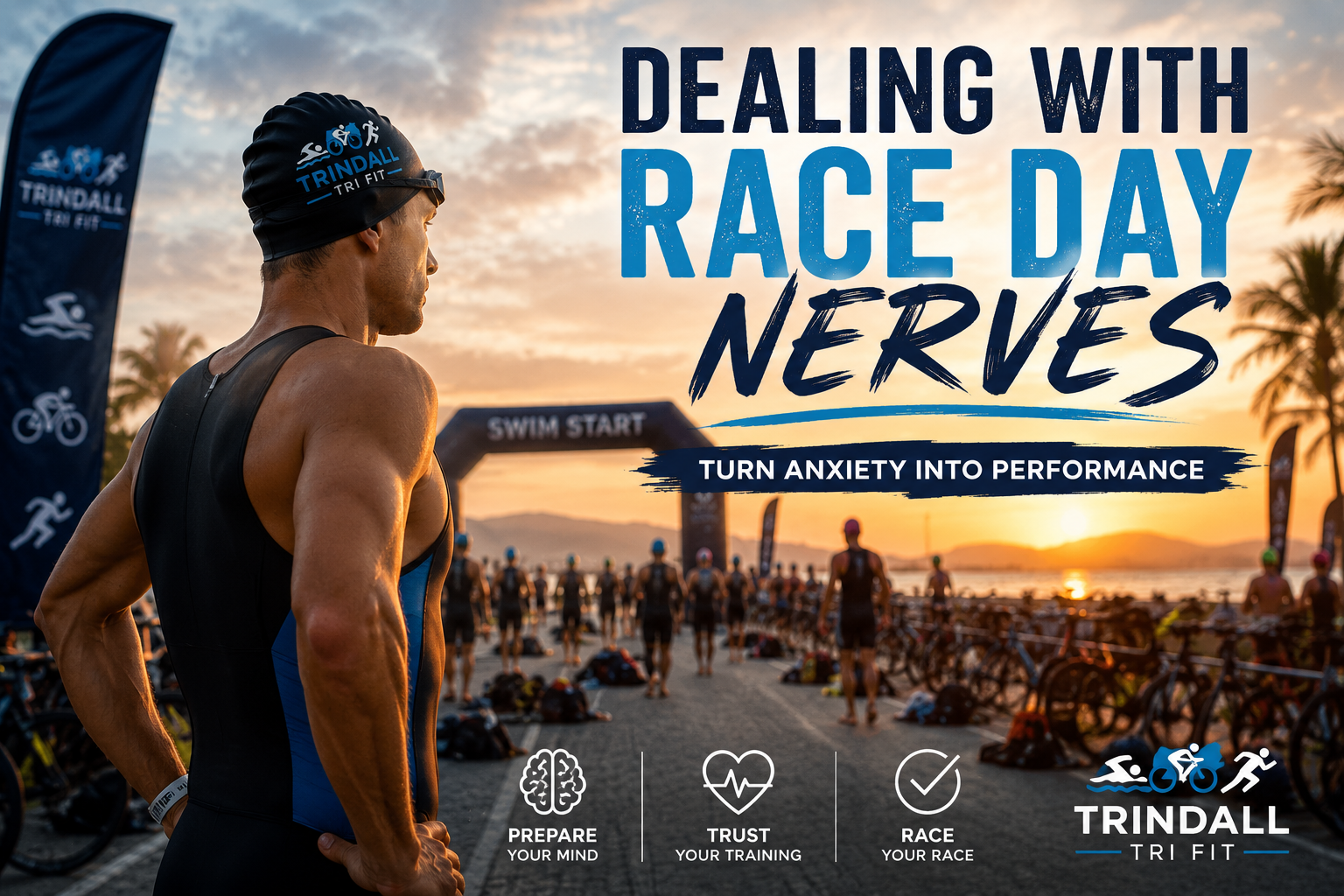
If you have a triathlon coming up and you're feeling nervous, anxious, or questioning whether you're ready, you're not alone.
Whether it's your first sprint triathlon or your tenth Ironman, race-day nerves affect almost every athlete. In fact, if you care about your performance, some level of nervousness is completely normal.
The good news is that nerves don't have to be your enemy. When managed correctly, they can actually help you perform at your best.
Why Do We Get Race Day Nerves?
Triathlons ask a lot from us.
Months of training, early mornings, long rides, missed social events, and countless hours invested in preparation all build towards a single day.
Your brain recognises that the event is important.
As race day approaches, it's common to experience:
- Self-doubt
- Poor sleep
- Increased heart rate
- Irritability
- Difficulty concentrating
- Constantly checking the weather forecast
- Worrying about things that could go wrong
These are all natural responses to a challenge that matters to you.
Nervous and Excited Feel Very Similar
One of the most useful things I learned as an endurance athlete is that nervousness and excitement create very similar physical sensations.
Butterflies in your stomach. Elevated heart rate. Extra energy. A heightened sense of awareness.
The difference is often the story we tell ourselves.
Instead of thinking:
"I'm nervous because I'm not ready."
Try:
"I'm excited because it's almost time to see what months of training can produce."
That simple shift in perspective can completely change your mindset.
Focus on What You Can Control
Many athletes waste valuable energy worrying about things they cannot influence.
You can't control:
- The weather
- Other competitors
- Water conditions
- Mechanical issues
- Race organisers
What you can control:
- Your preparation
- Your nutrition plan
- Your pacing strategy
- Your equipment checks
- Your attitude
The closer you get to race day, the smaller your circle of focus should become.
Trust Your Training
One of the biggest mistakes athletes make during taper week is trying to gain fitness at the last minute.
The reality is that your race fitness is already built.
The hard work is done.
You won't become significantly fitter in the final week, but you can definitely become more tired, stressed, or injured.
Trust the process. Trust the work you've already completed. Trust the long rides, long runs, pool sessions, and early mornings that got you here.
Visualise Success
Elite athletes have used visualisation for decades.
Spend a few minutes each day imagining:
- Walking into transition
- Setting up your gear
- Entering the water calmly
- Riding smoothly and efficiently
- Running strong and controlled
- Crossing the finish line
The more familiar race day feels in your mind, the less intimidating it becomes in reality.
Have a Race Morning Plan
An organised athlete is often a calmer athlete.
Prepare as much as possible before race morning:
- Lay out race gear
- Charge electronics
- Prepare nutrition
- Check bike tyres
- Review race schedule
- Know exactly when you need to leave
Every decision made the night before is one less thing to worry about on race morning.
👉 Use my Race Day Checklist to make sure you haven't missed anything.
Accept That Some Nerves Are Good
The goal isn't to eliminate nerves completely.
The goal is to keep them at a level that helps rather than hinders performance.
A little nervous energy sharpens focus. It makes you alert. It reminds you that what you're about to do matters.
Most athletes who have raced for years will tell you the same thing:
If the nerves ever disappear completely, it probably means they no longer care about the outcome.
My Own Experience
As I prepare for Ironman Cairns, I still get nervous.
I've been racing triathlons since 1983 and completed countless events, yet race week still brings moments of doubt and uncertainty.
The difference now is that I've learned to recognise those feelings for what they are.
They're not signs that I'm unprepared.
They're signs that I care.
And that's something every athlete should embrace.
A Pre-Race Nerves Toolkit
Here's a quick summary of strategies you can use in the days and hours before your next race:
| Strategy | When to Use |
|---|---|
| Reframe nerves as excitement | Race week |
| Narrow your circle of control | 2-3 days before |
| Visualise the race | Daily, 5 minutes |
| Prepare gear and nutrition | Night before |
| Follow a race morning plan | Race morning |
| Trust your training | Taper week |
| Breathe and stay present | Start line |
Final Thoughts
If you're feeling nervous before your next triathlon, don't fight it.
Accept it. Manage it. Use it.
You've done the training. You've made the sacrifices. You've earned your place on the start line.
Now it's time to trust yourself and enjoy the experience.
Because the nerves you're feeling today are often the same emotions you'll look back on fondly after crossing the finish line.
Good luck, race hard, and remember — courage isn't the absence of fear. It's taking the start line despite it.
Resources to Help You Prepare
- Race Day Checklist — Don't forget anything on race morning
- Heart Rate Zone Calculator — Nail your pacing strategy
- HRV Guide for Triathletes — Monitor your readiness
- DIY Energy Gels — Practise your race nutrition
— Des Trindall Brisbane, Australia