Welcome back to another update on my Road to Ironman Cairns 2026.
For those new to the journey, my name is Des Trindall — a 57-year-old triathlete based in Brisbane, Queensland, Australia. I've been involved in triathlon for over 40 years, and I'm documenting this journey for two reasons:
- To create a record I can look back on in years to come
- To share experience, lessons, and insights with others — especially athletes over 50
If you pick up something useful along the way, that's a bonus. And if you have questions, feel free to reach out — I read and respond to them all.
This week marks 13 weeks to go until Ironman Cairns… and the pressure is starting to build — in a good way.
Understanding My Training Structure
Before diving into the week, it's worth explaining how I structure my training.
I typically work in four-week training cycles:
| Week | Focus | Example (Endurance Ride) |
|---|---|---|
| Week 1 | Build | 3 hours |
| Week 2 | Build | 3.5 hours |
| Week 3 | Build (highest load) | 4 hours |
| Week 4 | Recovery (adaptation) | 2–2.5 hours |
The key point?
You don't gain fitness in the hard weeks — you gain it in recovery.
- Weeks 1–3 create fatigue
- Week 4 creates adaptation
This week was Build Week 3 — the toughest week of the block.
Monday – 4-Hour Endurance Ride
Monday was a day off work, which gave me the opportunity to move my long ride forward from Saturday.
Session:
- 4-hour Zone 2 ride
- Focus on staying controlled
- Practising race nutrition
One of my major focuses at the moment is training the gut — gradually increasing carbohydrate intake during long sessions.
| Metric | Current | Race-Day Target |
|---|---|---|
| Carbs per hour | ~70g | 90g |
This gradual build helps avoid race-day stomach issues and improves endurance performance significantly.
Tuesday – Endurance Run
Despite the long ride on Monday, Tuesday felt surprisingly strong.
Session:
- 60-minute Zone 2 run
- Solid endurance pace
- Good recovery from previous day
This was a good sign that the aerobic base is improving.
Wednesday – Double Session
This was a solid training day with two quality sessions.
Morning: Bike
- 1 hour 45 minutes Zone 2 ride
- Added short 5-minute Ironman-pace efforts
- Using power meter to guide effort
Afternoon: Swim
- 3,100m total volume
- 400m warm-up
- 5 × 50m drills
- Multiple 200m intervals at ~85% Ironman pace
- 45-second recoveries
- Warm-down
Nothing flashy — just consistent, structured work.
Thursday – Speed Session
Thursday was the weekly higher-intensity session.
Run Session:
- 10-minute warm-up
- 5 × 4-minute efforts at ~90% effort
- Focus on form, relaxation, breathing, and running posture
These sessions are faster than race pace but help develop:
- Running efficiency
- Speed reserve
- Running economy
I follow roughly an 80/20 approach:
- 80–85% easy aerobic work
- 15–20% higher intensity
This keeps training sustainable and reduces injury risk.
Friday – Active Recovery
By Friday, fatigue was building — which was expected after the week's load.
So I listened to the body.
Session:
- 60-minute Zone 1 ride
- Coffee stop included ☕
- Pure recovery focus
The goal here was to protect the weekend sessions.
Saturday – Long Ride
Saturday delivered the longest session of the week.
Session:
- 4.5-hour Zone 2 ride
Focus areas:
- Staying controlled
- Nutrition practice
- Hydration timing (every 15 minutes)
- Introducing some solid food
Once rides exceed 4 hours, it becomes critical to:
- Practise race nutrition — what works, what doesn't
- Practise pacing — staying disciplined when legs feel good
- Simulate race fatigue — because in Cairns, after that ride… you still have to run a marathon
By the end of the ride, I was definitely fatigued — which is exactly what we're training for.
Sunday – Listening to the Data
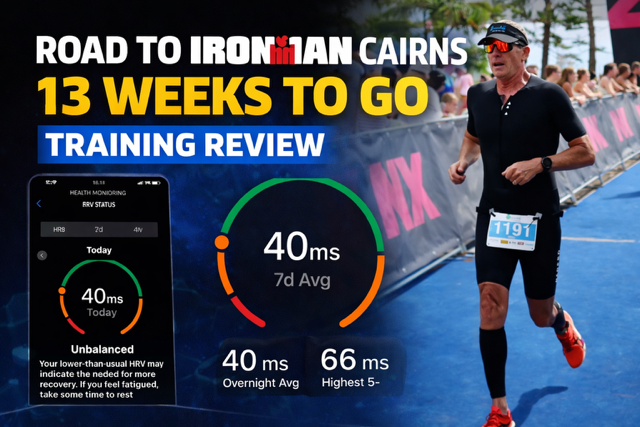
Sunday morning, I checked my recovery data:
| Metric | Status |
|---|---|
| HRV | 40ms (7-day average) |
| Resting Heart Rate | Monitored |
| Sleep Score | Reviewed |
I also uploaded this data into ChatGPT for feedback — almost like having an on-demand recovery coach.
The plan was a 2-hour Zone 2 run, but the feedback suggested caution:
- Slight fatigue indicators
- Watch for rising heart rate
- Monitor form
So I adjusted.
Final session:
- 1 hour 30-minute Zone 2 run
- Controlled effort
- Focus on staying injury-free
This is where experience matters. At 13 weeks out, there's no need to force sessions and risk injury.
Wetsuit Swim and Heat Preparation
Sunday also included a 3,100m swim — this time introducing wetsuit training.
Why? Ironman Cairns features:
- Warm water conditions
- Wetsuit mandatory for safety
- Heat management becomes critical
I'm starting to incorporate:
- Heat acclimation — building tolerance gradually
- Wetsuit comfort — getting used to restricted movement
- Race simulation — practising transitions and effort levels
This helps ensure I don't exit the swim already overheated.
Weekly Summary
| Metric | Value |
|---|---|
| Total Training Time | ~17 hours |
| Phase | Build Week 3 |
Key focus areas this week:
- Long ride progression to 4.5 hours
- Gut training and nutrition practice
- Data-based training decisions using HRV
- Heat acclimation and wetsuit training
Next week:
- Recovery week — reduced volume
- Preparation for Raby Bay Triathlon
Final Thoughts
With 13 weeks to go, the focus shifts slightly:
- Training smart
- Managing fatigue
- Staying injury-free
- Practising race execution
This week was a solid reminder: it's not just about training harder — it's about training smarter.
The countdown to Cairns continues.
If you're preparing for your own Ironman or long-course event, check out my training plans or get in touch for personalised coaching.