If you've ever looked at a training plan and seen instructions like "Zone 1 Recovery Ride" or "Zone 4 Bike Intervals" and wondered what they actually mean — or whether you're training in the right one — this guide is for you.
Understanding your training zones is one of the most important steps you can take to improve your triathlon performance.
Training zones help you control intensity, manage fatigue, improve endurance, and ultimately race faster. More importantly, they help you avoid the biggest mistake most age-group athletes make — training too hard, too often.
Why Training Zones Matter
Many athletes train based purely on feel.
The problem? "Easy" gradually becomes moderate. Moderate gradually becomes hard. And before you know it, every session sits in an uncomfortable middle ground that's too hard to build your aerobic base and too easy to genuinely improve speed.
Over time, this creates a cycle:
- Accumulated fatigue
- Poor recovery
- Inconsistent training
- Injury or burnout
Training zones provide objective feedback so every session has a clear purpose. Instead of guessing, you know exactly how hard your body is working.
This becomes even more critical for athletes over 40 and 50, where recovery capacity becomes one of the biggest performance limiters. I've written about this in detail in Why Running Feels Harder After 40.
The Five Training Zones
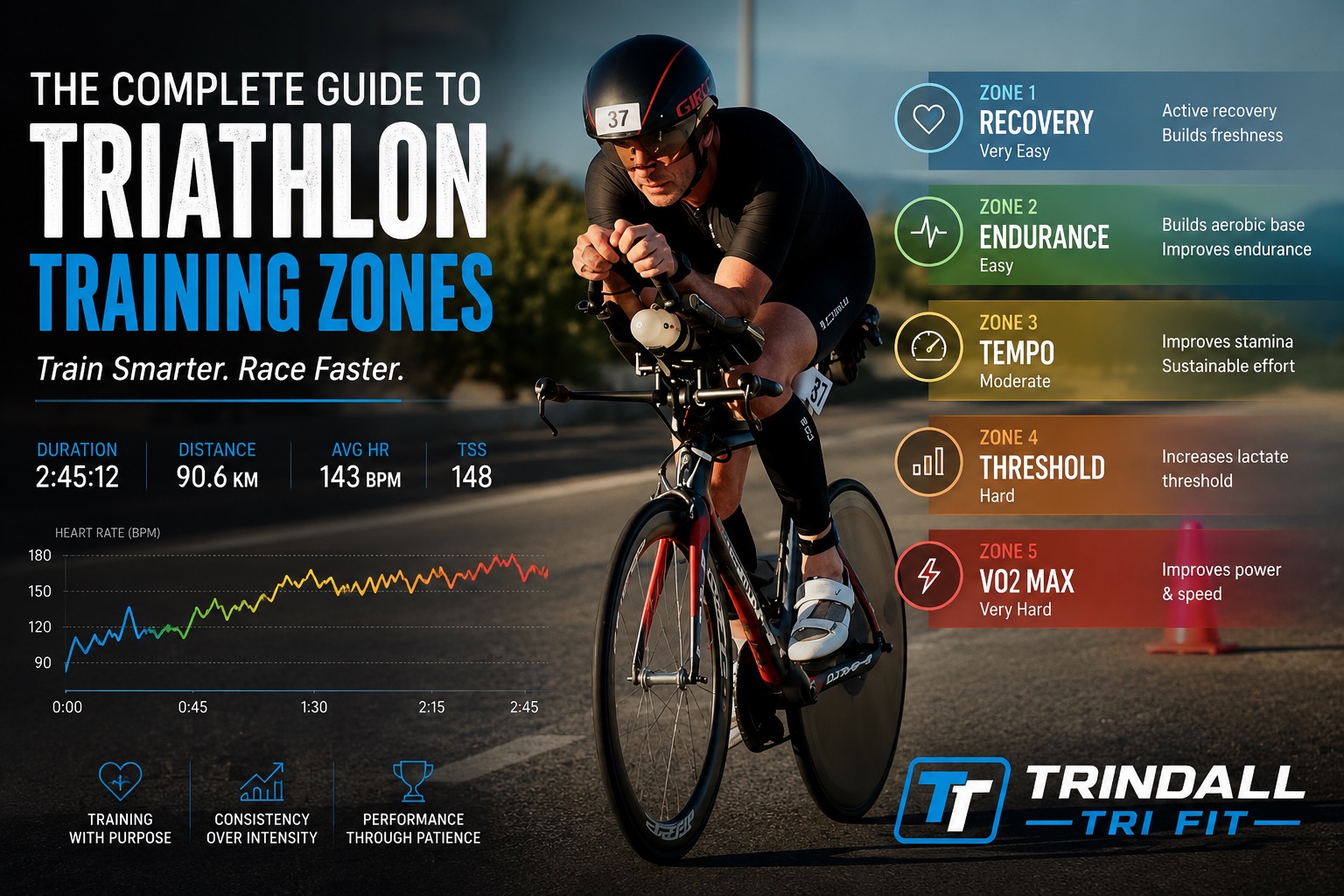
Most modern triathlon training uses a five-zone model. Here's what each zone means, how it feels, and when to use it.
Zone 1 — Recovery
| Effort | Very easy |
| Breathing | Comfortable, nasal breathing possible |
| Conversation | Full conversation, no effort |
| Purpose | Active recovery, freshness |
This is your recovery zone. The goal isn't fitness — the goal is recovery.
Typical sessions:
- Recovery runs and rides
- Easy swims
- Active recovery days
- The day after a hard session or race
The mistake most athletes make here is going too hard. If your Zone 1 session feels like "proper training," you're probably in Zone 2 or higher.
Zone 2 — Aerobic Endurance
| Effort | Easy to moderate |
| Breathing | Controlled, rhythmic |
| Conversation | Can talk in full sentences |
| Purpose | Builds aerobic base, improves endurance |
This is where most successful long-course triathletes spend the majority of their training time.
Zone 2 develops:
- Aerobic fitness and mitochondrial density
- Fat metabolism (your body's most efficient fuel source)
- Endurance capacity
- Recovery efficiency between sessions
For Ironman athletes, this is arguably the most important training zone. At Trindall Tri Fit, approximately 75–85% of our Ironman training volume is performed in Zone 2.
This is where you build the engine.
I've covered the science and practical application in depth: Why Zone 2 Training Is the Foundation of Triathlon Success.
Zone 3 — Tempo
| Effort | Comfortably hard |
| Breathing | Noticeably elevated |
| Conversation | Short sentences only |
| Purpose | Improves stamina, sustainable effort |
This zone sits between easy endurance work and high-intensity training. It's where many triathletes naturally default to — and that's part of the problem (more on this below).
When used intentionally, Zone 3 is valuable for:
- Long tempo runs
- Ironman and Half Ironman race-pace work
- Building muscular endurance
- Improving lactate clearance
The key word is intentionally. Drifting into Zone 3 during what should be a Zone 2 session is where problems start.
Zone 4 — Threshold
| Effort | Hard |
| Breathing | Heavy, laboured |
| Conversation | Difficult, a few words at most |
| Purpose | Increases lactate threshold |
You're working close to your lactate threshold — the point where fatigue starts accumulating rapidly.
Benefits:
- Increased threshold pace and power
- Higher sustainable output on race day
- Improved race performance at Olympic and Sprint distances
Common workouts:
- Bike intervals (e.g., 3 × 18 min @ threshold power)
- Track sessions (e.g., 4 × 4 min efforts)
- Threshold swim sets
These sessions are effective but require adequate recovery. For masters athletes, I typically programme at least 48 hours of easy training after a threshold session.
Zone 5 — VO2 Max
| Effort | Very hard to maximum |
| Breathing | Gasping |
| Conversation | Impossible |
| Purpose | Improves power and speed |
This is maximum aerobic effort. You can only sustain this intensity for short periods — typically 2–5 minutes.
Typical sessions:
- Short run intervals (e.g., 6 × 2 min)
- High-power bike efforts
- Sprint swim repeats
Used correctly, Zone 5 produces significant gains in VO2 max, speed, and neuromuscular efficiency. Used too often, it leaves you exhausted and increases injury risk.
For masters athletes: less is more. One well-timed Zone 5 session per week is usually sufficient.
Zone Summary Table
| Zone | Name | Effort | % of Max HR (approx.) | Primary Benefit |
|---|---|---|---|---|
| 1 | Recovery | Very easy | 50–60% | Active recovery, freshness |
| 2 | Endurance | Easy | 60–70% | Aerobic base, fat metabolism |
| 3 | Tempo | Moderate | 70–80% | Muscular endurance, race pace |
| 4 | Threshold | Hard | 80–90% | Lactate threshold, sustainable power |
| 5 | VO2 Max | Very hard | 90–100% | Speed, power, neuromuscular efficiency |
Note: These percentages are approximate. Your actual zones should be based on individual testing, not generic formulas.
How to Determine Your Zones
There are three primary methods, and ideally you'd use a combination.
Heart Rate
The most accessible option. A basic heart rate monitor and chest strap is all you need.
Using heart rate allows you to establish training zones based on your own physiology rather than generic formulas.
Avoid relying solely on "220 minus age." This formula can be wildly inaccurate — I've seen athletes whose actual max heart rate differs by 15–20 beats from the formula.
A better approach:
- Perform a field test (e.g., a 30-minute all-out run or ride)
- Use the average heart rate from the last 20 minutes as your lactate threshold heart rate (LTHR)
- Calculate your zones from LTHR
We have a free Heart Rate Zone Calculator on our resources page that does this for you.
Power (Cycling)
For cyclists and triathletes using a power meter, Functional Threshold Power (FTP) testing provides the most accurate cycling zones.
Power is often considered the gold standard because it measures actual work output — it doesn't fluctuate with heat, caffeine, fatigue, or emotion the way heart rate can.
A simple FTP test: ride as hard as you can sustain for 20 minutes. Multiply the average power by 0.95 — that's your estimated FTP.
Pace (Running and Swimming)
Running pace and swim CSS (Critical Swim Speed) can also establish zones. These work particularly well when combined with heart rate data for cross-referencing.
For running, a 30-minute time trial on a flat course gives you a reliable threshold pace.
The Biggest Mistake Triathletes Make
Most age-group athletes spend too much time training in the middle.
- Not easy enough to build aerobic fitness
- Not hard enough to improve speed
- Living in what coaches call the "grey zone"
This is Zone 3 by default — every session feels "about right" but nothing actually progresses.
Research consistently shows that successful endurance athletes perform most of their training at lower intensities, with a smaller amount of very hard training mixed in. This approach is often referred to as polarised training.
The distribution typically looks like:
| Intensity | % of Training | Purpose |
|---|---|---|
| Easy (Zone 1–2) | 75–85% | Aerobic base, recovery |
| Moderate (Zone 3) | 10–15% | Race-specific work |
| Hard (Zone 4–5) | 5–10% | Threshold and speed development |
The discipline isn't in the hard sessions — it's in keeping the easy sessions genuinely easy.
How I Use Zones at Trindall Tri Fit
As a 57-year-old age-group triathlete preparing for Ironman Cairns while working full-time shift work, I've learned that consistency beats hero workouts every time.
A typical training week looks like:
| Day | Session | Primary Zone |
|---|---|---|
| Monday | Rest or Zone 1 recovery | 1 |
| Tuesday AM | 2hr indoor bike (course simulation) | 2 |
| Tuesday PM | 3,500m wetsuit swim | 2 |
| Wednesday | Long run (2–2.5 hours) | 2 |
| Thursday | Structured bike (e.g., 3 × 18min @ 175W) | 2–4 |
| Friday | Short intervals or recovery run | 1 or 4–5 |
| Saturday | Long ride (3–4 hours) | 2 |
| Sunday | Easy ride or rest | 1 |
The vast majority of that week — roughly 80% — is Zone 1 and Zone 2. The hard sessions are specific, purposeful, and followed by adequate recovery.
This approach has produced:
| Achievement | Detail |
|---|---|
| Races | 9 |
| Podium finishes | 9 out of 9 |
| Queensland Triathlon Series | Age-group overall champion |
| Australian Age Group Team | Selected for 2026 World Championships |
The goal isn't to train harder. The goal is to train smarter.
Practical Tips for Getting Started
- Get a heart rate monitor — a chest strap is more accurate than wrist-based for training
- Do a field test — establish your actual threshold, don't guess
- Use our Heart Rate Zone Calculator to set personalised zones
- Keep a training log — note which zone each session targeted and whether you stayed in it
- Be honest about your easy days — if you can't hold a conversation, it's not Zone 2
- Review weekly — aim for 75–85% of total volume in Zone 1–2
Final Thoughts
Training zones take the guesswork out of triathlon training.
When every session has a purpose, recovery improves, consistency increases, and performance follows.
Whether you're training for your first sprint triathlon or chasing a personal best at Ironman distance, understanding your training zones is one of the most powerful tools available.
Train easy when it's supposed to be easy. Train hard when it's supposed to be hard.
And most importantly — stay consistent. Because consistency always wins.
Train smarter. Race faster.
Free 30-Minute Training Review
Not sure if your training zones are set correctly, or whether your intensity distribution is right for your goals?
I'm offering a free 30-minute training review call for masters athletes (40+). No sales pitch — just an honest look at your training.
Book your free training review →
Limited spots available each month.
Related: Why Zone 2 Training Is the Foundation of Triathlon Success
Recent: Why Running Feels Harder After 40 — And How to Fix It
Free tool: Heart Rate Zone Calculator
Free resources: Training Plans, Nutrition Guides, and More