There comes a point for many endurance athletes where running suddenly starts to feel… different.
The pace that once felt easy now pushes the heart rate higher. Recovery takes longer. Niggles appear more often. And some days the legs simply don't bounce the way they used to.
If you're over 40 — or over 50 like me — you're not imagining it.
But here's the important part:
You're not broken. You just need to train differently than you did in your 20s and 30s.
As a 57-year-old triathlete currently preparing for Ironman Cairns while working full-time shift work and balancing family life, I've learned that success in endurance sport after 40 isn't about training harder.
It's about training smarter.
Why Running Changes as We Age
As we get older, several things naturally shift:
| Change | What Happens | Impact on Running |
|---|---|---|
| Recovery slows | Tissue repair takes longer between sessions | Can't stack hard days like you used to |
| Muscle mass decreases | Gradual sarcopenia from ~35 onwards | Less power, higher injury risk |
| Tendons lose elasticity | Collagen turnover slows | Achilles, plantar fascia, calf issues become more common |
| Sleep quality fluctuates | Lighter sleep, more disruptions | Poorer overnight recovery |
| Intensity creates more fatigue | Nervous system takes longer to recover | High-intensity sessions dig a deeper hole |
| Injury risk increases | All of the above compounds | One wrong session can cost you weeks |
That doesn't mean your best days are behind you.
In fact, many masters athletes continue improving well into their 40s, 50s, and beyond — but they succeed because they adapt their training instead of fighting their age.
The Biggest Mistake Masters Athletes Make
Most runners over 40 are still trying to train like they're 25.
More mileage. More intensity. More "junk" sessions that sit in no-man's-land — too hard to be easy, too easy to be productive. And not nearly enough recovery.
That approach eventually catches up with you. Usually in the form of a niggle that won't clear, a plateau that won't shift, or a fatigue that sits in your legs for weeks.
One of the biggest breakthroughs I've had in recent years has been embracing aerobic Zone 2 training.
Ironically, slowing down has actually made me faster.
This season I achieved podium finishes in every race I entered — 9 races, 9 podiums — while doing the vast majority of my training at controlled aerobic effort.
| Metric | This Season |
|---|---|
| Races entered | 9 |
| Podium finishes | 9 |
| Queensland Triathlon Series | Age-group overall champion |
| Australian Age Group Team | Selected for 2026 World Championships |
That's the power of consistency over ego.
Recovery Is Now Part of Training
When you're younger, you can often get away with poor recovery habits — late nights, average nutrition, back-to-back hard sessions.
After 40, recovery becomes one of the most important performance tools you have.
That means:
- Prioritising sleep — it's where the adaptation happens
- Managing stress — cortisol doesn't care whether the stress is from work or intervals
- Fuelling properly — underfuelling compounds fatigue exponentially
- Taking easy days seriously — easy means easy, not "moderate"
- Listening to warning signs early — a small niggle on Monday becomes a missed month by Friday if you ignore it
- Being willing to adjust sessions when fatigue is high
One of the smartest things masters athletes can do is stop forcing sessions when the body is clearly asking for recovery.
Missing one session won't ruin your fitness. Ignoring fatigue might.
I learned this lesson firsthand just weeks ago when a calf strain during an easy recovery run forced me to shut down running completely for several days. The temptation to push through was enormous. The decision to rest was the right one.
Train for Durability, Not Just Speed
In endurance sport after 40, durability becomes the real superpower.
Ask yourself:
- Can you train consistently week after week?
- Can you avoid long injury breaks?
- Can you recover well enough to keep building month after month?
That matters far more than smashing one heroic workout.
The athletes who continue improving in their 40s and 50s usually share the same habits:
- Train consistently — showing up matters more than any single session
- Keep easy days easy — protect the recovery that fuels the hard days
- Strength train regularly — it's not optional after 40, it's essential
- Focus on aerobic development — build the engine, don't just rev it
- Respect recovery — sleep, nutrition, stress management
- Adjust training based on how you feel — not just what the plan says
The goal isn't to prove how hard you can train.
The goal is to stay healthy enough to keep training.
Using Data to Make Better Decisions
One thing that has genuinely helped me maintain consistency at 57 is using daily recovery data to guide training decisions.
Each morning I review:
| Metric | What I'm Looking For |
|---|---|
| HRV | Trending within or above baseline |
| Sleep score | Quality and duration |
| Body Battery | Energy reserves for the day |
| Resting heart rate | Stable or below baseline |
| Training readiness | Composite readiness score |
| Overall fatigue | Cumulative load over the past week |
Then I compare that against the day's planned session.
Sometimes the answer is: "Proceed as planned."
Other times it's: "Reduce intensity," or "Swap sessions," or simply "Focus on recovery today."
That small daily adjustment process helps remove emotion and ego from training decisions. And over time, those smarter decisions compound into consistent results.
If you're curious about how I use AI alongside this data, I wrote about my daily process in detail.
Running After 40 Can Still Feel Amazing
Yes, running changes with age. But that doesn't mean you stop improving.
In many ways, masters athletes become better athletes because they finally learn:
- Patience — the results come from months, not weeks
- Pacing — starting conservatively pays off every single time
- Discipline — doing the right session, not the hardest one
- Recovery — treating rest as training, not laziness
- Consistency — the unglamorous secret behind every good result
The key is accepting that your training needs to evolve.
Train for the decade you're in — not the one you left behind.
And remember: the goal isn't simply to keep running. The goal is to keep enjoying it.
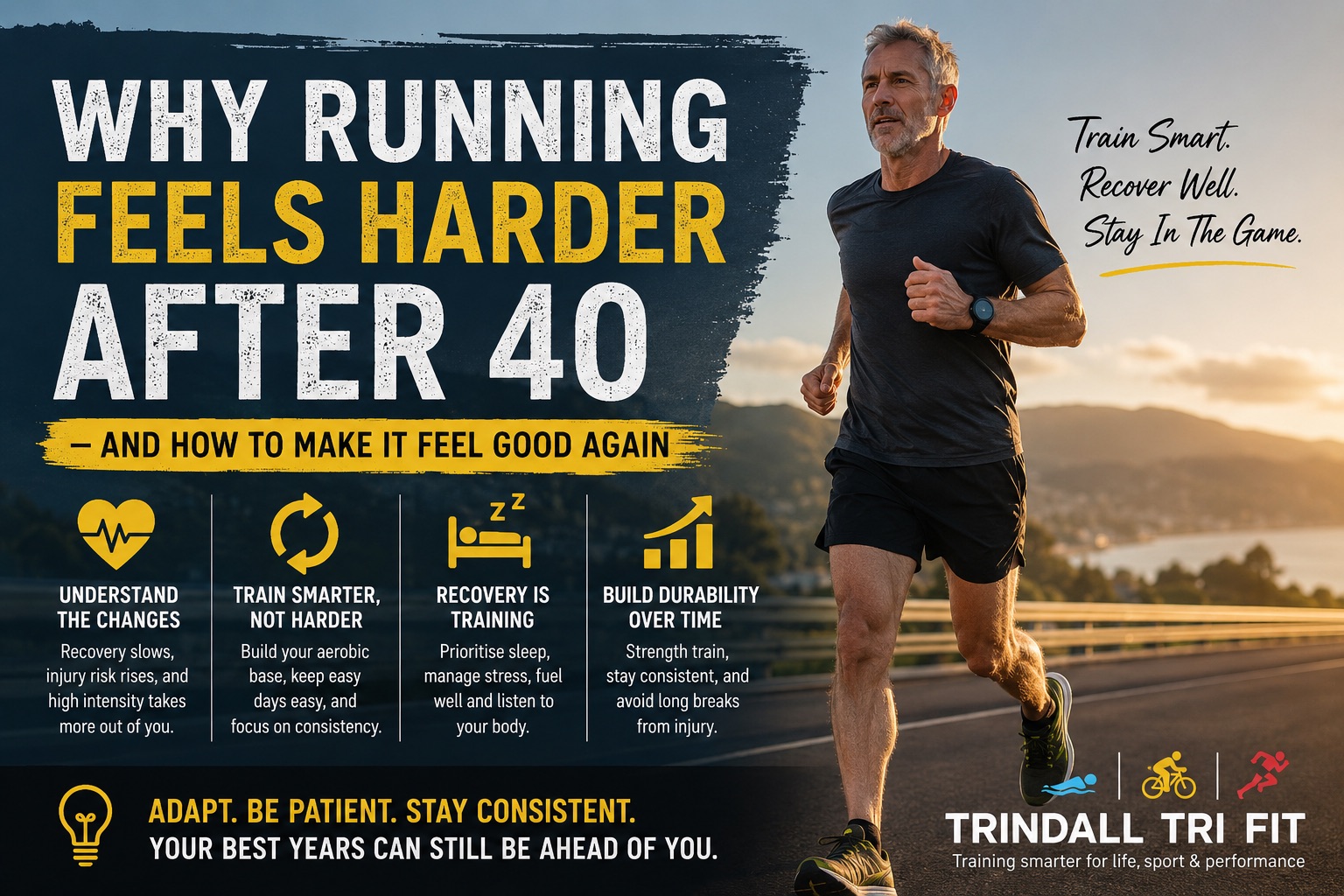
Four Principles to Start With
If you're over 40 and feeling like running has become a grind, here's where I'd start:
| Principle | Action |
|---|---|
| Understand the changes | Accept that recovery slows, injury risk rises, and high intensity takes more out of you than it used to |
| Train smarter, not harder | Build your aerobic base, keep easy days genuinely easy, and focus on consistency over volume |
| Recovery is training | Prioritise sleep, manage stress, fuel well, and listen to your body |
| Build durability over time | Strength train, stay consistent, and avoid the long breaks that come from pushing through injuries |
Adapt. Be patient. Stay consistent. Your best years can still be ahead of you.
Free 30-Minute Training Review
Want an honest conversation about whether your current training is working for you — or working against you?
I'm offering a free 30-minute training review call for masters athletes (40+). No sales pitch, no pressure — just a straightforward look at where you are and what might help.
Book your free training review →
Limited spots available each month.
Related: Why Zone 2 Training Is the Foundation of Triathlon Success
Recent: How I Use AI to Adjust My Ironman Training Day-by-Day
Free resources: Training Plans, Nutrition Guides, and More
Watch on YouTube: Trindall Tri Fit Channel