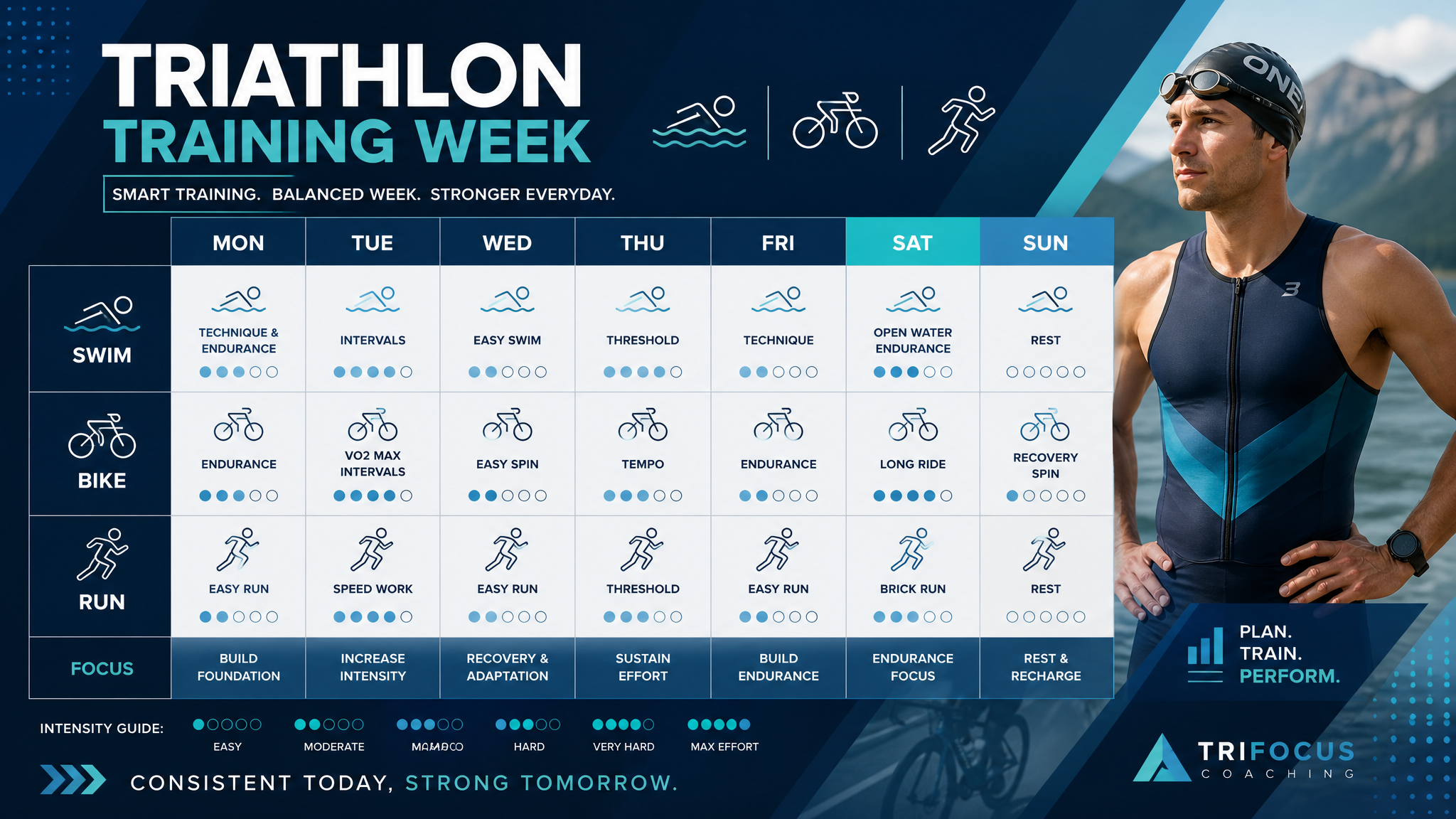
Four weeks to race day, the work is becoming more specific — but that doesn't mean every session needs to be hard.
I'm now into Build 2, Week 2 of my return to racing, and for the first time in quite a while, training is starting to feel normal again.
Earlier this year, a Grade 2 calf tear put me out of structured training for around six weeks. Since returning, I've been deliberately rebuilding rather than trying to immediately get back to where I was before the injury.
Now, with my first race of the season on 27 September, there's enough fitness back in the body to start adding more intensity — but the basic philosophy hasn't changed.
Every session needs a purpose.
For me, successful triathlon training isn't about seeing how much suffering I can fit into seven days. It's about combining swim, bike and run sessions in a way that allows me to consistently train, recover and adapt.
Here's how I'm currently doing it.
Build the Training — Then Give the Body Time to Adapt
My training is structured around a fairly simple build-and-recovery cycle.
During a build, I progressively increase the training load over three weeks. Earlier in the comeback, the emphasis was primarily on increasing volume rather than intensity. The fourth week then backs that volume off and gives the body an opportunity to absorb the work.
With Build 2, I'm now able to introduce a little more intensity alongside the volume.
That recovery week remains just as important.
It's tempting when training is going well to keep adding more. But fitness isn't simply created by the training session itself. We need the recovery afterwards to adapt to the work we've done.
That's particularly important for me as a masters athlete and after coming back from injury.
Monday: Recovery Is Part of Training
I generally take Monday off.
There's usually some decent volume across the weekend, so Monday gives me a physical and mental reset before starting another training week.
"Rest day" doesn't necessarily mean sitting on the couch all day. I may do some stretching and core work, and we'll often head out for an easy half-hour walk with the dog. But there's no structured endurance or high-intensity training.
One of the lessons I've learned over many years in endurance sport is that you don't have to fill every available space in the calendar with another workout.
Sometimes the best training decision is not to train.
Swimming: Three Sessions With Three Different Jobs
At the moment I'm swimming three times each week.
Rather than doing three versions of essentially the same workout, each session has a slightly different purpose.
Tuesday — 100m Strength-Endurance Intervals
Tuesday's swim is approximately 2,000 metres.
I start with a controlled 500m freestyle warm-up, followed by 10 × 50m freestyle.
The 50s aren't flat-out sprints. I'm concentrating on core stability, holding good form and producing a solid repeatable effort. I allow enough recovery between repetitions so technique doesn't deteriorate.
The main set is then 8 × 100m using paddles and pull buoy.
Again, I'm not trying to destroy myself.
I'm looking for strength-endurance and consistency.
Ideally, the first 100 and eighth 100 should look remarkably similar. If I'm fading badly toward the end, I've probably started too hard.
Thursday — Longer 200m Repeats
Thursday follows a similar structure, but I replace the 100m main set with:
4 × 200m paddles and pull buoy.
The longer repetitions change the stimulus slightly and continue developing the strength-endurance I'm looking for rather than outright sprint speed.
Saturday — 2,000m Endurance
Saturday is simpler.
2,000 metres of controlled endurance swimming.
I'm currently doing this in the pool because it allows me to control the environment and intensity. Before race day, I'll include some open-water sessions as well.
I've also started using the wetsuit for this session because I expect the first race to be a wetsuit swim. That gives me an opportunity to get accustomed again to the different body position and stroke sensation that comes with wearing one.
The lesson here isn't that everyone should copy these exact three sessions.
It's that each swim should have a reason for being there.
Cycling: Quality Indoors, Endurance Outdoors
I'm also currently riding three times each week:
Wednesday — structured indoor intervals Friday — shorter indoor intervals Sunday — outdoor endurance
The Wednesday session is around 90 minutes and uses longer structured intervals.
Friday is shorter — approximately 60 minutes — with shorter intervals and slightly higher intensity.
I like doing these sessions indoors because I can control the workload very precisely.
There's no traffic.
No traffic lights.
No downhill section where I stop pedalling.
No guessing whether I'm holding the intended power.
I can simply execute the workout.
But I still think getting outside is important.
My longer Sunday endurance ride is on the road because indoor training can't completely replicate road vibration, bike handling and holding an aero position in the real world for sustained periods.
This week's endurance ride was 2½ hours, predominantly in Zone 2.
That's the balance I'm looking for:
Use the trainer for precision. Use the road for specificity.
Running: Not Every Run Should Look the Same
Running is probably where athletes are most tempted to turn every workout into a test.
At the moment I'm using several very different running stimuli across the week.
Tuesday — 60-Minute Zone 2 Run
Tuesday afternoon is my main aerobic endurance run.
It's deliberately placed after Monday's recovery so I'm starting it on relatively fresh legs.
There's no pace target I'm trying to beat.
The objective is simply to spend approximately 60 minutes in Zone 2, keeping the effort controlled and accumulating aerobic work.
Wednesday — A Very Short Brick Run
After Wednesday's 90-minute indoor bike session, I put the running shoes on and head straight outside.
But I'm only running around one kilometre.
That's enough.
The purpose isn't to create another hard running session. It's simply to remind the body what the transition from cycling to running feels like.
That's an important distinction.
More isn't automatically better.
If ten minutes achieves the purpose of the workout, there's no prize for turning it into thirty.
Thursday — 6 × 2-Minute Intervals
Thursday is my quality running session.
After a proper warm-up, I'm currently doing:
6 × 2 minutes at around 4:10/km pace with 90 seconds walking recovery
My normal 5K pace off the bike is closer to the 4:25–4:30/km range, so these repetitions are deliberately quicker than expected race pace.
But notice how short the entire workout is.
Including the warm-up and cool-down, we're talking about roughly 38–40 minutes.
That's deliberate.
When intensity goes up, duration comes down.
Trying to combine high intensity with high volume every time is a very good way to turn a productive training program into a recovery problem.
Parkrun Doesn't Always Have to Be a Race
Saturday's run is one of my favourite sessions.
I jog approximately 2km down to the local parkrun and use the 5km event as my continuous tempo session.
This week the goal was approximately 4:45/km.
I deliberately started around the middle of the field rather than lining up with the faster runners at the front. That removed some of the temptation to get caught up in someone else's race.
I settled into my own rhythm and came in almost exactly on target.
That takes discipline.
You've got runners passing you. You've got people around you racing. You've got a finishing time being recorded.
But my goal wasn't to see how fast I could run 5km.
My goal was to complete a controlled 5km tempo run.
There's a big difference.
Sometimes the better athlete isn't the person who can go hardest.
It's the person who can stick to the purpose of the session.
Finishing the Week With Easy Running
After the Sunday morning endurance ride, I like to finish the week with a short, very easy run later in the afternoon.
Around 30 minutes at Zone 1 to low Zone 2 is enough.
Then it's back into Monday's recovery day.
Again, I'm not looking for speed.
It's another small durability stimulus without creating unnecessary fatigue.
The Biggest Progress This Week Wasn't a Number
There were plenty of numbers I could look at from this training week.
Swim times.
Bike power.
Running pace.
Heart rate.
Distance.
Training hours.
But perhaps the most encouraging development was something that didn't appear on the Garmin.
I stopped thinking about my calf.
For several weeks after returning from the injury, it was always somewhere in the back of my mind.
Is it tightening?
Can I feel something?
What happens when I increase the pace?
This week I completed the interval running and the controlled tempo run, and the calf continued to feel good. More importantly, I realised I wasn't constantly thinking about it anymore.
That's a pretty significant milestone in any injury comeback.
You Don't Need to Train Hard Every Day to Get Faster
If there's one thing I'd like an age-group athlete to take from my training week, it's this:
Don't judge the quality of your training by how exhausted you are afterwards.
Across a week I want different sessions doing different jobs.
Some develop aerobic endurance.
Some develop strength.
Some develop speed.
Some prepare me for the specific demands of racing.
And some exist purely to help me recover so I can do the next important session properly.
That's how I'm approaching this build.
With four weeks until race day, there's still work to do. But I'm not interested in cramming four months of training into four weeks.
The aim is to arrive at the start line fit, healthy, confident and ready to race.
And after the journey back from injury, that's a start line I'm very much looking forward to reaching.
Free Triathlon Training Resources
If you're working towards your first triathlon, returning to the sport, or simply looking for practical ways to structure your swim, bike and run training, I've put together a collection of free resources and training tools on the Trindall Tri Fit website.
Visit the Trindall Tri Fit Resources page for the free guides, training resources and calculators.
Train smart. Race confident. Enjoy the journey.