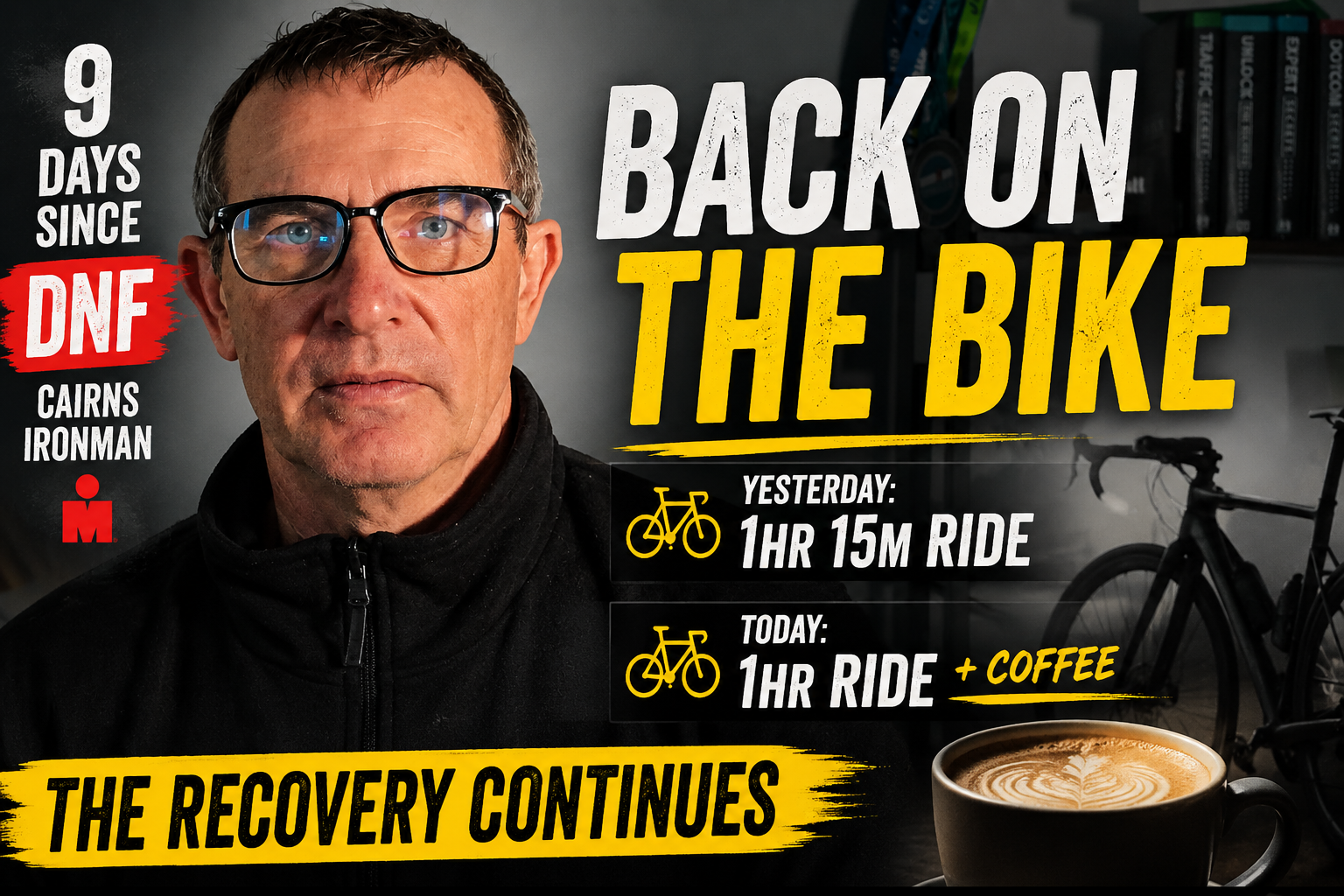
Nine days after my Ironman Cairns DNF, I'm finally starting to see some positive signs.
The Grade 2 calf tear that forced me to abandon the race at the 60km mark on the bike is slowly improving. I'm walking more freely, getting out for short afternoon walks with the dog, and over the past two days I've managed to get back on the bike for some easy rides.
Yesterday I completed a 1 hour 15 minute ride. Today, another easy one-hour spin — finishing with a well-earned coffee stop.
While it's still early days, these small milestones feel significant.
The Unexpected Challenge: Mental Health
One thing this injury has reminded me of is how closely our physical activity is linked to our mental health.
After a week and a half without training, I found myself feeling quite low.
At first, I thought I was simply frustrated about missing training sessions. But it quickly became apparent there was more to it than that.
Years ago, I suffered a serious accident while riding a BMX bike. I broke my scapula, collarbone, several ribs and punctured a lung — which kept me off all training for months.
My doctor at the time, who was also an experienced cyclist, warned me about something that has stayed with me ever since.
He said many endurance athletes become accustomed to the endorphin release that comes from regular exercise. When that suddenly stops due to injury, it's common to experience a significant dip in mental health.
This past week has reminded me just how true that is.
It's nothing to be ashamed of.
As we move through our 50s and beyond, we need to acknowledge the important role exercise plays — not just for our physical health, but also for our mental wellbeing.
| What Happens When Training Stops | Why It Affects You |
|---|---|
| Endorphin levels drop | Your body's natural mood-booster disappears |
| Daily routine disrupted | Loss of structure creates restlessness |
| Identity feels threatened | "I'm an athlete" becomes "I'm injured" |
| Sleep quality changes | Less physical fatigue = less restorative sleep |
| Social connection reduced | No training partners, no race community |
If you're going through something similar — whether it's injury, illness, or just life getting in the way of training — know that it's completely normal to feel flat. The important thing is recognising it and taking small steps to get moving again.
The Plan Moving Forward
The goal right now isn't to get fit quickly.
The goal is to rebuild properly.
This is where Project 58 really begins. For the next few weeks, my focus looks like this:
Cycling
| Week | Volume | Focus |
|---|---|---|
| Weeks 1–2 (now) | 1–1.5 hours/day | Easy aerobic riding, flat routes |
| Weeks 3–4 | 1.5–2 hours | Gradually reintroduce climbing |
| Weeks 5–6 | 2+ hours | Add some tempo efforts |
Running
| Milestone | Timeline |
|---|---|
| First test jog | Not before the 4-week mark |
| Reassess | Based on how the calf responds |
| Rebuild phase | Zone 2 running only — no intensity |
| Add speed work | Only when pain-free for 2+ weeks |
Swimming
| Target | Details |
|---|---|
| Return to pool | Around mid-July |
| Build phase | 8–9 weeks back in the water before racing |
| Focus | Technique and endurance, not speed |
Patience is everything here. At 57, I know pushing back too early risks turning a 6-week setback into a 6-month one.
A Different Approach to Racing This Season
I've also decided to simplify my racing schedule.
Instead of focusing on longer events, I'll spend the remainder of the year racing shorter distances.
The first race back will likely be the Moreton Bay Triathlon on 27 September.
The focus will be:
- 🏃 Shorter, sharper races
- ⚡ Building speed and VO2 max
- 📈 Increasing bike threshold power
- 😄 Enjoying the process again
At 57 years old, I know I may never have the same top-end power I had in my 20s, 30s and even early 40s.
But I also know there's still plenty of room for improvement — and that's what Project 58 is all about.
Looking Back on a Fantastic Season
As disappointing as Ironman Cairns was, I don't want one DNF to overshadow an incredible season.
Before Cairns:
| Achievement | Detail |
|---|---|
| Races completed | 9 |
| Podium finishes | 9 out of 9 |
| Age group wins | 2 outright |
| Fastest run split (age group) | Twice during the season |
| Queensland Tri Series | Age Division Champion |
| Australian Age Group Team | Selected for World Championships |
That's something to be proud of.
Unfortunately, the injury means I won't be ready to represent Australia in Spain this year — but that's okay.
There will be other opportunities.
One Race Doesn't Define the Journey
Ironman Cairns taught me something important.
The goal isn't simply to complete one race.
The goal is to build a sustainable, enjoyable and healthy lifestyle that allows us to keep moving well into our 50s, 60s and beyond.
Sometimes setbacks force us to slow down, reassess and come back stronger.
That's exactly what this next chapter is about.
I'd Love to Hear From You
What are your goals for the upcoming season? Are you training for a triathlon, returning from injury, or simply trying to stay active as you get older?
Leave a comment below.
Because this journey isn't just about racing anymore.
It's about longevity.
Navigating your own comeback from injury or building towards your first race? I offer a free 30-minute training review to help you create a plan that works for your body, your schedule, and your goals.
Related Reading: