I get asked this question more than any other.
"Des, I'm in my 50s. I'm overweight. I haven't exercised properly in years. Is it too late to start triathlon?"
The short answer is no.
The long answer is this blog post.
Because I didn't arrive at the start line of Ironman Cairns as a lifelong elite athlete who never missed a training session. The truth is messier than that — and I think more useful.
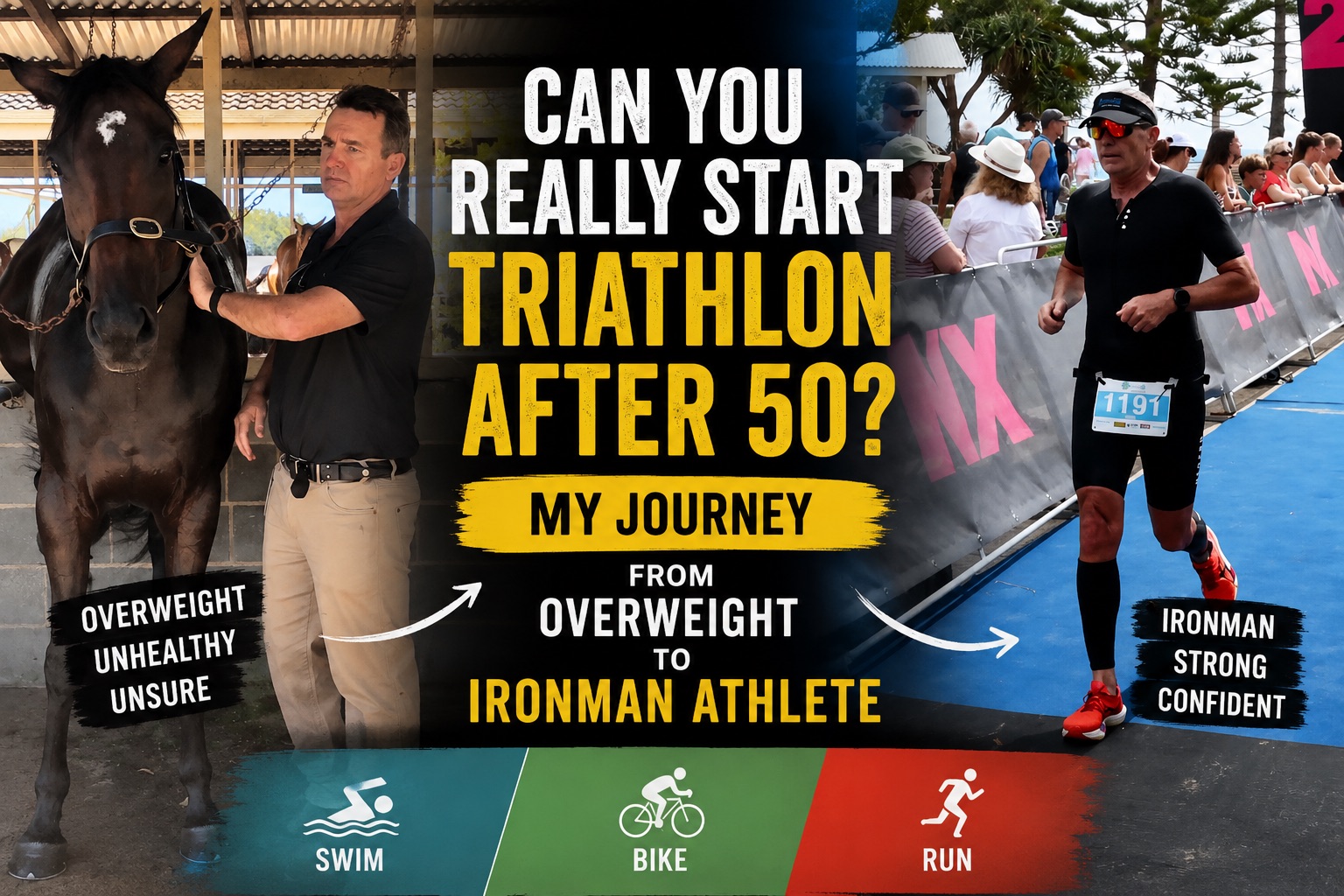
The Photo on the Left
If you've seen the thumbnail for this article, you'll notice two very different versions of me.
The photo on the left is the one most people don't expect.
I was overweight. Unfit. Working long hours as a racing steward — early starts, late finishes, irregular schedules, and meals grabbed on the run. The kind of lifestyle where exercise is the first thing that drops off the list.
I'd raced triathlon as a younger man. My first race was back in 1983 at age 13, when the sport was barely known in Australia. I'd even represented Australia at the ITU World Championships in Honolulu in 2005.
But life has a way of getting in the way.
Work took over. The weight crept on. The fitness disappeared. And the idea of standing on a start line again felt like it belonged to a different person.
The Turning Point
There wasn't one dramatic moment. No doctor's warning. No single event that changed everything overnight.
It was quieter than that.
It was looking in the mirror and not recognising the person staring back.
It was getting puffed walking up stairs.
It was realising that the sport I'd loved my entire life was slipping further and further away — and if I didn't do something about it now, it would be gone for good.
So I made a decision.
Not a New Year's resolution. Not a 12-week challenge. Not a dramatic social media announcement.
Just a quiet decision to start moving again.
Starting From Scratch (Almost)
The hardest part wasn't the training.
The hardest part was accepting where I was.
I'd been a competitive triathlete. I'd raced at World Championship level. And now I was struggling to run for 10 minutes without stopping.
That gap between who you were and who you are right now is brutal. It's where most people quit before they've really started.
Here's what I learned:
You Don't Need to Be Fit to Start
You need to start to get fit. That's the order. Not the other way around.
Consistency Beats Intensity
In those early weeks, I wasn't doing anything impressive. Short walks. Easy swims. Gentle rides. Nothing that would make a highlight reel.
But I showed up. Day after day. Week after week.
And slowly, the body responded.
Your Body Remembers More Than You Think
If you've been active at any point in your life, your body retains a surprising amount of that foundation. The fitness comes back faster than you expect — not overnight, but faster than starting from zero.
I've written about this in detail in Why Running Feels Harder After 40 — and How to Fix It, where I explain how ageing affects performance and what you can do about it.
The Progression
Here's roughly how my return unfolded:
| Phase | Focus | Duration |
|---|---|---|
| Phase 1: Just Move | Walking, easy swimming, short rides | First 2–3 months |
| Phase 2: Build Consistency | Regular training 4–5 days/week, all low intensity | Months 3–6 |
| Phase 3: Add Structure | Introduced training zones, structured sessions | Months 6–12 |
| Phase 4: Start Racing | First sprint triathlon, then Olympic distance | Year 1–2 |
| Phase 5: Push the Boundaries | Half Ironman, then full Ironman preparation | Year 2+ |
Notice what's missing from the early phases?
Speed work. Threshold sessions. High-intensity intervals.
None of that matters when you're rebuilding your base. The foundation comes first — always.
If you want to understand the science behind this approach, the Complete Guide to Triathlon Training Zones explains why Zone 2 training is the backbone of endurance performance.
What Changed Physically
The weight came off — not through dieting, but through consistent training and better habits.
The energy came back.
The sleep improved.
The mental clarity sharpened.
And something I didn't expect: the confidence returned.
Not just confidence in sport. Confidence in everything. Work. Relationships. Daily life.
There's something powerful about proving to yourself that you can still do hard things.
Where I Am Now
Fast forward to today.
At 57 years old, I'm in the best shape of my life.
This season alone:
- Nine races. Nine podium finishes.
- Queensland Tri Series — Overall Age Division Points Champion
- Selected for the Australian Age Group Team for the 2026 World Championships in Pontevedra, Spain
- Preparing for Ironman Cairns — 3.8km swim, 180km bike, 42.2km run
None of this was on the radar when I started moving again.
I wasn't thinking about Ironman. I wasn't thinking about World Championships. I was thinking about surviving a 20-minute jog.
But that's how it works. You don't need to see the whole staircase. You just need to take the first step.
The Five Things I Wish I'd Known
If I could go back and give myself advice at the start of this journey, it would be this:
1. Start Slower Than You Think
Every comeback athlete goes too hard too early. I did it too. The ego wants to train like you're 30. Your body is not 30.
Start embarrassingly easy. Your future self will thank you.
2. Invest in Recovery
When you're over 50, recovery isn't optional — it's where the adaptation happens. Sleep, nutrition, mobility work, and rest days are not weaknesses. They're the foundation.
3. Find Your Community
Triathlon can be a lonely sport if you let it. Join a club. Find a training partner. Connect with other masters athletes. The accountability and camaraderie make a massive difference.
4. Get Your Gear Right Early
You don't need the most expensive equipment, but you do need gear that fits properly and is comfortable. A properly fitted wetsuit, a bike that suits your body, and shoes that support your feet will prevent most early injuries.
I covered wetsuit selection in detail in Swimming in a Wetsuit: What Every Triathlete Needs to Know.
5. Don't Compare Yourself to Anyone
Especially not your younger self. The only comparison that matters is you today versus you yesterday.
The Myth of "Too Late"
The age-group fields at triathlon events are full of athletes who started in their 40s, 50s, and even 60s.
Some of the strongest, most consistent athletes I've raced against picked up the sport later in life. They bring discipline, patience, and life experience that younger athletes often lack.
Triathlon doesn't care about your age.
It cares about whether you're willing to show up and do the work.
A Practical Starting Point
If you're reading this and thinking "That sounds great, but where do I actually begin?" — here's a simple framework:
| Week | Swim | Bike | Run |
|---|---|---|---|
| 1–2 | 15–20 min easy | 20–30 min easy | 15–20 min walk/jog |
| 3–4 | 20–25 min easy | 30–40 min easy | 20–25 min jog |
| 5–6 | 25–30 min with drills | 40–50 min easy | 25–30 min jog |
| 7–8 | 30 min structured | 50–60 min with hills | 30 min continuous |
Rules:
- All sessions at conversational pace (Zone 1–2)
- Include at least one full rest day per week
- Listen to your body — skip a session if something hurts
- No racing for at least 8–12 weeks
For a more detailed plan, download one of the free training plans from the resources page.
Final Thoughts
Can you really start triathlon after 50?
Absolutely.
I'm living proof.
The person in that left photo — overweight, unhealthy, unsure — is the same person who now stands on podiums, represents Australia, and is preparing to race Ironman Cairns in 10 days.
The difference wasn't talent. It wasn't genetics. It wasn't some secret training method.
It was a decision to start, the patience to build slowly, and the discipline to keep showing up.
If you're sitting on the fence, wondering whether it's worth trying — it is.
The start line is waiting.
And trust me, crossing the finish line for the first time will be one of the best moments of your life.
Thinking about getting started? I'm offering a free 30-minute training review for masters athletes at any level — whether you're a complete beginner or returning after a break.
You can also explore the free resources page for training plans, nutrition guides, and gear checklists to help you take that first step.