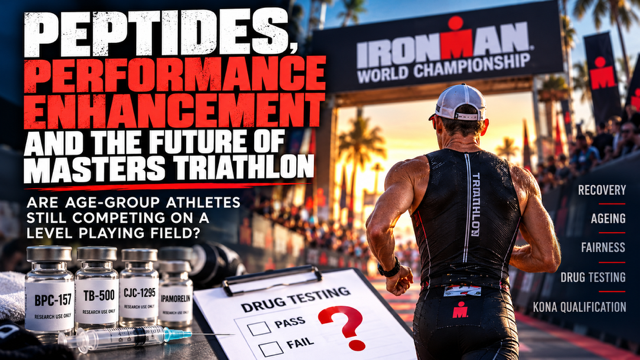
Are age-group athletes still competing on a level playing field?
I've been competing in triathlon since 1983. That's more than four decades of swimming, cycling, running, racing, training, injuries, setbacks and the occasional moment when everything comes together.
At 58, I'm still competing regularly, chasing podium finishes and working towards qualifying for international championships. And if there's one thing I've learned over those 43 years, it's that endurance sport rewards consistency, patience and hard work.
Recently, I came across a social media discussion that raised an interesting question:
Should age-group triathletes be drug tested after qualifying for an Ironman World Championship?
It generated plenty of opinions, and understandably so. For most age-group athletes, qualifying for Kona represents years of dedication, sacrifice and significant financial investment.
But the question got me thinking about something potentially much bigger: the rapidly growing interest in peptides, hormone therapies and other substances being promoted to older athletes for injury recovery, muscle retention, improved training capacity and slowing the ageing process.
Are we entering a new era of pharmaceutical performance enhancement in masters sport? And if we are, is age-group triathlon adequately prepared to deal with it?
Masters Athletes Are Redefining What's Possible
One of the most remarkable developments I've witnessed throughout my time in triathlon is the improvement in performance among older athletes.
Forty years ago, someone competing in their late 50s was often considered an exception. Today, athletes in their 50s, 60s and even 70s are producing extraordinary endurance performances.
Modern training methods, improved nutrition, sports science and better equipment have all contributed. Athletes are also far more knowledgeable about recovery, strength training and maintaining fitness as they age.
But make no mistake: age-group racing, particularly at the pointy end of World Championship qualification, is seriously competitive. In some age groups, minutes or even seconds separate athletes chasing the same qualification slot.
Those small margins matter. And when the stakes are high, the temptation to search for every possible advantage naturally increases.
Most of those advantages are perfectly legitimate — better coaching, improved nutrition, aerodynamic equipment and smarter training programs are all part of the sport.
But what happens when athletes begin exploring pharmaceutical interventions that may fall outside anti-doping regulations? That's where the discussion becomes considerably more complicated.
The Growing Popularity of Peptides
Unless you've been completely disconnected from social media, you've probably noticed the increasing discussion about peptides. They're appearing in fitness communities, longevity discussions, men's health circles and online conversations about injury recovery.
Some are promoted as solutions for stubborn tendon injuries. Others are marketed for muscle growth, fat loss, improved sleep or slowing the ageing process. For an older athlete dealing with declining recovery capacity or recurring injuries, those promises can sound attractive.
What Exactly Are Peptides?
Peptides are short chains of amino acids that can influence various biological processes. Importantly, not all peptides are the same.
Some peptide-based medications, such as insulin, are established medical treatments. Others are experimental substances with limited human research, uncertain safety profiles and significant anti-doping implications.
Among those attracting attention in athletic and anti-ageing communities are:
| Peptide | How it's commonly promoted |
|---|---|
| BPC-157 | Tendon, ligament and soft-tissue recovery |
| TB-500 | Tissue repair and musculoskeletal recovery |
| CJC-1295 | Stimulating growth hormone pathways |
| Ipamorelin | Growth hormone release |
These are not conventional nutritional supplements. They have significant biological activity, and all four are prohibited in sport according to Sport Integrity Australia.
Something being described as a recovery aid doesn't automatically make it safe, effective or legal in competitive sport.
What Does the Research Actually Say?
This is where things become particularly interesting. While online discussion about peptides keeps growing, the scientific evidence supporting many of the claims remains surprisingly limited.
Current Sports Medicine Reports (July 2026) published a review examining supplementation among masters athletes and adults over 55. It considered established supplements such as protein, caffeine and creatine alongside emerging peptides, including BPC-157 and thymosin-related compounds.
Its findings highlighted an important problem: much of the available research comes from younger populations, and evidence specifically involving masters athletes remains limited. The authors emphasised the need for better age-specific research and careful consideration of safety and legality.
That's particularly relevant to those of us racing in our 50s and 60s. We're being exposed to increasingly sophisticated marketing claims about substances that haven't been properly evaluated in people our age.
A review in the American Journal of Sports Medicine (2026) examined emerging peptide supplements used for musculoskeletal recovery. The researchers found that interest in these substances had moved well ahead of the evidence. Despite promising results in some laboratory and animal studies, reliable evidence of meaningful benefit in humans remains insufficient — and there are unresolved questions about long-term safety.
In September 2026, UCLA Health published a similar assessment, warning that marketing claims surrounding unapproved peptides were running well ahead of established medical evidence.
In other words, the popularity of peptides doesn't mean they work as advertised. And for athletes there's another consideration: even if a substance eventually proves beneficial for recovery, it may still be prohibited in competition.
Australian Authorities Are Already Raising Concerns
This isn't simply an overseas issue.
In May 2026, Sport Integrity Australia issued a warning about the growing use and promotion of peptides, highlighting serious health and anti-doping risks. It specifically identified BPC-157, TB-500, CJC-1295 and ipamorelin as prohibited in sport.
The warning was significant because these products are frequently marketed as recovery or wellness treatments rather than traditional performance-enhancing drugs.
But anti-doping rules don't distinguish between someone using a prohibited substance to recover from an injury and someone using it to improve performance. The rules depend on the substance, method, circumstances and any applicable therapeutic use exemption. For substances prohibited at all times, using them outside competition can still constitute an anti-doping rule violation.
Australia's Therapeutic Goods Administration (TGA) has also expressed concern about unapproved peptide products, warning about uncertain product quality, inaccurate labelling, contamination and potentially serious health consequences.
That should concern anyone considering these substances — but particularly competitive athletes. You could compromise both your health and your eligibility to compete.
The Masters Athlete Dilemma: Recovery Versus Performance
This is where the subject becomes personal for me.
At Ironman Cairns in June, I suffered a Grade 2 calf tear that ended my race. It was my first DNF since 1986.
After more than four decades in the sport, walking away from an Ironman because of injury is incredibly disappointing. And the frustration doesn't end when you leave the course. There's the rehabilitation, the loss of fitness, the gradual return to training and the uncertainty about how long it will take to regain your previous form.
At 58, recovery isn't as straightforward as it was at 25. It takes patience. It requires listening to your body. And sometimes it means accepting that the process simply cannot be rushed.
Now imagine someone offering you a substance that supposedly accelerates soft-tissue healing and gets you back training weeks earlier. I can understand why that might sound appealing — particularly when you've invested months preparing for a major race.
But here's the question:
If an athlete uses a prohibited substance to recover faster from an injury, is that any different from using a prohibited substance to improve race-day performance?
From a sporting integrity perspective, I believe the distinction is difficult to justify.
Recovery is an essential component of athletic performance. If one athlete can recover more quickly, train more consistently or tolerate greater workloads through prohibited pharmaceutical assistance, that could provide a competitive advantage.
Of course, the claimed recovery benefits of many experimental peptides haven't been established in reliable human studies. But the underlying principle remains: the rules governing prohibited substances apply to the preparation process, not just what happens on race day.
Testosterone Replacement Therapy: Another Complicated Question
Peptides aren't the only substances generating discussion among older athletes. Testosterone replacement therapy (TRT) has become an increasingly prominent topic in men's health and longevity circles.
As men age, testosterone levels may decline. For some individuals, medically supervised testosterone treatment may be appropriate for a diagnosed condition. That is a legitimate healthcare issue.
However, testosterone is also a prohibited anabolic agent under anti-doping rules, and having a prescription doesn't automatically give permission to use it while competing. Athletes may require a therapeutic use exemption (TUE), which must meet established medical criteria.
This raises some challenging questions for masters sport:
- Should an athlete receiving testosterone therapy be allowed to compete against athletes who aren't?
- What if the treatment is medically prescribed?
- What if the athlete argues they're simply restoring hormone levels rather than seeking an advantage?
These aren't questions that can be answered by age alone. But I believe one principle is fundamental: athletes entering the same competition should be subject to the same anti-doping requirements. Legitimate medical treatment should be respected — and the TUE process exists precisely to balance medical necessity with fair competition.
Is Doping Actually a Problem in Age-Group Triathlon?
Before going any further, I want to be clear.
There is insufficient reliable evidence to conclude that prohibited peptide use is widespread among masters triathletes. The popularity of peptides in online fitness and anti-ageing communities doesn't establish that significant numbers of competitive age-group athletes are using them.
We should be extremely careful about making assumptions. An athlete producing an outstanding performance in their late 50s or 60s shouldn't automatically be viewed with suspicion.
I've spent more than 40 years watching exceptional athletes achieve extraordinary things through dedication and consistency. Some people have remarkable natural ability. Others have spent decades developing their endurance. Many combine both. Their performances deserve respect.
However, the absence of reliable prevalence data doesn't mean the issue should be ignored. It means the discussion needs to be evidence-based.
There is a legitimate difference between asking whether existing anti-doping safeguards are sufficient and suggesting that successful competitors are cheating. My interest is firmly in the former.
Age-Group Drug Testing Is Already Happening
One interesting finding from researching this subject is that age-group triathletes are already subject to anti-doping testing.
- IRONMAN runs an anti-doping program covering professional and age-group athletes. According to reporting by Triathlete in 2025, IRONMAN confirmed age-group testing can be based on finishing positions or information gathered through its anti-doping intelligence arrangements.
- World Triathlon conducts anti-doping controls involving age-group athletes at its World Championships.
So this isn't about introducing drug testing into age-group triathlon for the first time. It already exists.
The more relevant question is whether the current level of testing is a meaningful deterrent — and whether the growing interest in emerging substances warrants a rethink of how testing resources are allocated.
Challenge Roth Has Already Taken Further Action
In 2025, Challenge Roth expanded its age-group anti-doping program, working with Germany's national anti-doping agency (NADA) and placing greater emphasis on both testing and athlete education. The initiative included dried blood spot testing, which makes collecting samples more practical at a mass-participation event.
That's significant. Roth attracts thousands of competitors, including some of the world's most competitive age-group athletes, and the organisers recognised that sporting integrity isn't exclusively a professional issue. Age-group competitors also deserve confidence that they're racing under fair conditions.
Interestingly, the focus wasn't only on catching deliberate cheats. With more athletes using supplements, wellness products and other treatments, there's a real risk of competitors breaching the rules inadvertently. That doesn't remove their responsibility — but it highlights why education matters. I believe other major endurance events could learn from that approach.
Should Ironman World Championship Qualifiers Be Tested?
Let's return to the original question.
My view is that there is a strong argument for more extensive testing. Not necessarily testing every qualifier — that would involve considerable expense and logistical challenges — but a properly run program combining random testing, targeted testing and greater scrutiny of qualifying performances.
Consider a hypothetical example. Two athletes spend years preparing for an Ironman, both chasing the same World Championship slot. One follows the rules, trains consistently and manages recovery through permitted methods. The other uses prohibited substances during preparation.
If the second athlete takes the slot, the consequences extend beyond a finishing position. The clean athlete may lose an opportunity they've spent years working towards.
And unlike professionals, most age-group competitors fund their own participation. Training, equipment, travel, accommodation and race entries represent a substantial financial commitment. A World Championship qualification is a major achievement — surely protecting its integrity is worth taking seriously.
Testing Alone Won't Solve Everything
Of course, anti-doping testing isn't a perfect solution. Some substances are difficult to detect. Others are only detectable for limited periods. And testing after a race doesn't necessarily reveal what was used during months of preparation.
Out-of-competition testing helps address that, but it's more expensive and harder to administer across large amateur fields. That's why I believe a combination of approaches makes sense:
- Random testing of World Championship qualifiers
- Targeted testing informed by credible intelligence
- Appropriate testing at major championships
- Greater athlete education, including clear information about prohibited substances and therapeutic use exemptions
The objective shouldn't be to create an atmosphere of suspicion. It should be to reinforce the principle that competing clean matters at every level of the sport.
The Anti-Ageing Industry and Masters Sport
Perhaps the biggest emerging challenge is the growing overlap between the anti-ageing industry and competitive masters sport.
The market for products promising improved recovery, muscle retention, longevity and physical performance is booming. Some treatments have legitimate medical applications. Others are experimental. And some are prohibited under sporting rules.
For someone simply wanting to improve their general health, the discussion may focus on medical evidence, safety and regulatory approval. But for a competitive athlete there's another layer: sporting eligibility.
A treatment doesn't become permissible under anti-doping rules simply because it's marketed as anti-ageing or prescribed for a medical condition. That puts the responsibility on athletes to understand exactly what they're using — and I wonder how many age-group competitors genuinely appreciate that distinction, particularly those entering competitive sport later in life.
Are Masters Athletes Receiving Enough Anti-Doping Education?
I suspect many age-group athletes have limited knowledge of anti-doping rules. Most understand that anabolic steroids and blood doping are prohibited. But what about:
- Peptides?
- Growth hormone secretagogues?
- Hormone replacement therapies?
- Certain medications?
- Supplements contaminated with prohibited substances?
The regulations can be complicated, and for athletes outside professional environments, reliable information isn't always readily available.
This is where national federations, race organisers, coaches and sporting integrity organisations have an important role. We shouldn't assume that because someone competes at an amateur level, they don't need anti-doping education. If anything, the opposite is true: age-group athletes often make their own decisions about supplements, medications and recovery treatments without the medical support professionals have.
If you're unsure about any product or medication, the free Sport Integrity App from Sport Integrity Australia lets you check substances against the prohibited list.
What Does Fair Competition Actually Mean?
There's an interesting philosophical question underlying this whole discussion. Age-group triathlon has never been completely equal.
Some athletes can afford the latest superbikes. Others have access to professional coaching, altitude camps and sophisticated recovery facilities. Some can train 20 hours a week; others are balancing full-time work, family and whatever training time they can find.
Those differences have always existed, and they're part of amateur sport.
But there's a distinction between unequal access to legitimate resources and the use of prohibited substances. One operates within the rules. The other doesn't.
We may never achieve a perfectly level playing field. But we can insist that everyone competes under the same fundamental rules. For me, that's what fair competition means.
My Perspective After 43 Years in Triathlon
At 58, I'm still motivated by many of the same things that attracted me to triathlon as a teenager. I enjoy the training. I enjoy the competition. And I enjoy seeing whether I can keep improving as I get older.
This season I'm again competing in the Queensland Triathlon Series — two rounds in, two silver medals — while continuing to rebuild after my injury earlier this year.
None of that comes easily. There are mornings when the legs feel heavy, sessions when the pace isn't where I'd like it, and periods when recovery takes longer than expected. But that's part of the challenge. I want to discover what I'm capable of through training, consistency and smart preparation.
I have absolutely no issue with athletes using every legitimate advantage available: better equipment, improved nutrition, strength training, professional coaching and appropriate medical treatment. These are all part of modern sport.
But there's an important distinction between optimising performance within the rules and using prohibited substances to gain an advantage. That distinction should apply whether you're competing for an Olympic medal or an age-group World Championship slot.
So, Is It Time for More Age-Group Drug Testing?
I believe it is.
Not because I think everyone is cheating. And certainly not because exceptional masters performances should automatically be questioned. Quite the opposite — the extraordinary achievements of clean age-group athletes deserve to be protected.
The growing interest in peptides and pharmaceutical recovery treatments presents new challenges for sport. Medical research is still developing. Commercial marketing is moving rapidly. And athletes are increasingly exposed to substances that may be prohibited, unapproved or poorly understood.
I'd like to see major triathlon organisations continue strengthening their anti-doping programs, particularly around World Championship qualification:
- More random testing
- Appropriate targeted testing
- Greater transparency about anti-doping education and enforcement
- Clearer information for masters athletes about peptides, hormone therapies and prohibited substances
Because ultimately, a World Championship qualification should represent athletic achievement — not access to prohibited pharmaceutical assistance.
After more than four decades in triathlon, I still believe the foundations of endurance performance remain remarkably simple:
Consistency. Patience. Hard work. And the willingness to keep showing up.
Those principles have served the sport well for generations. I'd like to think they'll continue to define age-group competition long into the future.
What Do You Think?
💬 Should Ironman and other major triathlon organisations expand anti-doping testing for age-group World Championship qualifiers? Do you believe the growing popularity of peptides and hormone-related treatments is a genuine challenge for masters sport? Or is the current approach to testing and education enough?
I'd love to hear your views in the comments below — particularly from those competing in the over-50 categories. Because regardless of our age, ability or ambitions, we all deserve the opportunity to compete fairly.
This article is general information and opinion only, not medical or legal advice. Always speak with a registered medical practitioner before starting any treatment, and check substances with Sport Integrity Australia if you compete.
Research and Further Reading
- Sport Integrity Australia — Peptides Pose Serious Anti-Doping and Health Risks (13 May 2026) — official Australian guidance on prohibited peptides, health risks and potential sanctions.
- Current Sports Medicine Reports — Effects of Supplementation in Masters Athletes and Older Adults (July 2026) — a review of supplements and emerging peptides among masters athletes and adults over 55.
- American Journal of Sports Medicine — Peptide Supplements and Their Therapeutic Applications in Sports Medicine (2026) — a review highlighting the gap between commercial claims and the available human clinical evidence.
- UCLA Health — With Peptide Supplements, Marketing Outpaces the Medicine (September 2026) — on the promotion of unapproved peptides and the limited evidence behind their claims.
- Therapeutic Goods Administration — Concerns Regarding Public Health Risks Associated with Unapproved Peptide Products (2026) — Australian regulatory warnings on product quality and health risks.
- Triathlete — Challenge Roth Will Drug-Test Age-Group Triathletes in 2025 — on expanded age-group testing at Roth and existing IRONMAN and World Triathlon programs.
- Sport Integrity Australia — Peptides Explained — which peptides are prohibited and athletes' responsibilities.