After months of consistent training, the final weeks before a big race should be exciting.
You've done the hard work. The fitness is there. Race day is approaching.
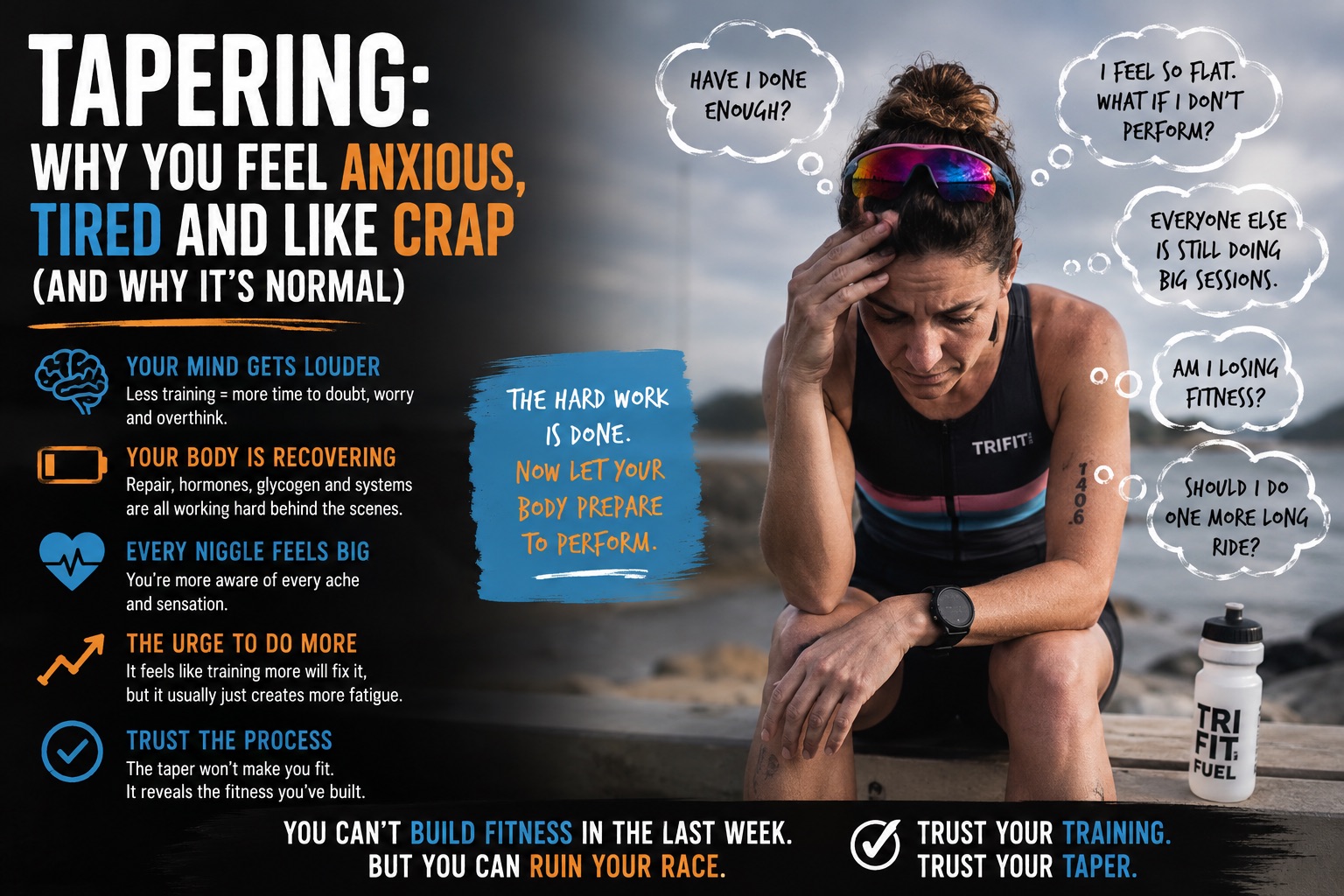
So why do so many triathletes suddenly feel anxious, sluggish, irritable, and convinced they're losing all their hard-earned fitness?
Welcome to the strange world of tapering.
If you've ever felt worse during your taper than you did during your biggest training weeks, you're certainly not alone.
With Ironman Cairns now just one week away, I'm living this right now. And I can tell you — even after 40+ years of racing, the taper still messes with your head.
"I Feel Terrible. My Race Must Be Ruined."
One of the most common conversations among triathletes during taper week sounds something like this:
"My legs feel heavy."
"I'm exhausted."
"My heart rate is weird."
"I feel flat."
"I haven't felt this unfit in months."
Ironically, these feelings often occur when athletes are at their fittest.
The problem is that after months of training, your body and mind become accustomed to carrying a certain level of fatigue. It becomes your normal.
When training volume suddenly drops, your body begins repairing itself. Muscles recover, inflammation reduces, hormone levels rebalance, and energy stores are replenished.
During this process, it's not uncommon to feel a little off.
| What You Feel | What's Actually Happening |
|---|---|
| Heavy, sluggish legs | Muscles repairing and rebuilding |
| Unusual fatigue | Body redirecting energy to recovery |
| Restless sleep | Reduced physical fatigue disrupting routine |
| Irritability | Less endorphin release from shorter sessions |
| Weight gain (1–2 kg) | Glycogen and water stores replenishing |
Some athletes feel fantastic immediately. Others feel terrible right up until race morning.
Both responses are completely normal.
Why Anxiety Increases During a Taper
During peak training, life is simple.
Wake up. Train. Eat. Recover. Repeat.
Every session feels productive. Every workout provides reassurance that you're getting fitter.
Then the taper arrives.
Suddenly there are fewer sessions, more free time, and less physical fatigue to distract you.
That leaves plenty of room for something else to creep in:
Doubt.
Questions begin circulating through your mind:
- Have I done enough training?
- Am I losing fitness?
- What if I don't perform?
- Should I squeeze in one more hard session?
- What if my competitors are training more than me?
The reality is that nothing has changed except your training volume.
The fitness you've built over months doesn't disappear in a week or two.
But your brain doesn't always believe that.
I wrote about managing this mental shift in 3 Weeks to Go — Fitness Is Banked, Health Is Everything, where the same doubts were already creeping in during the early taper phase.
The Strange Feeling of Being Tired While Training Less
This is perhaps the most confusing part of a taper.
Many athletes expect to feel energetic and unstoppable the moment training volume drops.
Instead they feel exhausted.
Why?
Because recovery itself requires energy.
For months, your body has been prioritising training. Now it finally has the opportunity to:
- Repair damaged muscle fibres
- Replenish glycogen stores
- Restore hormone balance
- Address accumulated fatigue
Think of it as finally paying off a debt you've been carrying all season.
The tiredness is often a sign that recovery is actually occurring.
Every Ache Feels Like a Major Injury
During taper week, athletes suddenly become hyper-aware of every sensation.
A tight calf becomes a potential race-ending injury.
A sore shoulder becomes a major concern.
A slight niggle in the knee feels catastrophic.
The reduced training load means you're no longer distracted by long sessions and daily fatigue. Small aches that were always present suddenly receive your full attention.
I experienced this firsthand with my calf scare during the final build. The key lesson? Respond, don't react. Assess calmly, manage sensibly, and don't let anxiety turn a niggle into a crisis.
Most of these concerns disappear once the race begins.
The Temptation to Train More
This is where many athletes make their biggest mistake.
Feeling flat often creates an urge to prove fitness.
A hard run. A big bike session. An extra swim. Something to reassure yourself that you're ready.
Unfortunately, the final week before a race is not where fitness is gained.
It's where races can be compromised through unnecessary fatigue or injury.
| What You Want to Do | What You Should Do |
|---|---|
| One more long ride | Short, sharp opener session |
| Hard threshold run | Easy 20–30 min jog |
| Extra swim to "feel the water" | Planned session only, then rest |
| Train through the anxiety | Trust the plan and recover |
The goal is no longer to get fitter.
The goal is to arrive healthy.
For a deeper look at how to structure these final sessions by intensity, the Complete Guide to Triathlon Training Zones explains what Zone 1–2 work looks like during a taper.
What a Good Taper Week Actually Looks Like
For athletes wondering what they should actually be doing in the final 7 days, here's a general framework:
| Day | Session | Effort |
|---|---|---|
| 7 days out | Short swim + easy ride | Zone 1–2 |
| 6 days out | Easy 20–30 min run | Zone 1–2 |
| 5 days out | Short swim with a few race-pace efforts | Mostly easy |
| 4 days out | Easy 30–45 min ride with 3×3 min openers | Zone 2 + brief Zone 3 |
| 3 days out | Short easy swim or complete rest | Zone 1 |
| 2 days out | 15–20 min easy jog + 3×30 sec strides | Shake out |
| 1 day out | Complete rest or 10 min easy swim | Nothing hard |
| Race day | Trust the process | Let it rip |
Notice the pattern: everything gets shorter, nothing gets harder.
Trust the Process
I've experienced this myself before every major race.
The closer race day gets, the more tempting it becomes to second-guess the training.
But experience has taught me that the feelings during a taper are often misleading.
- Heavy legs can become fast legs
- Low motivation can become race-day excitement
- Doubt can disappear the moment the start gun sounds
The key is understanding that taper anxiety is often a sign that the race matters to you.
It means you've invested the time, made sacrifices, and genuinely care about the outcome.
That's not weakness. That's commitment.
Final Thoughts
If you're feeling anxious, flat, tired, or worried during your taper, you're probably experiencing exactly what thousands of other triathletes experience before a big race.
It doesn't mean you're losing fitness.
It doesn't mean your preparation has failed.
It doesn't mean you're not ready.
In fact, it may simply mean your body is doing exactly what it should be doing — recovering and preparing to perform.
You can't build fitness in the last week. But you can ruin your race.
Trust your training. Trust your taper.
Race day is about revealing your fitness, not building it.
See you on the start line in Cairns. 🏁
If you're heading into a taper and want a second set of eyes on your final week, I'm offering a free 30-minute training review for masters athletes.
For more on managing the mental and physical challenges of racing over 40, read Why Running Feels Harder After 40 — and How to Fix It.