Triathletes love numbers.
Watts on the bike. Pace per kilometre. Heart rate. HRV. Swim splits. Training load. FTP. Recovery scores.
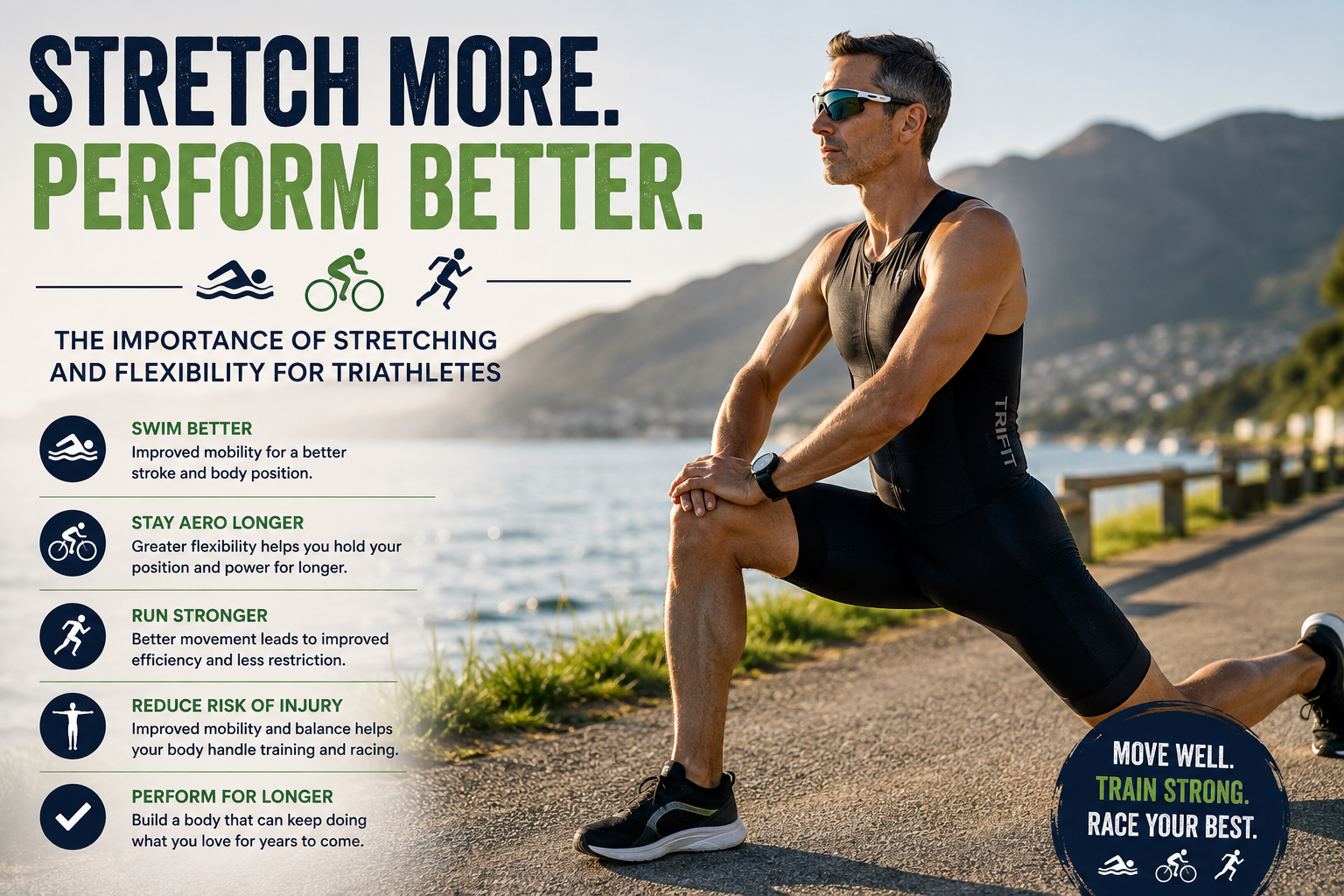
We can spend hours analysing how to swim faster, produce more power on the bike and run more efficiently. Yet one area of training is still regularly pushed aside because it doesn't necessarily feel like "real training":
Stretching, flexibility and mobility.
It's easy to look at a 20–30 minute flexibility session and think that time would be better spent adding another few kilometres to the bike or run.
But particularly as we get older, maintaining our ability to move well can become an important part of maintaining — and potentially improving — our performance.
The goal isn't to become a gymnast. The goal is to give our body enough usable range of motion to swim, ride and run efficiently.
Flexibility, Mobility and Stretching Aren't Quite the Same Thing
These terms are often used interchangeably, but there are some differences.
- Flexibility generally refers to the ability of muscles and other soft tissues to lengthen through a range of motion.
- Mobility is our ability to actively control movement through that range.
- Stretching is one of the tools we can use to maintain or improve flexibility.
For a triathlete, all three can matter.
You might have enough fitness to hold 200 watts comfortably, but if tight hips make it difficult to maintain your aero position, you're potentially giving away some of the aerodynamic advantage you've trained so hard to develop.
You might have excellent cardiovascular fitness, but restricted hip extension or ankle mobility can affect how freely you run.
And in swimming, limited shoulder and thoracic mobility can make achieving an efficient position in the water more difficult.
Fitness is only part of performance. We also need to be able to move effectively enough to use that fitness.
Swimming: Creating a Better Position in the Water
Swimming is probably the discipline where mobility restrictions can become most obvious.
An effective freestyle stroke requires movement through the shoulders, upper back and torso while maintaining good body position. Restrictions through the shoulders and thoracic spine can make it harder to achieve a comfortable streamlined position and an effective catch.
Instead of moving freely, the athlete may compensate elsewhere.
Improving mobility won't magically turn someone into a faster swimmer, but it can help create the physical environment required for better technique.
For triathletes, useful areas to work on include:
- Shoulders
- Lats
- Chest
- Thoracic spine
- Trunk rotation
- Ankles
The easier it is to get your body into the positions required for an efficient freestyle stroke, the better opportunity you have to apply your strength and technique effectively.
Cycling: Mobility Can Help You Stay Aero
This is one of the areas I believe triathletes sometimes overlook.
We spend thousands of dollars trying to become more aerodynamic. Aero helmets. Wheels. Tri suits. Bikes. Extensions. Bike fits.
But can your body actually hold an aerodynamic position comfortably for the duration of your race?
A lower, narrower position isn't particularly useful if you have to sit up every ten minutes because your hips, lower back, shoulders or neck can't tolerate it.
Hip mobility is particularly important. When we're riding in an aggressive aero position, the hip angle becomes more closed. If we lack sufficient mobility or control around that position, maintaining it can become uncomfortable and potentially interfere with how effectively we produce power.
Regular work around the hips, hip flexors, glutes, hamstrings and thoracic spine may help you become more comfortable in your race position.
And that can have a direct performance implication.
If improved mobility allows you to remain comfortably aero for longer while producing the same power, you may go faster without producing another watt. That's free speed.
If you want to know exactly how much power you're holding — and for how long — that's where a power meter earns its keep. I've written more about that in Training with Power: Why Every Triathlete Should Use a Power Meter.
Running: Allowing the Body to Move Naturally
Running involves thousands of repeated movements.
Even during a relatively short triathlon run, we're asking our body to repeat essentially the same movement pattern over and over again. If certain areas are restricted, the body often finds another way to produce the movement.
For runners and triathletes, areas worth paying attention to include:
- Calves
- Ankles
- Hip flexors
- Glutes
- Hamstrings
- Hips
- Thoracic spine
The objective isn't to force huge ranges of motion. It's about maintaining enough functional movement that your running mechanics aren't unnecessarily restricted.
This becomes even more relevant when we're running off the bike. We've just spent a significant amount of time in a relatively fixed cycling position and then suddenly ask the body to stand upright and run.
Some mobility work within a well-designed training program can help us maintain the movement capacity needed for both disciplines. (Having torn a calf myself this year, I've learnt not to take that transition for granted — more on that in 3 Weeks Back Training After My Calf Tear.)
The Masters Athlete Has Another Reason to Pay Attention
For athletes in their 40s, 50s, 60s and beyond, I think mobility deserves even more attention.
We naturally tend to lose some flexibility and mobility as we age, particularly if we're not actively maintaining it. Then add work, driving, sitting at a desk and the repetitive nature of endurance training.
The answer isn't simply to stretch harder. It's to make mobility, flexibility and strength part of the overall training program.
I increasingly look at endurance performance through four interconnected areas:
- Strength
- Mobility
- Endurance
- Recovery
We often obsess over the endurance component while giving the others whatever time is left over.
For a masters athlete who wants to continue racing well for another 10, 20 or even 30 years, I think that approach needs to change.
The objective isn't just to be fit this season. It's to build a body that can continue training consistently for years to come.
Can Stretching Actually Make You Faster?
This needs some perspective.
Simply becoming more flexible doesn't automatically make you faster. More flexibility is not necessarily better, and excessive flexibility without the strength and control to use that range isn't the goal.
The performance benefit is more likely to come from addressing restrictions that interfere with your sport-specific movement.
Think about it this way. If mobility work helps you:
- achieve a better swimming position,
- maintain your aero position longer,
- move more freely when running,
- tolerate your training positions better, or
- arrive at key sessions feeling less restricted,
then it is contributing to performance.
Not because stretching itself produces watts or improves VO2 max, but because it can help you use the fitness you've already developed more effectively.
When Should a Triathlete Stretch?
This is where it's important to distinguish between different types of stretching.
| Timing | Best type of stretching | Examples |
|---|---|---|
| Before harder training or racing | Dynamic mobility | Controlled leg swings, hip movements, shoulder rotations, walking lunges |
| After easy sessions / later in the day | Longer static stretching | Held stretches for tight areas, dedicated flexibility work |
| As its own session | Mixed mobility + flexibility | 15–30 min routine, 2–3× per week |
Before harder efforts, I generally prefer dynamic mobility that gradually takes the body through the ranges it's about to use. Longer static stretching is generally better placed away from maximal efforts.
A dedicated session doesn't need to take an hour. Even 15–30 minutes performed consistently two or three times each week can become a valuable part of the overall program.
Consistency is far more important than occasionally doing an enormous stretching session because everything suddenly feels tight.
Don't Stretch Everything Just Because You Can
Mobility training should have a purpose.
If you've already got plenty of range through a particular joint, continually trying to increase that range may provide little benefit. Instead, identify where you're genuinely restricted. Ask yourself:
- Can you comfortably maintain your aero position?
- Can you reach overhead without excessive compensation?
- Do you have adequate ankle movement?
- Are your hip flexors constantly feeling restricted?
- Does one side move significantly differently from the other?
Those questions are far more useful than simply deciding that every triathlete needs to touch their toes.
And if you have persistent pain, recurring injuries or significant asymmetry, that's where working with an appropriately qualified physiotherapist or other health professional can be valuable.
Mobility Doesn't Replace Strength Training
I see mobility and strength as partners.
Having range of motion is useful. Being able to control that range and produce force through it is even more useful. That's why a good triathlon program — particularly for masters athletes — should include both.
For example, improving hip mobility can be beneficial, but strengthening the glutes, hamstrings and surrounding musculature helps the athlete control and use that movement. Likewise, shoulder mobility can help swimming mechanics, but strength and stability around the shoulder remain important.
We don't simply want flexible athletes. We want strong athletes who move well.
Stop Judging Training Only by Calories Burned
One of the hardest mindset changes for endurance athletes is accepting that not every valuable training session needs to leave us exhausted.
A 30-minute mobility session might barely register on your training platform. There may be no impressive Strava graph. No average watts. No kilometre splits. No personal best.
But that doesn't mean nothing happened.
If those 30 minutes help you move better, maintain your position, tolerate your training load and get more from tomorrow's key session, they've done their job.
Sometimes the sessions that improve performance aren't the sessions that look impressive on your watch.
The Bigger Picture: Train for Performance and Longevity
Triathlon performance isn't simply about how much training we can cram into a week. It's about how consistently we can train, recover and adapt.
As I've got older, I've become increasingly interested not just in how fast we can race today, but how we keep ourselves capable of racing tomorrow.
That's particularly important for masters athletes.
We want to swim strongly. We want to produce power on the bike. We want to run fast. But we also want to keep doing those things into our 60s, 70s and hopefully beyond. That means looking after the body that allows us to do it.
So the next time you're tempted to skip your stretching or mobility session because it doesn't feel like "training", remember:
Performance isn't only about building a bigger engine. It's also about making sure the chassis can use it.
Train strong. Move well. Recover properly. And keep doing the sport you love for as long as possible.
If you'd like a training program that treats strength, mobility, endurance and recovery as equal partners — not afterthoughts — that's exactly how I coach. You can book a free intro call or explore my free training resources to get started.
Have a mobility routine that works for you, or an area you always struggle to keep loose? I'd love to hear about it in the comments below.
Coach Des Trindall Trindall TriFit Training should fit around your life — not the other way around.