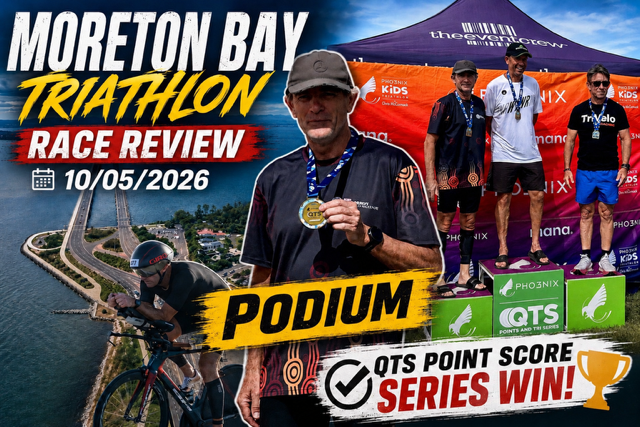
The Moreton Bay Triathlon — the final round of the Pho3nix Queensland Tri Series and, for me, the last proper race simulation before Ironman Cairns in 31 days. A 2 km swim, 60 km bike, and 15 km run, literally 2 kilometres from my front door.
This wasn't an A-race. It was a dress rehearsal — for pacing, nutrition, equipment, and race-day execution. And it delivered exactly what I needed: a podium, a series win, and one very important lesson that might have saved my Cairns campaign.
Why This Race Mattered
I deliberately chose the Classic distance (the longest option) for two reasons:
- Ironman preparation — a 60 km bike and 15 km run off a 2 km swim is a solid race-intensity simulation six weeks out
- Race nutrition testing — I wanted to practise my Cairns nutrition plan at an intensity slightly above Ironman race pace
There were shorter club and enticer distances available, but this was about testing systems under pressure, not chasing a time.
Pre-Race Conditions
| Factor | Detail |
|---|---|
| Start time | 6:23 am (Wave 2 — white caps, 50+ age group) |
| Wave gap | ~3 minutes behind Wave 1 (pink caps, under 50s) |
| Wetsuit | Required — cooler mornings after a southerly front |
| Wind | Light breeze, minimal chop |
| Temperature | Cool but manageable — much better than the rain and heavy chop from 2025 |
The cold snap earlier in the week had everyone expecting the worst, but Sunday morning delivered near-perfect conditions. Light wind, manageable swell, and enough overcast to keep the temperature comfortable.
The Swim — 2 km (2 laps)
Course Layout
Two laps of roughly 1 km each. Beach start into shallow water (waist-height for about 50 m out to the first buoy), then out to the far turning buoy on the left, down the back straight, around the bottom, and back into the beach for lap two.
How It Went
I positioned myself on the far left of the field at the start. The shallow water let me use a push-dive technique — diving forward, pushing off the bottom, surfacing and diving again — staying controlled and keeping the heart rate low.
By the first buoy, I was surprised to find myself leading the swim by two to three body lengths.
That wasn't the plan. I'd wanted to practise swimming on someone's hip or feet — drafting skills I'll need at Cairns. But no one was there to draft off.
So I put my head down and focused on what I could control: smooth stroke, consistent breathing, and sighting.
The Sighting Challenge
Sighting was tricky in the early-morning light:
- Overcast sky made buoys harder to spot against the water
- Tinted goggles — I wore them expecting sun later, but in hindsight clear lenses would have been better for the darker start
- Enough chop to make buoys disappear between swells
On the first lap, I drifted in on the back straight — a sighting error that cost time. But it gave me a fix for lap two: I used the big white inflatable water park at Clontarf as a background landmark, which let me hold a much straighter line on the second lap.
| Lap | Back Straight | Sighting Method |
|---|---|---|
| Lap 1 | Drifted in — had to correct back out to buoy | Buoy-only (difficult in low light) |
| Lap 2 | Straight line — much cleaner | Landmark sighting (water park) |
Swim Exit
Exiting the water, I looked over my shoulder:
- Nearest white cap: 30–40 seconds behind
- Next group: 2+ minutes back
- Average heart rate: 138 bpm — very conservative
- Effort level: Controlled and comfortable
That's exactly where I want the swim to be heading into Cairns — fast enough to be competitive, easy enough to preserve energy for 180 km of riding and a marathon.
Lesson: Always have a backup sighting landmark. Buoys alone aren't reliable in low light or choppy conditions.
Transition 1
Smooth this time. The run from the beach into the park at Clontarf was short and well-marked. Found my gear quickly and was out onto the bike without drama.
The Bike — 60 km (6 laps)
Course Layout
Six laps of a roughly 10 km circuit: out of transition onto the Hornibrook Highway, up and over the bridge, U-turn at the far end, back past transition, out to a second U-turn about 2 km further, then back to start the next lap.
How It Went
Deliberately controlled. This was a pacing discipline exercise.
| Factor | Approach |
|---|---|
| Power target | Held steady — didn't push above race watts |
| Headwind | Slight headwind heading up onto the bridge — dropped speed but maintained power |
| Tailwind | Coming back off the bridge — easily above 40 km/h, touching 50 km/h at times |
| Congestion | Got busier after lap 1 as shorter distances started — extra caution needed |
The multi-lap format created some congestion challenges. You had newer riders from the shorter distances merging onto the course, and with the speed differential (particularly on the bridge descent), you had to give heaps of clearance and heaps of notice when passing.
I also got overtaken by some absolute flyers sitting on 44+ km/h — a good reminder that the Classic distance attracts a range of abilities, and you ride your own race.
Bike Result
Second-fastest bike split in my age group. Happy with that given the controlled effort — it confirmed the power target is in the right zone.
Transition 2
This one deserves a mention because it's been a weak point all season — I keep losing time hunting for my shoes in transition.
The fix? My wife bought me a bright yellow towel. Spotted my gear instantly. No wasted time, no panicking.
Sometimes the simplest solutions are the best ones. If you struggle with T2, make your setup impossible to miss.
Race belt, shoes, hat, sunnies — out onto the run.
The Run — 15 km (2 laps)
Course Layout
Two laps of 7.5 km — out along the waterfront to the turnaround at the end of the bridge (same spot as the bike U-turn), then back.
How It Went — The Good
I came off the bike still leading my age group (fastest swim, second-fastest bike). The legs felt okay initially and I settled into rhythm.
I'd been keeping mental note of race numbers in my age group throughout the day. No one from my block had passed me on the bike, so I knew I was in front.
How It Went — The Chase
At about the 3 km mark, Darren — the bloke who'd beaten me by 8 seconds at the previous race — came past me. And he was flying.
I tried to respond at the 3.5 km turnaround. For the next kilometre I pushed hard, looked down at the watch:
4:30/km — roughly the pace I'd planned to hold for the entire run — and he was pulling away from me like I was standing still.
He ran an extraordinary race. Full credit to Darren — well deserved.
How It Went — The Fade
The last 3 km were tough. At about 1.5 km to go, John came past me for second — again, well deserved. He looked fresh and strong.
I crossed the line in third place in the 55–59 age group.
| Position | Athlete | Key Strength |
|---|---|---|
| 1st | Darren | Exceptional run — uncatchable from 3 km |
| 2nd | John | Strong late-race running |
| 3rd | Me | Led swim and bike, faded on run |
Not the result I wanted on paper, but exactly the race I needed for the information it gave me.
The Shoe Wake-Up Call
This was the single most valuable takeaway from the entire race.
I'd been racing all season in the ASICS MetaSpeed Sky Tokyo — a carbon-plated speed shoe. They've been brilliant for the shorter stuff: 5 km parkruns, 10 km races, Olympic distance.
But at the 12 km mark of this 15 km run, my feet were absolutely aching. Not muscle fatigue — actual foot pain from the shoe.
The problems:
- Insufficient cushioning for anything beyond 10 km off the bike
- Minimal heel support — you feel every impact
- Poor lateral stability — I've nearly rolled my ankle on turn markers multiple times this season
- No forgiveness when fatigue sets in and form deteriorates
| Factor | Up to 10 km | 12+ km Off the Bike |
|---|---|---|
| Cushioning | Fine | Painful |
| Heel support | Adequate | Lacking |
| Stability | Marginal | Risky |
| Carbon plate benefit | Noticeable | Irrelevant when feet are aching |
The critical point: I was planning to wear these for the Ironman marathon — 42.2 km off a 180 km bike. If they failed at 12 km of a 15 km run, they would have been catastrophic at Cairns.
Better to learn this at Moreton Bay than at kilometre 30 of an Ironman marathon.
I'm now sourcing a different shoe with proper cushioning, heel support, and stability for the full distance. If you've got suggestions for a good Ironman marathon shoe, throw them in the comments.
For the deeper thinking behind why testing gear before race day matters — and why the "more is better" approach doesn't work after 50 — check out why wasting less beats doing more.
The Residual Fatigue Factor
One thing to acknowledge: I wasn't fresh for this race.
The week prior was a recovery week, but before that I'd come through a 16-hour build week — the biggest of the entire Ironman build. Four weeks of progressive loading don't fully clear in one recovery week.
That accumulated fatigue was sitting in my legs on the run. My heart rate data confirmed it — cardiac output wasn't the limiter. The legs and feet were.
That's a normal part of Ironman training. You don't taper fully for a training race six weeks out. You accept the fatigue, take the data, and use it.
If you want to understand how heart rate, power, and pace each tell you different things about what's really going on in your body, that's worth a read.
Queensland Tri Series — Overall Points Win 🏆
The Moreton Bay Tri was the final round of the Pho3nix Queensland Tri Series — an eight-race season.
With work commitments and scheduling (the joys of shift work as a racing steward), I managed to race six of the eight rounds. The series counted your best five results.
And I'm proud to say I accumulated enough points to take out the overall series points score for the 55–59 age group.
This was never a goal for the season. Every one of these races was entered as training, motivation, and race practice for Cairns.
But consistency compounds. Six races, six top-three finishes, showing up week after week. That's what did it.
Credit to the organisers for running a safe, well-structured series all year. And credit to the competition — the racing in our age group was quality throughout.
Recovery — Listening to the Body
Today is Wednesday, three days post-race. Here's how recovery has tracked:
| Day | Session | Notes |
|---|---|---|
| Monday | 60 min easy recovery ride | Felt okay — legs turning over |
| Tuesday | 90 min ride | Building back steadily |
| Wednesday (today) | 90 min run (planned 2:15) | Cut short — body said enough |
| Wednesday (later) | 3,000 m endurance swim | Steady session |
The key decision: I had a 2 hour 15 minute run planned for today. I pulled it back to 90 minutes.
Listening to the body isn't weakness — it's intelligence. Especially five weeks out from an Ironman.
If you want the science behind why backing off strategically makes you faster, read about why recovery weeks are where fitness actually happens.
Key Takeaways
- Race for information, not just results. Third place doesn't tell the full story. The swim data, shoe failure, and nutrition testing were worth more than a podium.
- Test your race gear under race conditions. A 10 km training run doesn't expose what a 15 km race off a 60 km bike will. Test everything before your A-race.
- Sighting in open water needs a backup plan. Buoys alone aren't enough in low light or chop. Always identify background landmarks.
- Simplify your transition setup. A bright towel solved a problem that cost me time at multiple races this season.
- Accumulated fatigue is real — and it's normal. Don't panic when your training race doesn't reflect your true fitness. You're not tapered.
- Consistency wins series. Show up, race smart, stay healthy. The points take care of themselves.
What's Ahead
With five weeks to Cairns, the priorities are clear:
- Source a proper Ironman marathon shoe
- Continue wetsuit swim practice
- Final build phase with race-specific intensity
- Dial in the nutrition plan that worked on Sunday
- Stay healthy and arrive at the start line ready
Thirty-one days. The nerves are real. But the preparation has been thorough, the lessons have been learned, and the hay is nearly in the barn.
Catch the full race review on YouTube: Moreton Bay Triathlon Race Review
Race week recap: 6 Weeks to Go — Recovery, Podium, and Series Win
Previous week: 7 Weeks to Go — Big Week, Big Lessons
Want to build your own race plan? Check out the Training Plans, explore the free Resources, or get in touch directly.
— Coach Des Trindall