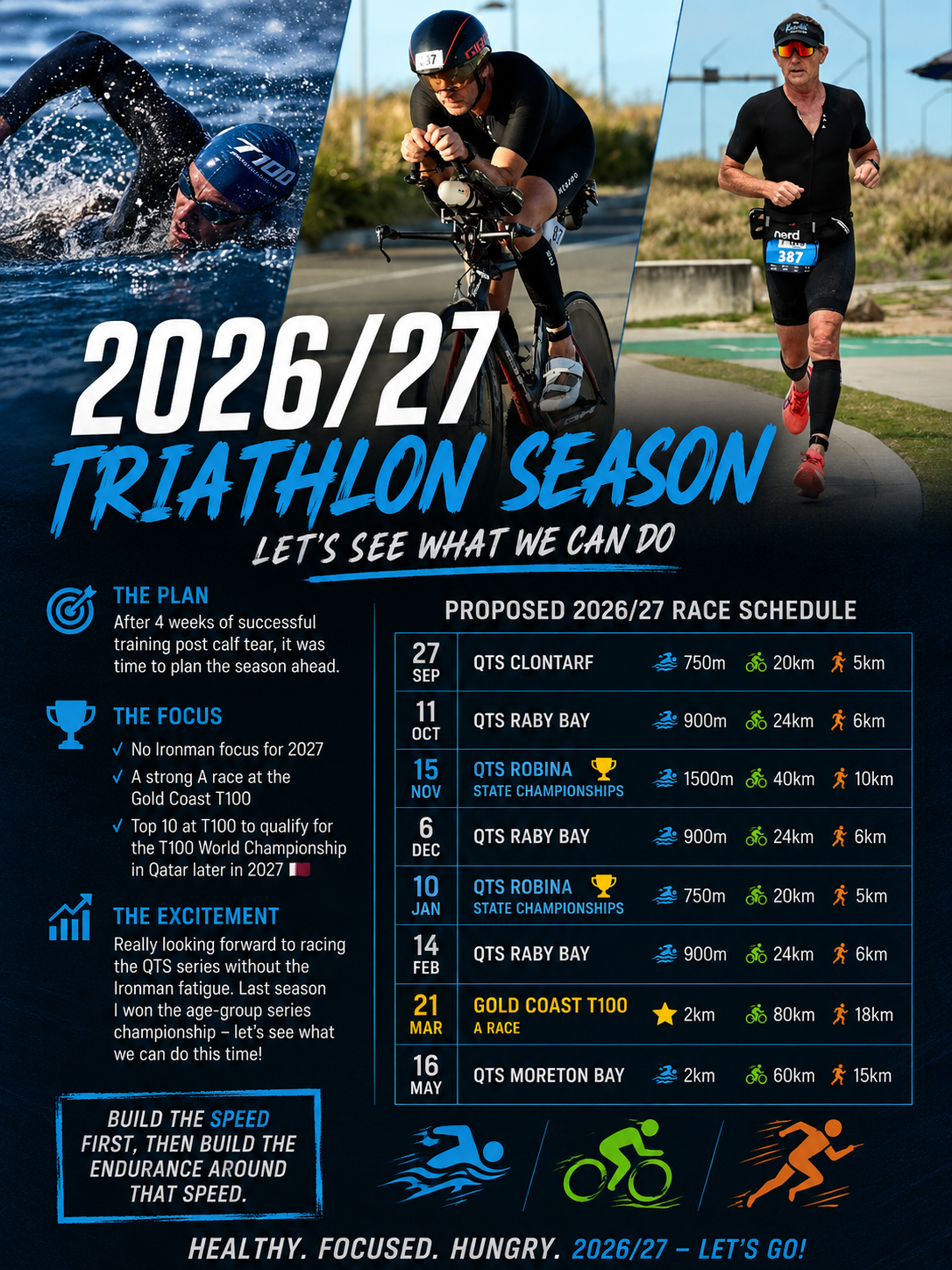
After four successful weeks back in structured training following my calf tear, I decided it was time to sit down and properly map out my 2026/27 triathlon season.
I've raced triathlon for more than four decades, and one lesson I've learnt is that a successful season rarely happens by accident. You need a destination.
Without clear goals, it's very easy to fall into the trap of simply training — swimming, riding and running each week without really knowing what you're trying to achieve. Planning your season gives every training block a purpose.
Don't just train to get fit. Train for something.
(If you missed how the comeback has been going, I covered it in 3 Weeks Back Training After My Calf Tear.)
Start With Your Biggest Goal
The first question I believe every athlete should ask is: what is the one race I most want to perform well at this season?
For me, the answer is very clear. My A race for the 2026/27 season is the Gold Coast T100 in March 2027 — a 2km swim, 80km bike and 18km run. My goal is to finish inside the top 10 of the M55–59 age group, which would earn a qualifying spot for the T100 World Championship in Qatar later in 2027.
That's a big goal. But having that target immediately gives the season direction. Instead of simply asking "what training should I do this week?", I can ask: "What does the athlete I need to be in March need to develop between now and then?" That's a much more useful question.
Not Every Season Needs to Be About Going Longer
Another major decision I've made is that there will be no Ironman focus in 2027. That's quite a change. For years, Ironman has influenced a lot of my training — the huge endurance demands of preparing for a 3.8km swim, 180km bike and marathon naturally affect everything else you do.
This season I want to find out what happens when the focus changes. Rather than building enormous endurance and then trying to find speed, we're approaching things from the opposite direction:
Build the speed first, then build the endurance around that speed.
That means developing bike power, run speed, threshold fitness and swimming speed through the shorter races before gradually extending those abilities toward the demands of the T100. I'm genuinely excited to see what difference that makes.
Use Smaller Races to Build Toward the Big One
Having an A race doesn't mean everything else is unimportant — quite the opposite. The races leading into your major goal become some of the best training and benchmarking opportunities available. Here's how my proposed 2026/27 calendar looks:
| Date | Race | Swim | Bike | Run |
|---|---|---|---|---|
| 27 Sep 2026 | QTS Clontarf | 750m | 20km | 5km |
| 11 Oct 2026 | QTS Raby Bay | 900m | 24km | 6km |
| 15 Nov 2026 | QTS Robina — State Champs | 1500m | 40km | 10km |
| 6 Dec 2026 | QTS Raby Bay | 900m | 24km | 6km |
| 10 Jan 2027 | QTS Robina — State Champs | 750m | 20km | 5km |
| 14 Feb 2027 | QTS Raby Bay | 900m | 24km | 6km |
| 21 Mar 2027 | Gold Coast T100 — A Race | 2km | 80km | 18km |
| 16 May 2027 | QTS Moreton Bay | 2km | 60km | 15km |
There's a deliberate progression within that calendar. The early races let me concentrate on speed. The Olympic-distance State Championship starts extending that speed. Then, after the January State Championship, the emphasis progressively moves toward the longer sustained efforts required for the T100.
Give Your Races Different Priorities
One mistake age-group athletes make is trying to peak for every race. You can't. That's why I like dividing races into priorities:
- A Race — Gold Coast T100. Everything ultimately leads toward 21 March. The goal is top 10 and qualification for Qatar. If something needs to be sacrificed during the season to improve my chances, the T100 wins.
- State Championships. The two Queensland State Championship races are important targets — I want to be competitive at both, and they're excellent opportunities to measure how training is progressing.
- Queensland Triathlon Series. I won my age-group points championship last season, so naturally I'd love to defend the title. But I'm particularly interested in seeing how competitive I can be without carrying the fatigue of Ironman preparation.
(If you want the backstory on that series win, it's in my Moreton Bay race review.)
Goals Make Training Measurable
One of the biggest benefits of a season plan is that progress becomes measurable. Instead of saying "I think I'm getting fitter," we can actually test it. Over the coming months I'll be watching things such as:
- Bike FTP and sustainable race power
- Power-to-weight ratio
- Aerobic efficiency
- Run pace at threshold and 5km performance
- Swim pace
- Performance off the bike
- Recovery between hard sessions
- Actual race results against athletes I regularly compete against
That last one is particularly valuable. Numbers in a training app are useful, but racing provides a reality check. If athletes who were around me last season suddenly start disappearing up the road, something needs attention. If I'm becoming more competitive against them, that's strong evidence the program is working. (This is exactly why I train with objective data — more on that in Training with Power.)
Your Goals Should Influence Your Training
This sounds obvious, but it's worth saying: your training should reflect what you're trying to achieve. Someone preparing for their first sprint triathlon shouldn't train like someone preparing for an Ironman. Likewise, an experienced athlete trying to improve their 5km run doesn't necessarily need more and more slow running.
For me, the current focus includes shorter run intervals, bike power development, increased swim frequency and race-specific intensity. Later, those demands will change — as the T100 approaches, bike sessions will include more sustained race-specific work, endurance rides will get longer, run durability will become increasingly important, and brick sessions will become more specific. The destination hasn't changed; the training required to reach it evolves as the season progresses.
Be Prepared to Change the Plan
There's another important lesson I've learnt over the years: a season plan is a roadmap, not a contract.
Injury happens. Work gets busy. Family commitments change. You get sick. Sometimes you're progressing faster than expected; sometimes you're not absorbing the training. My own season is already an example — a calf tear changed my plans and forced me to rebuild gradually. So we'll keep reviewing the program throughout the season and adjusting it according to how my body responds and what the performance data tells us. The goal stays the same. The route to get there can change.
Set Goals That Excite You
Perhaps this is the most important part. At 57, I'm still setting sporting goals that genuinely make me excited to get out of bed and train.
I don't know whether I'll qualify for the T100 World Championship. That's the point. If I knew I could do it, it wouldn't be much of a goal. I know the standard required, I know some of the athletes I'll be racing against, and I know there's plenty of work to do between now and March — but I've also raced competitively against athletes already performing around that level. That makes the goal challenging without making it meaningless. And that's where good goals should sit:
Big enough to make you work. Realistic enough to make you believe.
What's Your A Race?
Whether you're preparing for your first sprint triathlon, chasing a personal best, trying to qualify for a championship, or simply wanting to finish your first race — take some time to map out your season. Choose your major goal. Work backwards from it. Decide which races matter most. Identify what you need to improve. Then build your training around those priorities.
Don't just train to get fit. Train for something.
For me, the destination is now very clear: Gold Coast T100 — March 2027. Let's see what we can do.
If you'd like help mapping out your own season and setting goals that actually fit your life, book a free 30-minute consultation with me, or explore my free training resources to get started.
Coach Des Trindall — Trindall TriFit
Training should fit around your life — not the other way around.
What's your A race for the season ahead? Drop it in the comments below — I'd love to hear what you're building toward.