Can four weeks of consistent endurance training make a measurable difference to cardiovascular fitness?
One of the most interesting aspects of endurance training is watching how the body responds to consistent exercise. We often focus on the obvious performance indicators: running pace, cycling power, swimming speed and overall training volume. But sometimes the most interesting changes occur when we're doing absolutely nothing.
Resting heart rate can provide valuable insight into how the cardiovascular system is responding to training. As I approach the end of my fourth week of structured training following the Raby Bay Triathlon on 11 October, I've noticed an interesting trend in my Garmin data: my resting heart rate has been steadily declining.
When I compare that trend with the improvements I'm experiencing in swimming, cycling and running, it raises an interesting question. How much cardiovascular adaptation can occur in just four weeks of consistent endurance training?
Let's take a closer look.
The Starting Point: Raby Bay, 11 October
Following several months of interrupted training due to calf and hamstring injuries, Raby Bay highlighted just how much fitness I'd lost. Although I finished second in my age group, my performance was well below what I expected. My cycling power was down, my running pace was slower than anticipated, and I struggled to find the same level of comfort I'd previously enjoyed during racing.
My body weight had also increased considerably. At Ironman Cairns in June, I weighed approximately 78kg. By the time I returned to racing at Raby Bay, my weight had climbed to 87.9kg — almost 10kg of additional body weight (I wrote about that in Part 1 of my weight series).
Following Raby Bay, I made a commitment to rebuilding my endurance fitness through consistent training, improved nutrition and a gradual return to structured running. Four weeks later, the changes are becoming increasingly noticeable.
What the Garmin Data Shows
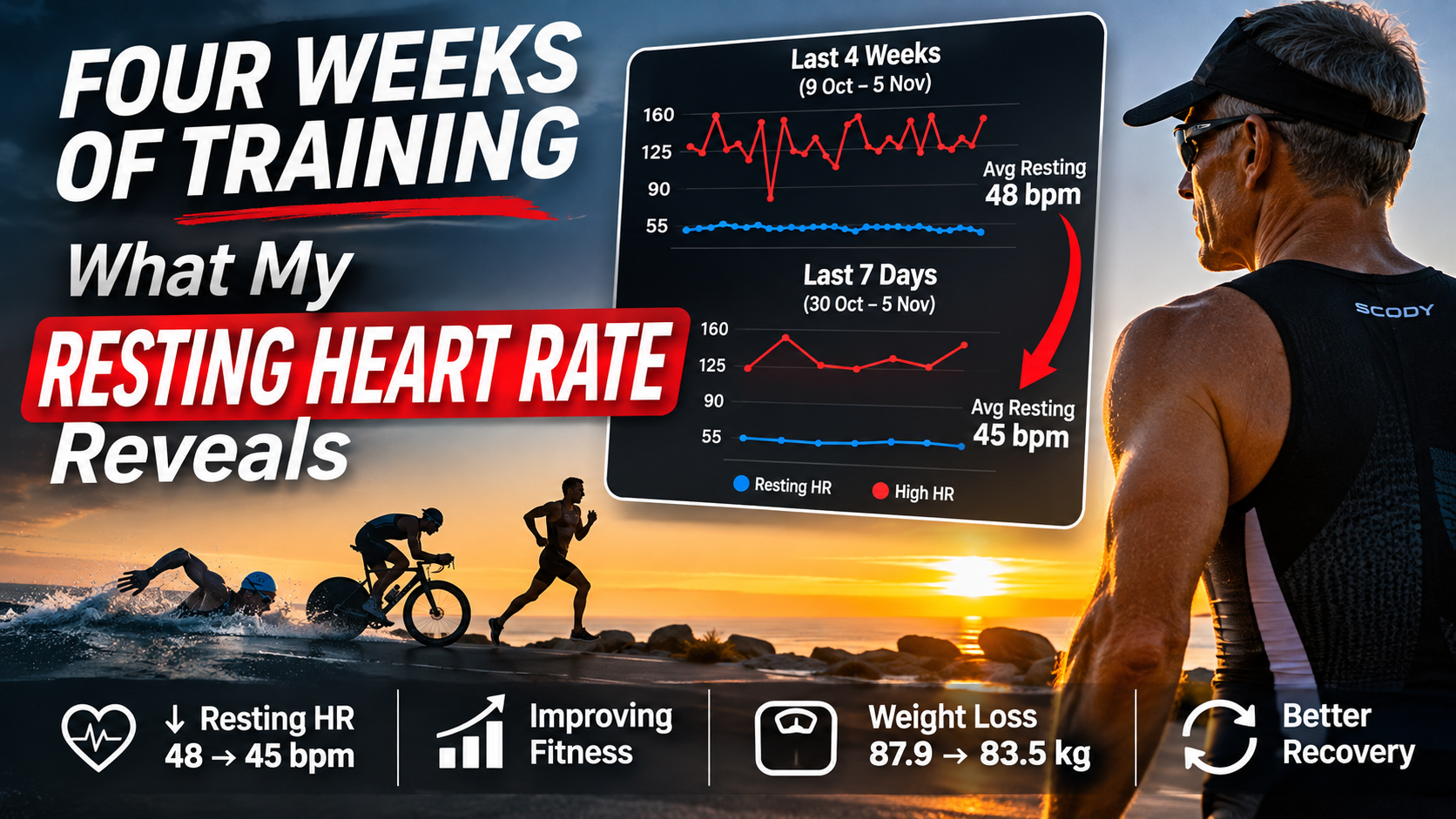
Looking at my resting heart-rate data between 9 October and 5 November, there's a clear downward trend.
| Measurement | Resting heart rate |
|---|---|
| Early October | Approximately 47–52 bpm |
| Four-week average (9 Oct – 5 Nov) | 48 bpm |
| Last seven-day average (30 Oct – 5 Nov) | 45 bpm |
| Lowest recent readings | Approximately 42–43 bpm |
The difference between my four-week average and my most recent seven-day average is three beats per minute — a reduction of approximately 6.3%.
It's important to recognise that the four-week average includes the most recent week, so these aren't two completely independent periods. Nevertheless, the daily readings show a noticeable downward progression. During the first part of October, my resting heart rate was regularly approaching 50 bpm. Over the past week, it's generally been sitting in the mid-40s, with some readings even lower.
What's particularly interesting is that this reduction has occurred during a period of increased training volume. Rather than reducing my workload, I've been consistently building my swimming, cycling and running endurance.
So what might explain the change?
Understanding Resting Heart Rate
Resting heart rate is the number of times the heart beats per minute when the body is at rest. For endurance athletes, it's a useful metric for monitoring long-term cardiovascular adaptations and changes in recovery status.
A lower resting heart rate is commonly associated with endurance training, although individual values vary considerably. Some highly trained endurance athletes regularly record resting heart rates in the 40s or even lower.
However, a low resting heart rate doesn't automatically mean someone is fitter than another athlete. Genetics, age, medication, hydration, sleep, illness and individual physiology all influence the measurement. The most useful comparison is generally against your own historical data.
The important question isn't how low your resting heart rate is compared with someone else's. It's how your resting heart rate changes over time.
Why Does Endurance Training Lower Resting Heart Rate?
Several physiological adaptations can contribute to a reduction in resting heart rate.
1. Increased Stroke Volume
Stroke volume refers to the amount of blood pumped by the heart with each contraction. Regular aerobic exercise can improve the heart's ability to pump blood efficiently. As stroke volume increases, the heart may require fewer contractions to circulate the same volume of blood while resting. This is one of the important cardiovascular adaptations associated with endurance training.
2. Increased Blood Plasma Volume
One of the earlier adaptations to consistent endurance exercise can be an increase in blood plasma volume. This can improve circulation and support cardiovascular function during exercise. Plasma-volume changes can occur relatively quickly, sometimes within the first few weeks of consistent training — although the size and timing of these changes vary between athletes.
3. Changes in Autonomic Nervous System Regulation
The autonomic nervous system helps regulate heart rate. It has two major components:
- The sympathetic nervous system, associated with increased physiological activity and the body's response to stress.
- The parasympathetic nervous system, associated with resting functions and recovery.
Endurance training can shift this balance, contributing to a lower resting heart rate. These adaptations are one reason experienced endurance athletes often develop relatively low resting heart rates. (If you'd like to dig deeper into this side of things, my HRV guide explains how heart-rate variability reflects autonomic balance.)
4. Improved Aerobic Conditioning
As the body adapts to endurance training, it becomes more efficient at transporting and utilising oxygen. These adaptations involve both the cardiovascular system and the skeletal muscles, and over time they contribute to improved endurance performance.
However, resting heart rate alone cannot establish exactly which physiological adaptations have occurred. It provides one useful piece of a much larger picture.
The Training Behind the Changes
Since Raby Bay, my training has focused heavily on rebuilding aerobic endurance. Rather than immediately chasing speed, I've concentrated on consistent training across all three disciplines.
Swimming
Three sessions each week, generally covering approximately 2,500 metres per session. These include freestyle endurance work, interval sets and strength-endurance sessions using paddles and a pull buoy.
Cycling
Cycling volume has increased considerably, with regular 90-minute rides and longer endurance sessions on weekends. One of the more encouraging observations has been my ability to produce higher cycling power at similar heart rates.
That's an important performance indicator because it suggests improved efficiency or aerobic conditioning — although environmental conditions, fatigue and cardiac drift also influence the relationship.
Running
Running has progressed to include:
- A weekly 90-minute endurance run.
- Structured 4 × 4-minute interval sessions.
- A controlled 5km tempo run.
- An additional easy 30-minute recovery run.
The biggest improvement has been how comfortable the endurance sessions are beginning to feel. My recent 90-minute runs have felt increasingly controlled, and my faster interval sessions are becoming smoother. Perhaps most importantly, the calf and hamstring injuries that disrupted much of the year are no longer causing noticeable problems during training.
The combination of increased training consistency and improving performance is encouraging. But there's another factor worth considering.
The Impact of Losing 4.4kg
Alongside the training improvements, my body weight has fallen from 87.9kg to approximately 83.5kg — a reduction of 4.4kg in less than four weeks, and now just 0.5kg away from the 83kg milestone I set in my last update.
For endurance athletes, particularly runners, body mass can have a significant influence on performance. Running requires the body to repeatedly support and propel its own weight, so reducing excess body mass can lower the mechanical and metabolic demands of running at a given pace.
However, the relationship between body weight and resting heart rate is more complicated. Weight loss doesn't automatically cause resting heart rate to decrease. Changes in hydration, energy intake, training status and body composition can all influence cardiovascular measurements. It's also worth recognising that rapid weight changes can include fluctuations in water and glycogen stores rather than exclusively body fat.
The important objective is to improve body composition without compromising training quality, recovery or muscle mass. For masters athletes, maintaining adequate energy availability is particularly important.
The goal isn't simply to become lighter. It's to become fitter, stronger and more efficient.
Does a Falling Resting Heart Rate Mean You're Getting Fitter?
This is where interpreting the data becomes particularly interesting. A gradual reduction in resting heart rate during a period of consistent endurance training can be a positive sign — but it shouldn't be viewed in isolation.
An athlete might experience a lower resting heart rate because of improved cardiovascular conditioning. But changes in sleep, stress, hydration, medication or accumulated fatigue can also affect the measurement. In some circumstances, excessive training fatigue may even be associated with a suppressed heart-rate response.
This is why monitoring performance alongside resting heart rate is so important. Consider two different scenarios:
| Scenario one: positive adaptation | Scenario two: accumulated fatigue | |
|---|---|---|
| Resting heart rate | Gradually decreasing | Decreasing |
| Training performance | Pace and power improving | Deteriorating |
| How training feels | More comfortable | Persistent fatigue, low motivation |
| Likely interpretation | Improving endurance fitness | Not a positive adaptation — back off |
The difference lies in the broader training picture.
For my current four-week block, the encouraging aspect is that my resting heart rate has fallen while my training performances have generally improved. That doesn't prove every change is caused by increased cardiovascular fitness, but it does provide useful supporting evidence.
Why Masters Athletes Should Monitor Resting Heart Rate
As we age, recovery and training management become increasingly important. For masters endurance athletes, particularly those in their 50s and 60s, maintaining consistent training without accumulating excessive fatigue can be challenging.
Resting heart rate is one of several useful monitoring tools. When combined with heart-rate variability, sleep quality, training performance and perceived exertion, it can help identify changes in recovery status.
However, individual daily readings should not be overinterpreted. A resting heart rate that's three or four beats higher than normal on a particular morning doesn't automatically mean an athlete is overtrained. Likewise, a lower reading doesn't guarantee complete recovery.
Longer-term trends are generally more informative — and that's what makes four weeks of data particularly interesting. Rather than focusing on one unusually low reading, we can examine whether a consistent pattern is developing.
A few practical tips for tracking your own resting heart rate:
- Use the same method each day — ideally your watch's overnight reading, or a manual check on waking before you get out of bed.
- Look at seven-day averages rather than single mornings.
- Note anything unusual alongside the number: poor sleep, alcohol, illness, travel, a hard session or a stressful day.
- Compare the trend with how training actually feels and performs, not just the number on the screen.
Four Weeks of Training: What Have We Learned?
Looking back at the period following Raby Bay, several changes stand out.
- Resting heart rate has declined. The seven-day average is now 45 bpm compared with a four-week average of 48 bpm.
- Running endurance has improved. The 90-minute endurance sessions are becoming more comfortable, while faster interval sessions feel increasingly controlled.
- Cycling performance is improving. Higher power outputs at comparable heart rates suggest positive changes in endurance performance.
- Body weight has decreased. A reduction of approximately 4.4kg has helped move body composition back towards a more suitable racing range.
- Training consistency has returned. Perhaps the most important improvement is the ability to train regularly without the calf and hamstring problems that disrupted the previous months.
Individually, none of these observations tells the complete story. Together, they suggest that the body is responding positively to a sustained period of structured endurance training.
What Happens During the Taper?
With the Queensland Olympic Distance State Championships at Robina approaching on 15 November, the next stage is to reduce accumulated training fatigue.
After four weeks of consistent training, the objective isn't to suddenly increase fitness through additional demanding sessions. Instead, the focus shifts towards maintaining training adaptations while allowing the body to recover. This is where tapering becomes important: reducing training volume while retaining some carefully controlled intensity can help athletes arrive at the start line feeling fresher.
It will also be interesting to monitor how resting heart rate responds as training load decreases. Will it remain around 45 bpm? Will it decrease further? Or will it increase slightly as the body adjusts to a different training stimulus?
There isn't one universally correct response. The most useful information will come from combining the heart-rate trend with how the body feels and performs — and I'll share what happens after Robina.
Final Thoughts: Sometimes the Biggest Improvements Are the Ones You Can't See
Four weeks isn't a particularly long period in endurance training. Building the aerobic foundation required for long-distance triathlon takes months and years of consistent preparation. But four weeks can be enough to observe meaningful changes in training performance and physiological measurements.
In this case, a gradual reduction in resting heart rate has accompanied improvements in cycling power, running endurance and overall training consistency. It's an encouraging combination, and it highlights why monitoring more than just pace, distance and power can be valuable.
For masters athletes, understanding how the body responds to training becomes increasingly important. Resting heart rate isn't a perfect measure of fitness. It can't tell us everything about recovery, cardiovascular function or race readiness. But when interpreted alongside training performance and general wellbeing, it can provide another useful window into the adaptation process.
The takeaway?
Fitness isn't always measured by how fast you're moving. Sometimes, one of the most interesting signs of adaptation is how slowly your heart is beating when you're standing still.
And after four weeks of consistent endurance training, that's certainly a trend worth watching.
Do you track your resting heart rate? Have you noticed it change during a solid training block — or rise when fatigue builds up? Share your experience in the comments below. And if you'd like help setting your own training zones, try my free heart rate zone calculator or find out about coaching.