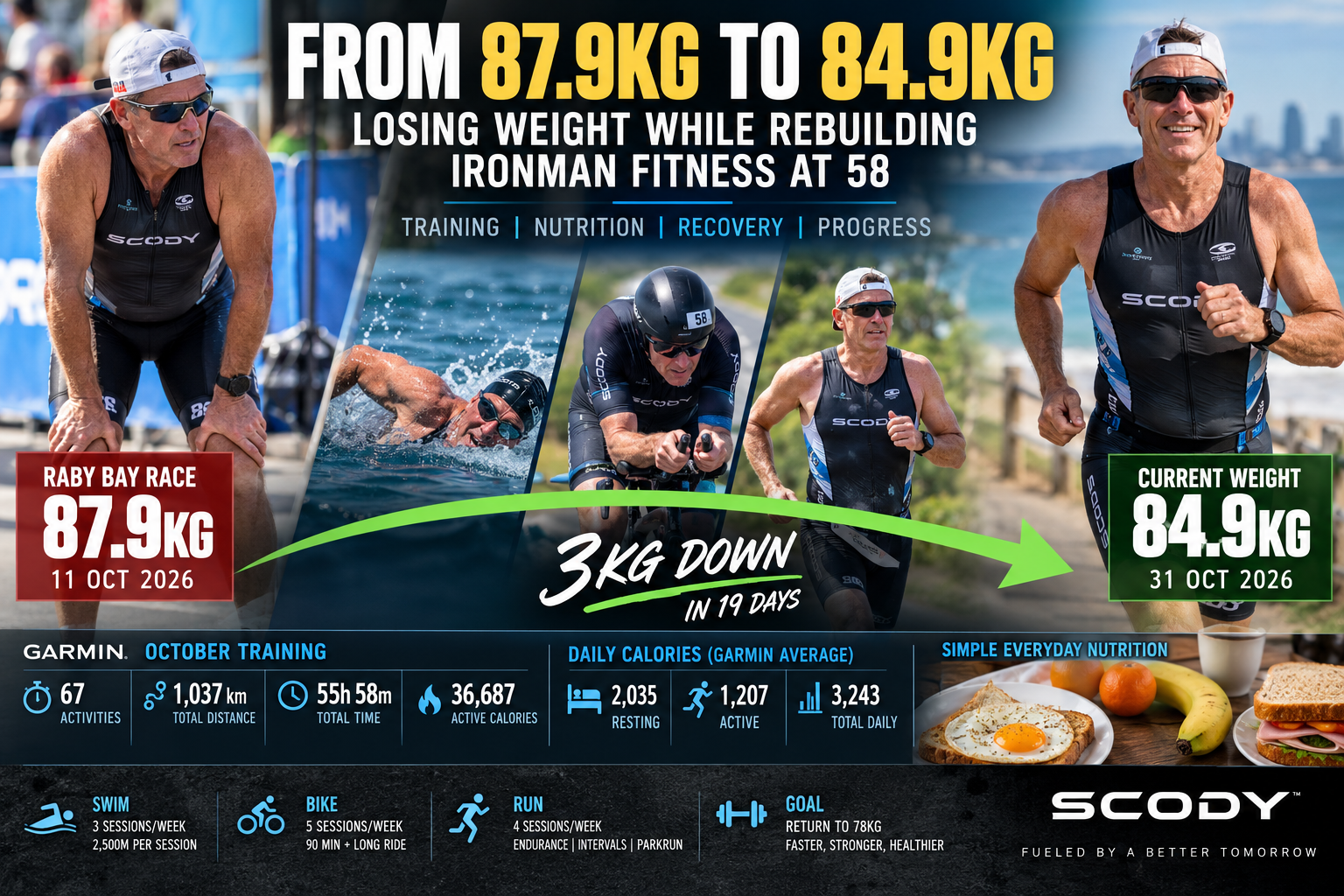
Three kilograms lighter in 19 days, almost 56 hours of recorded activity in October, and some encouraging improvements in my cycling and running. The comeback is gathering momentum.
A little over a week ago, I published From 78kg to 87.9kg: The Hidden Challenge of Returning to Triathlon After Injury at 58. In that article, I discussed the reality of gaining almost 10kg following my injury at Ironman Cairns in June, the interrupted training that followed, and the challenge of returning to competitive triathlon while carrying considerably more weight.
At the time of writing, my weight had dropped from 87.9kg to 85.8kg. Today, 31 October, I'm down to 84.9kg — a reduction of 3kg since I first weighed myself following Raby Bay on 12 October.
| Date | Weight | Change |
|---|---|---|
| 12 October (day after Raby Bay) | 87.9kg | — |
| Part 1 update | 85.8kg | −2.1kg |
| 31 October | 84.9kg | −3.0kg |
But this update isn't just about the weight I've lost. It's about the training I've been doing, how I've been managing my food intake, and what the numbers tell us about the relationship between calories consumed, energy expenditure and improving fitness.
October: A Solid Month of Training
Looking back over my Garmin Connect calendar, October has been a substantial month. Despite racing at Raby Bay on 11 October, I've managed to progressively increase my training volume while maintaining consistency across swimming, cycling and running.
My Garmin Connect totals for October were:
| Training metric | October total |
|---|---|
| Recorded activities | 67 |
| Total distance | 1,037.4km |
| Total recorded activity time | 55h 58m |
| Recorded activity calories | 36,687 kcal |
These figures include walking, warm-ups and cool-downs, rather than just my three triathlon disciplines. The interesting part is how my training has developed since Raby Bay.
Cycling: Building Aerobic Strength
I've increased my cycling to approximately five sessions per week, with most weekday rides lasting 90 minutes. The majority of these sessions have been Zone 2 aerobic work, focusing on maintaining a consistent effort rather than chasing high power numbers. Sunday remains my longer endurance ride, generally around 2.5 hours.
A considerable amount of this training has been completed indoors, partly because of the weather. While indoor training isn't always particularly exciting, there's a significant advantage: you don't stop pedalling. There's no coasting, no traffic lights and no downhill recovery. Ninety minutes on the indoor trainer provides a very consistent aerobic workload.
More importantly, I'm starting to see improvements. Over the past fortnight, I've noticed that I can produce higher power outputs at similar heart rates compared with immediately after Raby Bay. That's encouraging and suggests my cycling fitness is returning.
Running: The Confidence Is Coming Back
Running has probably been the most satisfying part of my return. Following the Grade 2 calf injury at Cairns and subsequent hamstring problems, there were times when I wondered how long it would take to feel comfortable running again.
My current weekly structure consists of:
- Tuesday: 90-minute endurance run.
- Thursday: 4 × 4-minute intervals, with two-minute walking recoveries.
- Saturday: 5km tempo parkrun, including warm-up and cool-down.
- Sunday: Separate easy 30-minute afternoon run.
The difference over the last few weeks has been noticeable. My intervals are feeling smoother, my endurance runs are becoming more comfortable, and the calf and hamstring issues are no longer something I'm constantly thinking about.
This morning's parkrun was a good example. I completed the 5km in 22:26, averaging approximately 4:29/km. It was a controlled tempo effort through the middle kilometres, with a stronger finish over the final 500m.
What makes that particularly encouraging is that I'm still carrying almost 7kg more than I was at Ironman Cairns. As the weight continues to come down and my running fitness improves, it'll be interesting to see where my pace settles.
Swimming: Maintaining Consistency
Swimming has remained relatively straightforward: three sessions per week, generally around 2,500m per session. I've been alternating between continuous freestyle, 100m intervals and strength-endurance work using paddles and a pull buoy.
The aim is to maintain swimming fitness and strength without adding unnecessary fatigue to the overall training programme.
Calories In Versus Calories Out: The Numbers Are Interesting
One of the biggest changes I've made since Raby Bay is paying closer attention to my daily calorie intake. I've set myself a target of approximately 2,000 calories per day. That's my starting point for managing nutrition, while recognising that longer or harder training days may require additional fuel.
Now compare that with what Garmin estimates I'm burning. According to my October daily calorie data:
| Average daily energy | Calories |
|---|---|
| Resting calories | 2,035 |
| Active calories | 1,207 |
| Total daily expenditure | 3,243 |
| Daily food intake target | 2,000 |
| Theoretical daily deficit | 1,243 |
That's a substantial difference. If Garmin's estimated expenditure is reasonably accurate, and I consume exactly 2,000 calories, the theoretical deficit would be around 1,243 calories per day. Over seven days, that represents approximately 8,700 calories.
Of course, these calculations are only estimates. Garmin doesn't directly measure my total energy expenditure, and my actual food intake isn't identical every day. Some training days require more carbohydrate, and longer rides need additional fuel. Nevertheless, the figures help explain why my weight has been trending down as my training volume has increased.
An important caution: a sustained deficit of more than 1,200 calories per day could be excessive for an endurance athlete completing this volume of training. Under-fuelling can compromise recovery, muscle retention, training adaptation and long-term health.
So while 2,000 calories is my current daily target, it's something I need to assess against training performance, recovery and actual weight-loss trends rather than treating it as an inflexible limit.
The objective is to reduce body fat while maintaining the energy required to train and recover properly.
What Am I Actually Eating?
I've kept my diet relatively simple. No special weight-loss products, no complicated meal plans and certainly nothing particularly fashionable. A typical day looks something like this:
- Breakfast: Usually eggs on toast, along with coffee made with low-fat milk.
- Lunch: Two ham, cheese and tomato sandwiches, generally on white bread, with a Pepsi Max.
- Snacks: Fruit such as a banana or mandarin, depending on the day.
- Dinner: A normal home-cooked meal, generally around 700 calories. That might be chicken with vegetables and potatoes, beef stew with rice, or a noodle stir-fry.
I also have coffee throughout the day, and the milk contributes to my overall calorie intake. For longer training sessions, I use additional carbohydrates where needed, including food during rides.
The important change hasn't been completely overhauling what I eat. It's been paying attention to portion sizes, daily intake and the relationship between food and training.
Having spent more than four decades involved in endurance sport, I know how easy it is to assume that because you're training regularly, you can eat whatever you like. Unfortunately, my weight gain following Cairns was a fairly good reminder that energy balance still matters.
Three Kilograms in 19 Days: How Much Is Actually Fat?
When I stepped on the scales on 12 October, I weighed 87.9kg. Today I'm 84.9kg. That's 3kg in 19 days, averaging approximately 1.1kg per week.
Using the commonly quoted estimate of 7,700 calories per kilogram of body fat, losing 3kg entirely as fat would represent an accumulated deficit of approximately 23,100 calories. Spread across 19 days, that's roughly 1,216 calories per day.
Interestingly, that's close to the theoretical daily deficit suggested by comparing my Garmin energy expenditure with my 2,000-calorie intake target.
But that doesn't prove the entire 3kg has been body fat. I've also stopped taking creatine, which may have contributed to changes in water retention. My body weight can also fluctuate because of hydration, glycogen storage, food volume and the normal physiological response to training. I've already experienced several mornings where my weight increased despite following a similar routine.
So I'm not getting too concerned about individual daily readings. What matters is the overall trend — and at the moment, that trend is heading in the right direction.
The Real Goal Isn't Just Getting Back to 78kg
One of the things I've been conscious of throughout this process is that losing weight and improving performance aren't necessarily the same thing.
Yes, I'd like to return towards the 78kg I weighed at Cairns. But I don't want to arrive there having sacrificed cycling power, swimming strength or running fitness. At 58, preserving muscle mass and recovering properly from training are particularly important. There's little point becoming lighter if it leaves me weaker.
- Running: reducing unnecessary body mass may improve running economy, provided I maintain strength.
- Cycling: the benefits depend on the course. Power-to-weight ratio becomes increasingly important on climbs, while absolute power and aerodynamics remain major considerations on flatter courses.
- Swimming: technique, body position and efficiency are generally more important than simply weighing less.
What I'm looking for is the combination of reduced body fat and improved fitness. And over the last few weeks, I'm beginning to see both moving in the right direction.
The Next Milestone: 83kg
My first weight milestone remains 83kg. At 84.9kg, I'm now 1.9kg away. I'm pleased with that progress, but I don't intend to force the remaining weight off simply to meet a deadline.
The next race is the Queensland Olympic Distance State Championships at Robina on 15 November — just over two weeks away. The priority between now and then is to continue training consistently, manage fatigue and arrive at the start line properly recovered and fuelled.
I'm particularly interested in seeing how my cycling and running compare with Raby Bay. My weight will be lower, my training has been more consistent, and my confidence is improving. Whether that translates into a faster race remains to be seen.
Beyond Robina, the bigger objective remains the Gold Coast T100 in March 2027. That's where I want to be genuinely competitive in the 55–59 age group, with the longer-term ambition of qualifying for the T100 World Championships.
What Have I Learned?
Looking back over the last three weeks, a few things stand out.
Firstly, consistency is making a difference. I've returned to regular training, with a strong emphasis on aerobic endurance rather than trying to force fitness improvements through high-intensity sessions.
Secondly, paying attention to food intake has helped me better understand my energy balance. My 2,000-calorie daily target gives me a framework, but it needs to remain flexible enough to support training and recovery.
Thirdly, the scales don't tell the whole story. Weight can fluctuate considerably from one day to the next, particularly when training volume is high.
And finally, the most encouraging changes aren't necessarily the numbers on the scales. They're how I'm feeling when I train. My cycling is getting stronger. My running is becoming smoother. The injuries are no longer holding me back. And I'm enjoying the process again.
The Comeback Continues
On 12 October, I weighed 87.9kg. Nineteen days later, I'm 84.9kg.
October has included almost 56 hours of recorded activity, more than 1,000km of combined distance, and a renewed focus on nutrition and recovery. There's still a fair way to go before I'm back to my previous racing weight. But after the disappointment of Ironman Cairns, followed by months of interrupted training, it's satisfying to see some genuine progress.
Three kilograms lighter. Cycling stronger. Running better. And feeling more like the athlete I was before the injuries.
That's a pretty good result for three weeks. And with Robina just around the corner, I'm looking forward to finding out how much difference it's making.
The weight is coming down. The fitness is coming back. And the journey continues.
Are you working your way back to fitness after injury, or trying to balance weight loss with training load? I'd love to hear what's working for you — share your experience in the comments below. And if you'd like structured support with your own comeback, take a look at my coaching.
This article is Part 2 of my return-to-fitness journey. Read Part 1: From 78kg to 87.9kg — The Hidden Challenge of Returning to Triathlon After Injury at 58. Follow along as I race the 2026/27 Queensland Triathlon Series and prepare for the Gold Coast T100 in March 2027.