When most people think about a sports injury, they think about the physical pain.
The torn muscle. The swollen joint. The weeks of rehabilitation.
But after more than 45 years in endurance sport, I've learned that sometimes the hardest injury isn't the one you can see.
It's what happens inside your head.
Training Isn't Just Exercise
For many endurance athletes, training becomes much more than a way to stay fit.
It's our routine. Our stress relief. Our social connection. Our identity.
Every morning we wake up with a purpose. There's a swim to complete. A ride to finish. A run to tick off.
Training provides structure, achievement and a daily sense of progress.
When injury suddenly removes that, it can leave a huge gap — one that's far bigger than most people realise.
The Emotional Rollercoaster
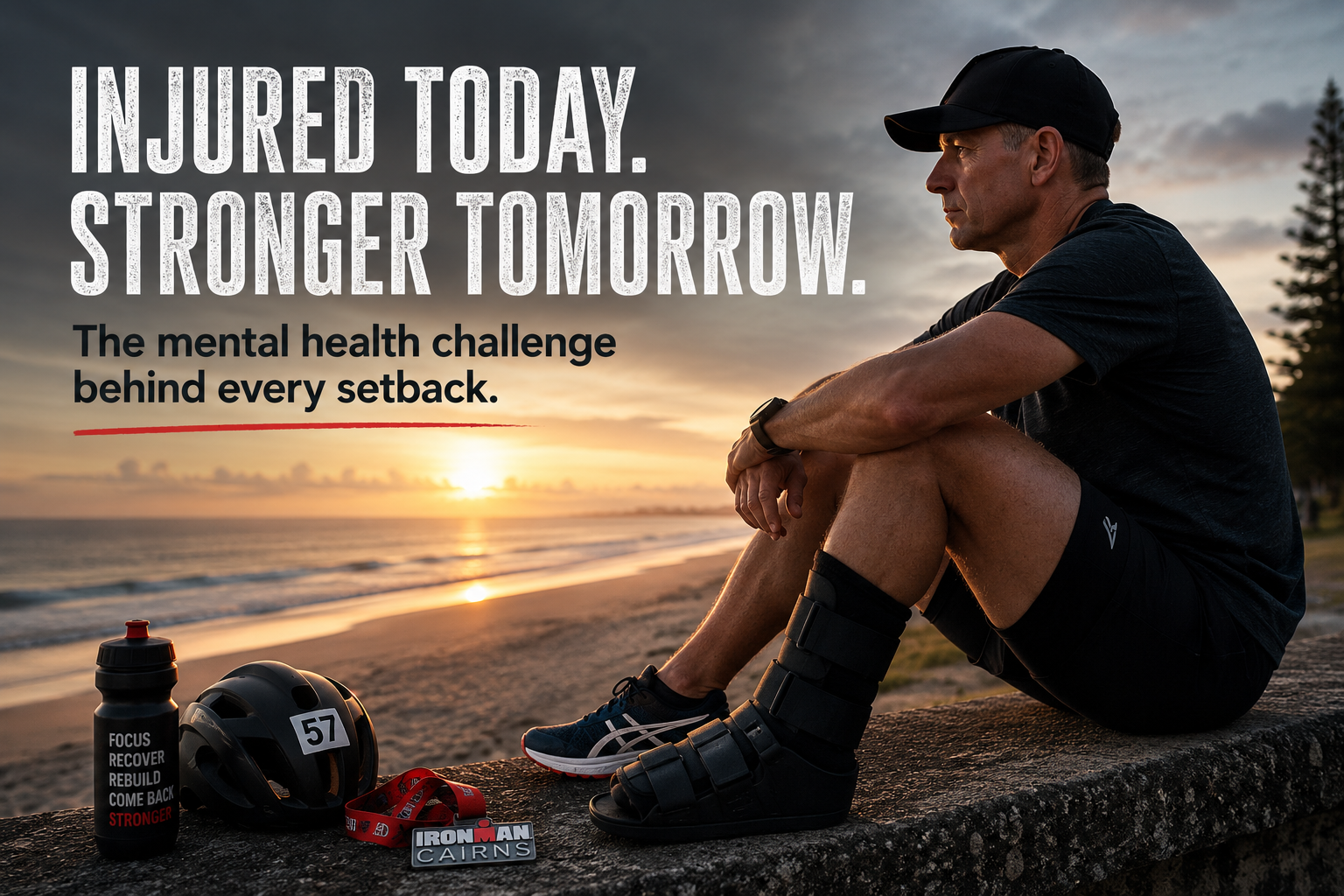
Following my DNF at Ironman Cairns and subsequent diagnosis of a Grade 2 calf tear, I experienced something I wasn't fully prepared for.
I wasn't just disappointed.
I felt flat.
After months of training towards one goal, I suddenly found myself unable to do the very thing that had become such a big part of my daily life.
Many injured athletes experience similar emotions:
| Emotion | What It Feels Like |
|---|---|
| Frustration | "I should be training right now" |
| Anger | "Why did this have to happen now?" |
| Loss of motivation | "What's the point if I can't race?" |
| Fitness anxiety | "I'm losing everything I've built" |
| Fear | "What if I never get back to where I was?" |
| Identity loss | "If I'm not training, who am I?" |
These emotions are completely normal.
If you're feeling any of these right now, you're not alone. I wrote about this same experience in 9 Days After My Ironman Cairns DNF — and the response from other athletes was overwhelming.
Your Brain Misses Exercise Too
Exercise doesn't just strengthen muscles.
It has a profound effect on our brain.
Regular endurance training increases the release of chemicals such as endorphins, serotonin and dopamine — all of which help regulate mood, reduce stress and improve wellbeing.
When training suddenly stops, those positive effects can reduce almost overnight.
| Brain Chemical | What It Does | What Happens When It Drops |
|---|---|---|
| Endorphins | Natural painkiller, "runner's high" | Mood drops, increased pain sensitivity |
| Serotonin | Regulates mood and sleep | Irritability, poor sleep, low mood |
| Dopamine | Reward and motivation | Loss of drive, reduced pleasure |
| Norepinephrine | Focus and alertness | Brain fog, fatigue, lethargy |
For athletes who have trained consistently for years, that change can be significant.
It's one reason many injured athletes report symptoms similar to depression during rehabilitation.
My doctor, who was also an experienced cyclist, once told me: "Many endurance athletes become accustomed to the endorphin release that comes from regular exercise. When that suddenly stops, it's common to experience a significant dip in mental health." That advice has stayed with me for over 20 years.
Fitness Isn't Lost Overnight
One of the biggest mistakes injured athletes make is believing they're losing everything.
The reality is very different.
| What You Think | What's Actually True |
|---|---|
| "I'm losing all my fitness" | Aerobic base takes 4–6 weeks to decline significantly |
| "I'll have to start from scratch" | Muscle memory means you rebuild 2–3x faster |
| "Everyone's getting ahead of me" | A healthy athlete always beats an injured one racing |
| "I'll never be as fast" | Many athletes come back stronger with proper rehab |
| "My season is over" | A few weeks off rarely ruins a whole season |
Fitness returns much faster than it was originally built.
Muscle memory is real. Aerobic fitness can often be rebuilt surprisingly quickly once training resumes.
Your body remembers. Recovery isn't starting from scratch.
For more on how the body responds to forced rest, read Tapering: Why You Feel Anxious, Tired, and Like Crap — the physiology is surprisingly similar.
Finding a New Purpose
What helped me most wasn't pretending everything was fine.
It was shifting my focus.
Instead of asking:
"Why can't I train?"
I started asking:
"What can I improve while I'm injured?"
That mindset changed everything.
During my recovery I focused on:
| Activity | Why It Helped |
|---|---|
| Learning about strength training | Building a foundation I'd been neglecting |
| Improving mobility | Addressing weaknesses that may have caused the injury |
| Creating YouTube content | Staying connected to the triathlon community |
| Writing blogs | Processing the experience and helping others |
| Building new business projects | Channelling energy into something productive |
| Quality time with family | Reconnecting with what matters most |
In many ways, the injury forced me to slow down and invest in areas I'd been neglecting.
This became the foundation for Project 58 — my commitment to becoming the strongest, fastest and healthiest version of myself at 58.
Recovery Is Training
One of the biggest lessons Ironman Cairns taught me is that recovery isn't time away from training.
Recovery IS training.
- Looking after your body
- Sleeping well
- Managing stress
- Improving movement
- Building strength
They're all part of becoming a better athlete.
Especially after 50.
The athletes who sustain long careers aren't the ones who never get injured. They're the ones who treat recovery with the same discipline they bring to their hardest training sessions.
You're Not Alone
If you're currently injured and feeling flat, please know you're not weak.
You're human.
The emotions you're feeling are shared by countless athletes around the world.
What You Can Do Right Now
| Action | Why It Matters |
|---|---|
| Talk to someone | A coach, a friend, a professional — don't carry it alone |
| Stay connected | Keep in touch with training partners and your community |
| Keep moving | Do whatever your healthcare professional recommends |
| Set new goals | Focus on what you can do, not what you can't |
| Be patient | Healing takes time — and that's okay |
Most importantly, remember that your value isn't determined by your training log or your race results.
The finish lines will still be there.
Your comeback will come.
Sometimes the strongest athletes aren't the ones who never get injured.
They're the ones who learn how to rebuild — both physically and mentally.
Have You Struggled Mentally After an Injury?
I'd love to hear your experience in the comments below.
By sharing our stories, we can remind each other that setbacks are just another part of the journey.
If you're navigating a comeback from injury and need guidance on how to rebuild safely, I offer a free 30-minute training review. Let's build a plan that works for where you are right now — not where you wish you were.
Related Reading:
- 9 Days After My Ironman Cairns DNF: Recovery Is About More Than Healing an Injury
- From Setback to Reset: What a Grade 2 Calf Tear Taught Me at 57
- Project 58: Building the Strongest, Fastest and Healthiest Version of Myself at 58
- Ironman Cairns 2026 — Not the Finish I Wanted
- Can You Really Start Triathlon After 50?