
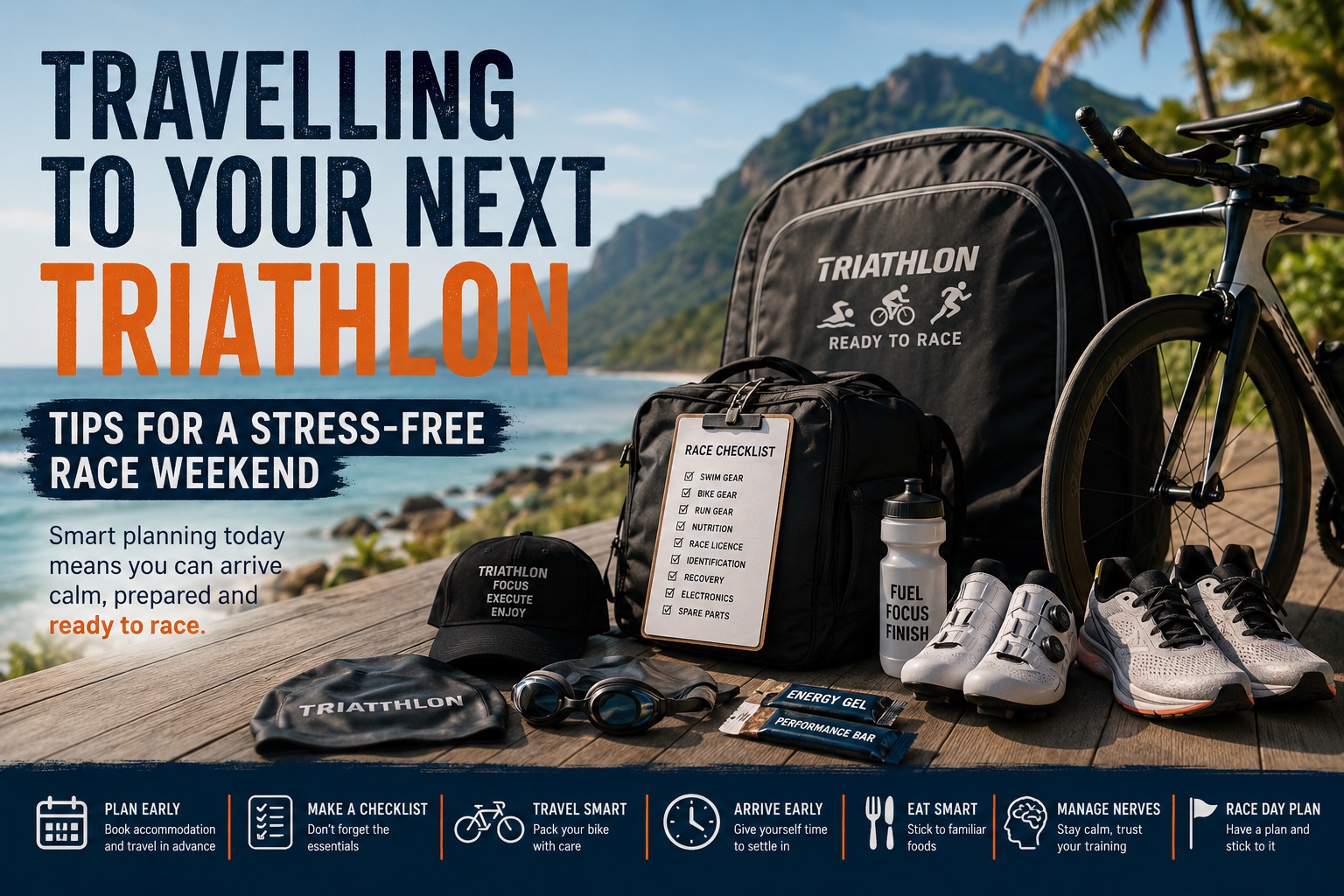
Whether you're heading to your first sprint triathlon or travelling interstate for an Ironman, race week can quickly become stressful if you're not organised.
After years of racing around Australia, I've learned that successful race weekends start long before the swim start. The goal is simple: arrive calm, prepared and ready to race.
Here are my nine essential tips for travelling to your next triathlon.
1. Start Planning Early
As soon as you enter a race, start thinking about logistics.
Book accommodation early, particularly for major events like Ironman Cairns, Noosa Triathlon or Age Group Championships. Hotels close to transition often fill quickly and become expensive.
| Consider | Why It Matters |
|---|---|
| Distance from race venue | Less travel = more rest on race morning |
| Access to race registration | Avoid unnecessary driving around |
| Bike storage options | Secure, sheltered storage for your pride and joy |
| Nearby supermarkets & restaurants | Familiar food options close by |
| Airport transfers (if flying) | Sorted in advance = zero stress |
The less time spent travelling around on race weekend, the more energy you'll have for race day.
2. Create a Race Checklist
Nothing creates panic faster than arriving at a race and realising you've forgotten something important.
I recommend creating a master race checklist that you can use for every event. We've got a detailed Race Day Checklist on the resources page, but here's the essentials:
Swim
| Item | Packed? |
|---|---|
| Wetsuit | ☐ |
| Goggles | ☐ |
| Spare goggles | ☐ |
| Swim cap (race provides, but bring a spare) | ☐ |
| Anti-chafing cream | ☐ |
Bike
| Item | Packed? |
|---|---|
| Bike | ☐ |
| Helmet | ☐ |
| Cycling shoes | ☐ |
| Nutrition (on-bike) | ☐ |
| Spare tubes (x2) | ☐ |
| CO₂ cartridges + inflator | ☐ |
| Mini pump (backup) | ☐ |
| Bike computer charger | ☐ |
| Di2 / eTap charger | ☐ |
Learned this one the hard way — a flat Di2 battery five minutes into a ride is not ideal. Charge it. Then charge it again.
Run
| Item | Packed? |
|---|---|
| Running shoes | ☐ |
| Race belt + bib | ☐ |
| Hat or visor | ☐ |
| Sunglasses | ☐ |
General
| Item | Packed? |
|---|---|
| Race licence | ☐ |
| Photo ID | ☐ |
| All chargers (watch, computer, phone) | ☐ |
| Recovery nutrition | ☐ |
| Compression gear | ☐ |
A checklist removes guesswork and reduces stress. Print it. Tick it off. Don't rely on memory.
3. Travel with Your Bike Carefully
For many triathletes, the bike is the most expensive item they'll travel with.
If flying:
- Use a quality bike travel case
- Remove pedals
- Protect the derailleur (turn it inward or remove)
- Take photos of your bike before packing — useful for insurance and reassembly
- Carry essential tools in your hand luggage
When you arrive, rebuild your bike as soon as possible and take it for a short test ride.
Don't wait until the day before the race to discover something isn't working properly.
If you get a flat during reassembly, knowing how to fix it without a tyre lever will save you a trip to the bike shop.
4. Arrive Earlier Than You Think You Need To
One of the biggest mistakes athletes make is arriving too late.
For longer races, I prefer to arrive at least two to three days before race day.
| Task | Why You Need Time |
|---|---|
| Registration & race pack collection | Queues can be long |
| Race briefing attendance | Often compulsory |
| Transition area familiarisation | Know your entry/exit points |
| Course reconnaissance | Preview key sections |
| Travel recovery | Especially after flying |
| Equipment troubleshooting | If something goes wrong, you have a buffer |
If something goes wrong — and something always does — you'll have time to fix it without panicking.
5. Stick to Familiar Foods
Race week is not the time to become adventurous with your diet.
Avoid:
- Excessive alcohol
- Heavy, rich meals
- Spicy foods you haven't tested
- Large amounts of unfamiliar local cuisine
Stick with foods that have worked during training. Your digestive system doesn't care that you're on holiday.
For more on dialling in your race nutrition, check out the Nutrition Guide on our resources page. And if you want to make your own race-day fuel, the DIY Energy Gels Guide walks you through exactly how.
6. Keep Training Light
Many athletes panic before a race and try to squeeze in extra training.
You will not gain fitness in race week.
Instead, focus on:
- Short swim sessions for feel and confidence
- Easy bike rides to keep legs turning
- Brief runs with a few race-pace efforts
The objective is to stay loose and confident while allowing your body to absorb months of training.
If you want to understand the science behind why less is more in race week, read Tapering: Why You Feel Anxious, Tired, and Like Crap.
7. Expect Pre-Race Nerves
Every athlete gets nervous. Even after years in the sport, I still feel nervous before important races.
Those nerves are completely normal.
Rather than fighting them:
- Accept them — they mean you care
- Focus on what you can control — preparation, nutrition, sleep
- Follow your routine — don't change what works
- Trust your training — the work is already done
Remember that nervous energy can become race-day performance if channelled correctly.
If you're a masters athlete wondering whether it's too late to start — it's not. Read Can You Really Start Triathlon After 50? for the honest truth.
8. Have a Race Morning Plan
Race morning should feel automatic.
| Decision | Sorted the Night Before |
|---|---|
| Wake-up time | Set two alarms |
| Breakfast | Prepared and familiar |
| Departure time | Allow buffer for parking/shuttles |
| Transition opening time | Know the exact window |
| Route to start line | Walked or planned |
The fewer decisions you need to make on race morning, the calmer you'll feel.
Lay everything out the night before. Race kit, nutrition, timing chip, race belt — all ready to grab and go.
9. Prepare for the Unexpected
No race weekend ever goes perfectly.
Flights get delayed. Bikes get damaged. Weather changes. Equipment fails.
The athletes who perform best aren't the ones who avoid problems — they're the ones who adapt quickly when problems occur.
Stay flexible and focus on solutions rather than frustrations.
I've had punctures in transition, goggles knocked off at swim starts, and electronic shifting die mid-ride. None of those ended a race — because the response matters more than the problem.
Final Thoughts
Travelling to a triathlon should be part of the adventure, not a source of stress.
A little preparation can make a huge difference to your race experience.
The goal isn't simply to arrive at the start line.
The goal is to arrive relaxed, confident and ready to perform.
Because after months of training, the last thing you want is a forgotten wetsuit, a damaged bike or unnecessary race-week stress getting in the way of your best performance.
Plan ahead. Stay organised. And enjoy the journey.
See you on the start line.
Need help putting together your race-week plan or reviewing your preparation? I offer a free 30-minute training review — let's make sure you arrive ready to race.
Related Reading: